
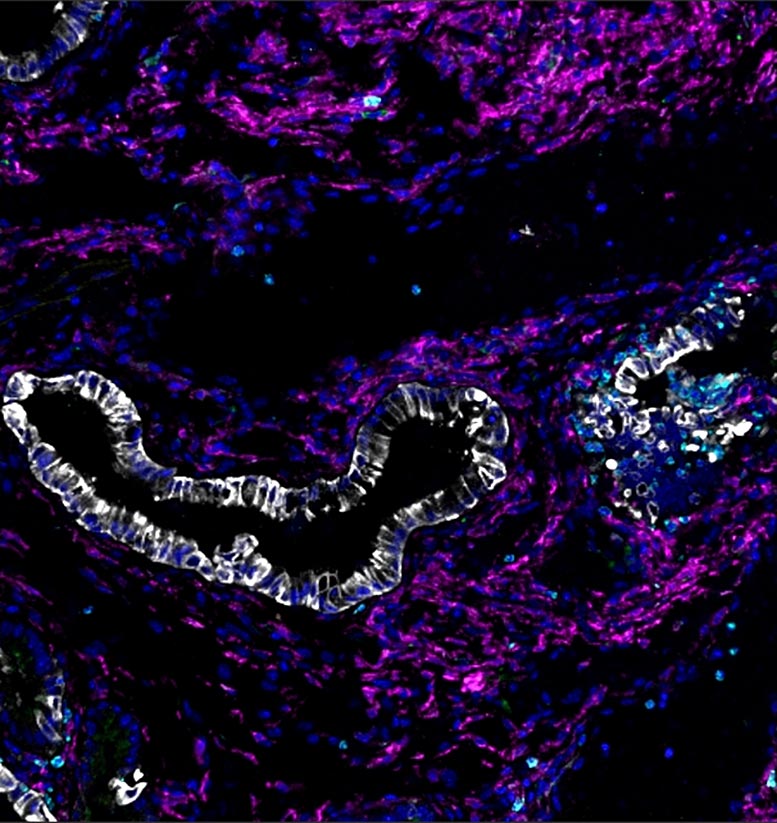
A groundbreaking discovery shows that cancer development hinges on how oncogenes interact with tissue-specific genetic networks.
Why do alterations of certain genes cause cancer only in specific organs of the human body? Scientists at the German Cancer Consortium (DKTK), the Technical University of Munich (TUM), and the University Medical Center Göttingen have now demonstrated that cells originating from different organs are differentially susceptible to activating mutations in cancer drivers: The same mutation in precursor cells of the pancreas or the bile duct leads to fundamental different outcomes. The team discovered for the first time that tissue specific genetic interactions are responsible for the differential susceptibility of the biliary and the pancreatic epithelium towards transformation by oncogenes. The new findings could guide more precise therapeutic decision making in the future.
There have been no major improvements in the treatment of pancreatic and biliary tract cancer in the last decades and no effective targeted therapies are available to date. “The situation for patients with pancreatic and extrahepatic bile duct cancer is still very depressing with approximately only 10% of patients surviving five years,” says Dieter Saur, DKTK Professor for Translational Cancer Research at TUM’s university hospital Klinikum rechts der Isar, DKTK partner site Munich.
DKTK is a consortium centered around the German Cancer Research Center (DKFZ) in Heidelberg, which has long-term collaborative partnerships with specialist oncological centers at universities across Germany.
“To discover novel therapeutic strategies that improve prognosis of these patients, it is essential to understand the fundamental genetic networks and interactions that drive these tumors in a tissue-specific fashion. This will allow highly precise molecular interventions in future.”
Tissue-Specific Responses to Oncogenes
The research team looked at the development of biliary tract and pancreatic cancer in mice, replacing the normal “oncogenes” PIK3CA and KRAS with a version containing a mutation identical with that in human cancers. Expression of these oncogenes in the common precursor cells of the extrahepatic bile duct and the pancreas led to very different outcomes. Mice with the mutated PI3K gene developed mostly biliary tract cancer, mice with the mutated KRAS gene instead developed exclusively pancreatic cancer.
This was unexpected because both genes are mutated in both human cancer types. Subsequent analyses discovered the fundamental genetic processes underlying the differential sensitivity of the different tissue types towards oncogenic transformation.
“Our results are an important step toward solving one of the biggest mysteries in oncology: Why do alterations of certain genes cause cancer only in specific organs?” says Chiara Falcomatà the first author of the new publication. “Our studies in mice revealed how genes co-operate to cause cancer in different organs. We identified main players, the order in which they occur during tumor progression, and the molecular processes how they turn normal cells into threatening cancers. Such processes are potential targets for new treatments”.
In the mice, the team uncovered a stepwise process of genetic alterations, which drive the development of these cancer types. Some cooperating genetic events overactivate the PI3K signaling pathway, making them cancerous. Others disrupt regulators proteins, inactivating their ability to suppress cancer progression.
Personalized Cancer Therapies
“Understanding the genetic interactions in different cancer types will guide more precise therapeutic decision making in the future,” says Günter Schneider, Professor for Translational Cancer Research at the University Medical Center Göttingen. “Our ability to engineer specific genetic alterations in mice allows us to study the function of cancer genes and to model specific cancer subtypes. Such mouse models are also invaluable for testing anticancer drugs before using them in clinical trials”.
“What we showed is that the function of an oncogene is different depending on the tissue type and what other genes are altered,” says Roland Rad Professor at TUM and a DKTK researcher. “These oncogenes need to hijack the intrinsic signaling network of a specific tissue to allow cancer development. Interestingly, such networks exist only in specific tissue types making them susceptible for cancer development.”
These findings have important implications for therapeutic interventions. “The concept that multiple tissue-specific genetic interactions drive cancer progression demonstrates that no single gene can predict responsiveness of a cancer to a particular therapy,” says Saur. “In future, it is key to mechanistically understand the tissue specific determinants of therapeutic response and resistance to get precision medicine to the next level.”
Several of the authors including Dieter Saur and Roland Rad are based at TranslaTUM, TUM’s Center for Translational Cancer Research. In this interdisciplinary research institute, doctors work with colleagues from the fields of natural sciences and engineering on research into causes, diagnostics and potential treatments of cancerous diseases.
Reference: “Genetic screens identify a context-specific PI3K/p27Kip1 node driving extrahepatic biliary cancer” by Chiara Falcomata, Stefanie Barthel, Angelika Ulrich, Sandra Diersch, Christian Veltkamp, Lena Rad, Fabio Boniolo, Myriam Solar, Katja Steiger, Barbara Seidler, Magdalena Zukowska, Joanna Madej, Mingsong Wang, Rupert Ollinger, Roman Maresch, Maxim Barenboim, Stefan Eser, Markus Tschurtschenthaler, Arianeb Mehrabi, Stephanie Roessler, Benjamin Goeppert, Alexander Kind, Angelika Schnieke, Maria S Robles, Allan Bradley, Roland M Schmid, Marc Schmidt-Supprian, Maximilian Reichert, Wilko Weichert, Owen J Sansom, Jennifer P Morton, Roland Rad, Gunter Schneider and Dieter Saur, 19 July 2021, Cancer Discovery.
DOI: 10.1158/2159-8290.CD-21-0209
Chiara Falcomatà, Stefanie Bärthel, Angelika Ulrich, Sandra Diersch, Christian Veltkamp, Lena Rad, Fabio Boniolo, Myriam Solar, Katja Steiger, Barbara Seidler, Magdalena Zukowska, Joanna Madej, Mingsong Wang, Rupert Öllinger, Roman Maresch, Maxim Barenboim, Stefan Eser, Markus Tschurtschenthaler, Arianeb Mehrabi, Stephanie Roessler, Benjamin Goeppert, Alexander Kind, Angelika Schnieke, Maria S. Robles, Allan Bradley, Roland M. Schmid, Marc Schmidt-Supprian, Maximilian Reichert, Wilko Weichert, Owen J. Sansom, Jennifer P. Morton, Roland Rad, Günter Schneider, Dieter Saur: Genetic screens identify a context-specific PI3K/p27Kip1 node driving extrahepatic biliary cancer
Never miss a breakthrough: Join the SciTechDaily newsletter.
Follow us on Google and Google News.
1 Comment
what about prostrate cancer moved to all bones