

French physicist Louis de Broglie’s pilot wave theory proposed that quantum particles are directed by a guiding wave. Although de Broglie later renounced his theory due to its complexity and abstractness, the concept was revived by David Bohm and remains a topic of ongoing scientific exploration and debate.
Celebrating a Century of Quantum Discovery
Last week marked the 100-year anniversary of French physicist Louis de Broglie presenting his doctoral thesis, a groundbreaking work that earned him a Nobel prize for “his discovery of the wave nature of electrons.” His discovery became a cornerstone of quantum mechanics and gave rise to his renowned “pilot wave” theory—an alternative framework for understanding the quantum world. Yet, despite its significance, de Broglie later rejected his own theory. Why did he abandon it?
Quantum mechanics, the theory describing matter on extremely small scales like atoms and electrons, emerged in the early 20th century. While revolutionary, it remains full of mysteries. One of its most puzzling aspects is the dual nature of quantum particles, such as electrons, which can exhibit both particle-like and wave-like behavior depending on how they are observed.
Challenging the Copenhagen Interpretation
The Copenhagen interpretation, developed at the beginning of the 20th century, concluded that the quantum world cannot be analyzed according to classical physical concepts. This view has met with a number of objections, and numerous scientists, including Albert Einstein, have looked for a causal and mechanistic understanding of the weirdness of quantum behavior.
De Broglie was among those who refused the Copenhagen reading, and he proposed his pilot wave theory in 1927. According to this model, matter is made up of particles, whose movement is guided by a “quantum wave,” thus explaining the reasons for the wave behavior of particles.
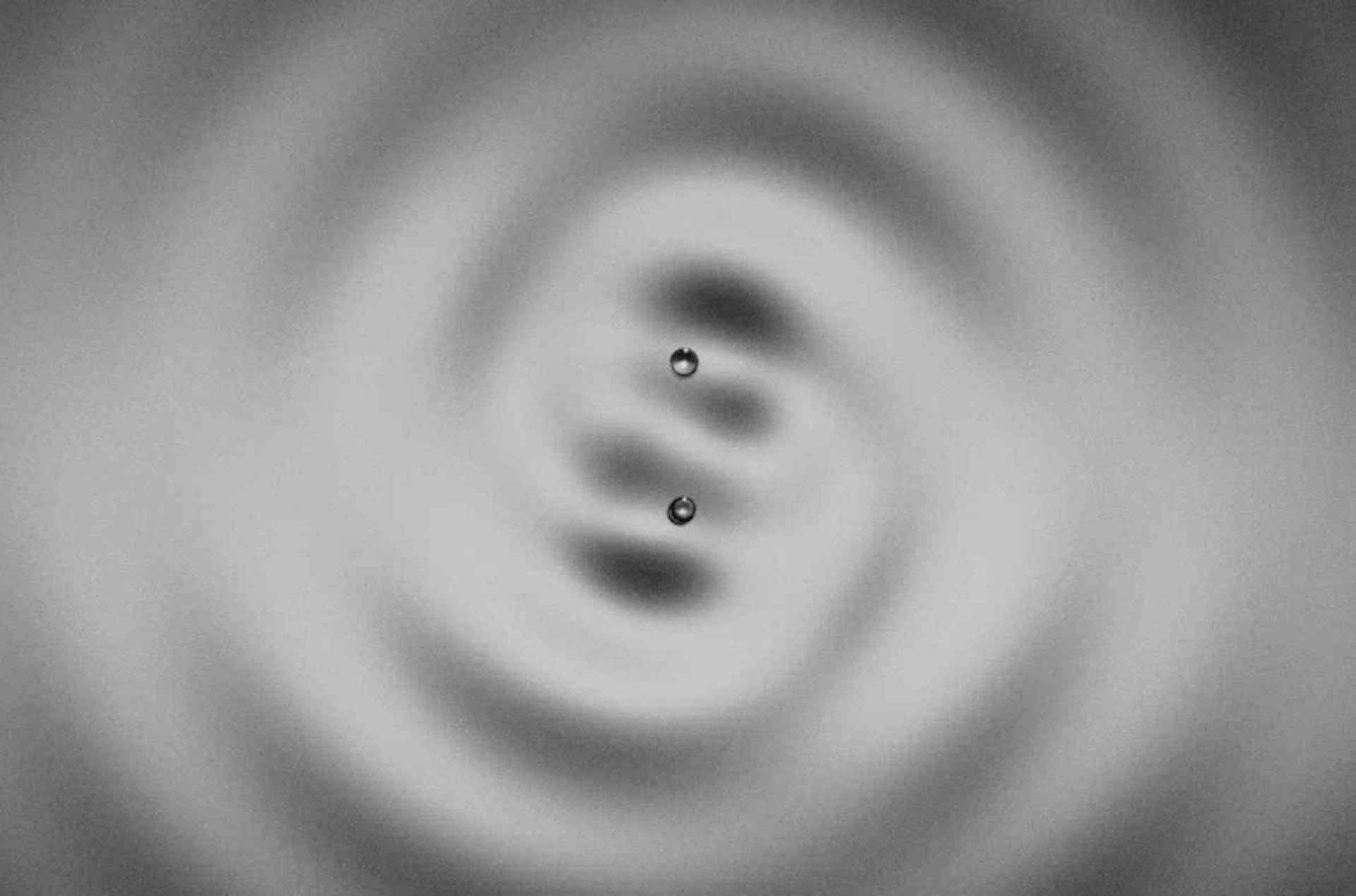
The Fall and Rise of the Pilot Wave Theory
However, a few years after de Broglie made his discovery, he renounced his theory. What prompted this change of heart, and how did his work impact the scientific community?
There are multiple causes for the abandonment of the pilot wave theory. However, two characteristics of the model have made it particularly dubious. First, it suggests that the motion of one particle can depend on that of another, even if their distance, according to Einstein’s theory of relativity, should prohibit any interaction.
Furthermore, the pilot wave does not have a clear physical meaning. Unlike conventional waves, such as ocean waves or electromagnetic waves, it is not a wave that evolves in our three-dimensional physical space. Rather, it is a wave that unfolds in an abstract mathematical space with a large number of dimensions, making its interpretation difficult.
These aspects of the pilot wave were very disturbing for de Broglie, who explicitly abandoned his theory in his subsequent writings. His deeper ambition was to develop a somewhat different approach, called the “double solution theory.” Its main object would have been a less abstract wave, which would unfold within the space familiar to our perception. This alternative model would have been much more intuitive and easy to understand.
However, the mathematical complexity of this approach was considerable. De Broglie worked on this project until the end of his life, despite the limited interest it garnered from his fellow physicists.
Enduring Questions and Contemporary Research
De Broglie’s work has deeply influenced the scientific community. The US physicist David Bohm independently rediscovered pilot wave theory in 1952. Rather than rejecting the model because of its strangeness, Bohm and many other subsequent researchers have undertaken the challenge of giving it meaning. Questions relating to the exact content and interpretation of the theory are still debated today.
Furthermore, the double solution theory that de Broglie worked on has not been completely abandoned. Some contemporary physicists are still working on its formulation. This approach may one day help us better understand our world on a small scale, with a reduced impact on our classical intuitions.
Written by Laurie Letertre, Munich Center for Mathematical Philosophy, Ludwig Maximilian University of Munich
Adapted from an article originally published in The Conversation.
Never miss a breakthrough: Join the SciTechDaily newsletter.
Follow us on Google and Google News.
3 Comments
While physicists tend to eschew analogical thinking in the pursuit of viable theories, the extent to which oil droplets can co-propagate with associated surface oil waves and the attendant phenomena’s mapping into attributes of quantum propagation is striking, lately even extending to double-slit behavior.
De Broglie’s shift to a less abstract representation of his conjectured pilot wave may have been warranted.
I am no mathematician or physicist, (though I am proud of my physics library and I did get through Feynman’s Lectures on Physics), but I have read two books of Thad Roberts and to the best of my knowledge, they make sense. And starting from one assumption it would appear that he develops all the constants and needed equations in physics. He bases his ideas on De’ Broglie’s and Bohm’s ideas.
I hope I am not overstating his work, it has been a couple of years since I read his books.
De Broglie’s Nobel prize was for his double solution theory, not his pilot wave theory. De Broglie developed his pilot wave theory later, when he tried to combine the physical wave with the wave function. De Broglie realized his pilot wave theory was incorrect and went back to his original double solution theory.