
Close Menu
    Facebook X (Twitter) Instagram
    SciTechDaily
    • Biology
    • Chemistry
    • Earth
    • Health
    • Physics
    • Science
    • Space
    • Technology
    Facebook X (Twitter) Pinterest YouTube RSS
    SciTechDaily
    Home»Space»Why the Sky Glows Green Over Chile’s Desert – And It’s Not an Aurora
    Space

    Why the Sky Glows Green Over Chile’s Desert – And It’s Not an Aurora

    By European Southern Observatory (ESO)May 4, 2025No Comments3 Mins Read
    Facebook Twitter Pinterest Telegram LinkedIn WhatsApp Email Reddit
    Share
    Facebook Twitter LinkedIn Pinterest Telegram Email Reddit
    Green Airglow La Silla Observatory
    Airglow — a ghostly green shimmer in the night sky — drifts silently above La Silla Observatory, revealing the quiet magic of Earth’s upper atmosphere. Unlike auroras, this subtle glow is ever-present and captured only by sensitive cameras in the darkest places. Credit: J. Pérez/ESO

    Hidden away in the darkest corners of Earth’s atmosphere, a faint green airglow quietly paints the night sky, far from the bustling interference of light pollution.

    Captured above the La Silla Observatory in Chile’s Atacama Desert, this phenomenon is often confused with the more dramatic auroras but has its own mesmerizing, silent charm.

    A Hidden Glow Above the Desert

    The soft green glow filling the sky in this image is called airglow, a faint light naturally emitted by Earth’s upper atmosphere. Unlike the stars or auroras, you can’t see airglow with the naked eye. It’s far too dim. But in extremely dark locations, sensitive cameras can capture its ghostly presence. One such place is the La Silla Observatory, operated by the European Southern Observatory (ESO), nestled on the edge of Chile’s remote Atacama Desert, where light pollution is almost nonexistent.

    Airglow vs. Auroras: What’s the Difference?

    Although airglow may look similar to the shimmering lights of an aurora, the two phenomena are quite different. Airglow is created when ultraviolet radiation from the Sun energizes atoms and molecules in the upper atmosphere. As these particles return to their normal state, they release faint light, producing a soft, steady glow.

    Auroras, in contrast, are dramatic bursts of light triggered by charged particles from the Sun interacting with Earth’s magnetic field. Auroras are brief, unpredictable, and typically much brighter than airglow.

    While airglow is ever-present in the night sky, it’s subtle—more like a gentle background hum than a fireworks show. The green color seen here comes from oxygen atoms, but airglow can also appear red or yellow, depending on the specific molecules involved.
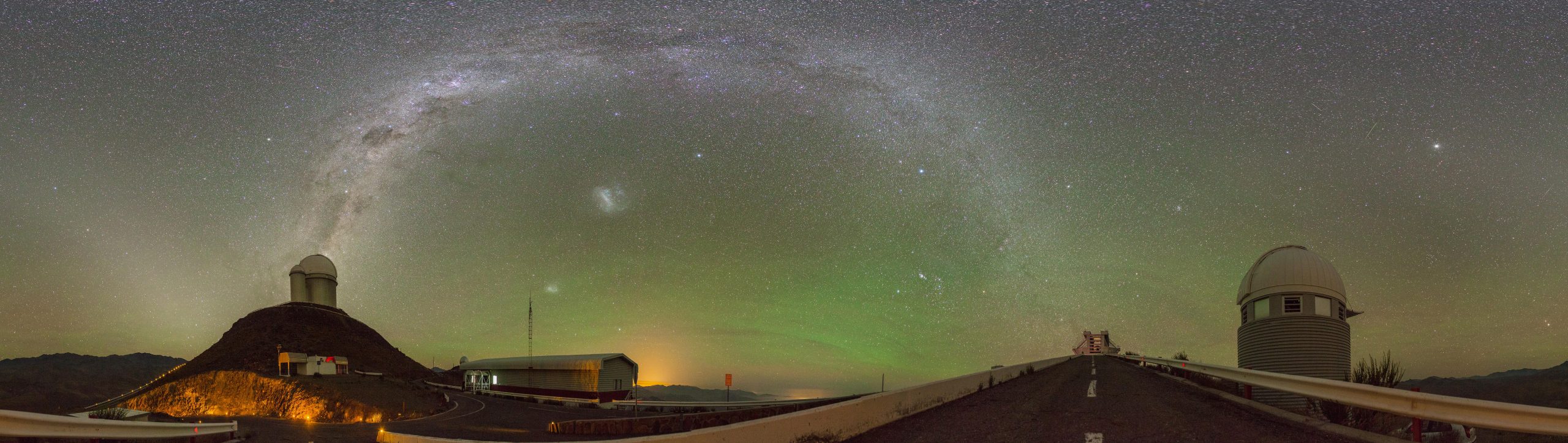
    Green Airglow La Silla Observatory Equirectangular Projection
    This is an equirectangular projection of the same image. From left to right, we can see ESO’s 3.6m telescope, ESO’s New Technology Telescope, and the Swiss 1.2-meter Leonhard Euler Telescope. Credit: J. Pérez/ESO

    A Telescope Treasure Hunt at La Silla

    But there is more than just airglow hiding in this fisheye view of La Silla. Can you spot the three telescopes? ESO’s 3.6m telescope, at the bottom, is the one seemingly puffing the Milky Way like smoke. The Swiss 1.2-meter Leonhard Euler Telescope (top left) is also pretty easy to find, but the almost unrecognizable New Technology Telescope might be more of a challenge to find (it’s hiding at the top).

    Now that you’ve found the telescopes, how about seeing them up close? Yes, you can actually visit them. There will be no airglow, as visits are during daytime to avoid interfering with the night-time work, and airglow is invisible to the naked eye – but the telescopes more than make up for it.

    Never miss a breakthrough: Join the SciTechDaily newsletter.
    Follow us on Google and Google News.

    Astronomy European Southern Observatory
    Share. Facebook Twitter Pinterest LinkedIn Email Reddit

    Related Articles

    Supermassive Black Holes on a Collision Course: Closest Pair of Supermassive Black Holes to Earth Ever Discovered

    Black Hole Discovered Lurking in Star Cluster Outside Our Galaxy

    Discovery in a Galaxy Over 12 Billion Light-Years Away – Reveals How Element Found in Our Bones Is Forged in the Universe

    Strange 160 Mile-Long “Dog-Bone” Asteroid Kleopatra Captured in Detailed Images

    Astronomers Find Small Rocky Planet – Just Half the Mass of Venus

    First Clear Detection of a Moon-Forming Disc Around a Planet Outside Our Solar System

    Mystery Solved: Astronomers Unravel the Puzzle of Betelgeuse’s “Great Dimming”

    Stunning Galactic Fireworks: New ESO Images Reveal Spectacular Features of Nearby Galaxies

    Astronomers Were Puzzled by “Great Dimming” of Betelgeuse – Now the Mystery Is Solved

    Leave A Reply Cancel Reply

    • Facebook
    • Twitter
    • Pinterest
    • YouTube

    Don't Miss a Discovery

    Subscribe for the Latest in Science & Tech!

    Trending News

    Researchers Warn Widely Prescribed Blood Pressure Drugs Could Be Harming Diabetic Kidneys

    James Webb Spots Something Strange Between Day and Night on an Alien Planet

    How Ancient People Moved a 6-Ton Stone 700 Kilometers to Stonehenge

    The Unexpected Gut Health Risk of Cutting Out Sugar

    Popular Weight-Loss Drugs Like Ozempic Linked to Lower Breast Cancer Risk

    AI Learned the Rules of the Universe and That Became a Problem

    Scientists Found a Hidden Brain Signal That Predicts Social Behavior

    Even GPT-5 Failed This Human Attention Test

    Follow SciTechDaily
    • Facebook
    • Twitter
    • YouTube
    • Pinterest
    • Newsletter
    • RSS
    SciTech News
    • Biology News
    • Chemistry News
    • Earth News
    • Health News
    • Physics News
    • Science News
    • Space News
    • Technology News
    Recent Posts
    • Women’s Brains May Be More Vulnerable to Dementia Risk Factors Than Scientists Realized
    • Scientists Say We’ve Been Wrong About the Aging Brain
    • More Weight Loss, Fewer Fractures? New Study Points to Semaglutide
    • These Tiny Birds Became Giants on Remote Scottish Islands
    • A Fatal Deer Disease May Be Spreading in Ways No One Expected
    Copyright © 1998 - 2026 SciTechDaily. All Rights Reserved.
    • Science News
    • About
    • Contact
    • Editorial Board
    • Privacy Policy
    • Terms of Use

    Type above and press Enter to search. Press Esc to cancel.