
Ancient species may have evolved at a slower pace and endured longer, but evolutionary rates sped up significantly following global ice ages, according to a new analysis by Virginia Tech. Published in the journal Science, the study charts the cycles of rise and decline in ancient life over millions of years.
If the world is a stage and every species plays its part, the rock record holds the story of their entrances and exits.
Fossilized skeletons and shells offer a vivid timeline of evolution and extinction over the last 500 million years. Now, a new analysis from Virginia Tech extends this timeline back nearly 2 billion years.
This expanded chart tracks fluctuations in species diversity, providing scientists with crucial insights into the origins, diversification, and extinction of ancient life.
With this new study, the chart of life now includes life forms from the Proterozoic Eon, 2,500 million to 539 million years ago. Proterozoic life was generally smaller and squishier — like sea sponges that didn’t develop mineral skeletons — and left fewer traces to fossilize in the first place.
Virginia Tech geobiologist Shuhai Xiao and collaborators published a high-resolution analysis of the global diversity of Proterozoic life based on a global compilation of fossil data, which was released Dec. 20 in the journal Science.
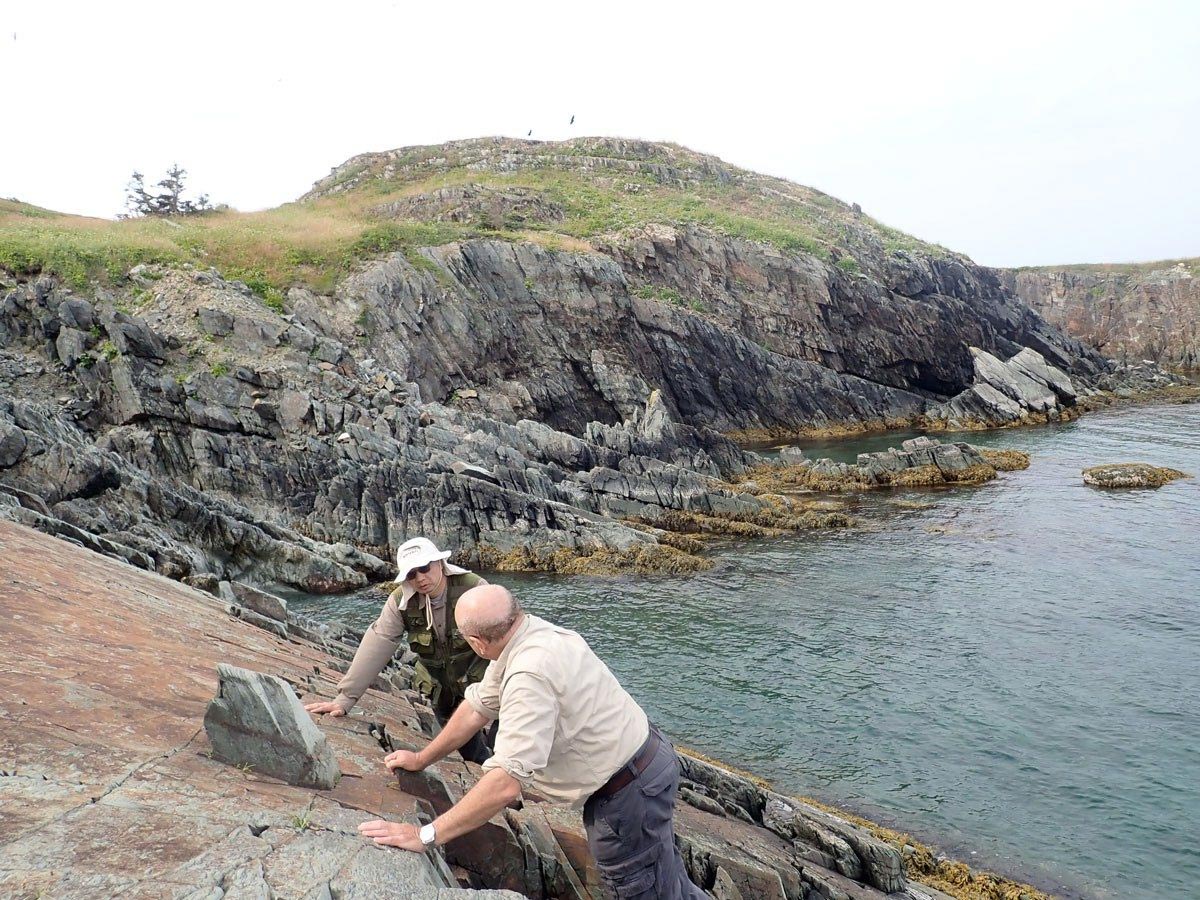
Xiao and his team looked specifically at records of ancient marine eukaryotes — organisms whose cells contain a nucleus. Early eukaryotes later evolved into the multicellular organisms credited for ushering in a whole new era for life on Earth, including animals, plants, and fungi.
“This is the most comprehensive and up-to-date analysis of this period to date,” said Xiao who recently was inducted into the National Academy of Sciences. “And more importantly, we’ve used a graphic correlation program that allowed us to achieve greater temporal resolution.”
The choreography of species offers critical insights into the parallel paths of the evolution of life and Earth.
Observed patterns and insights suggested by the analysis:
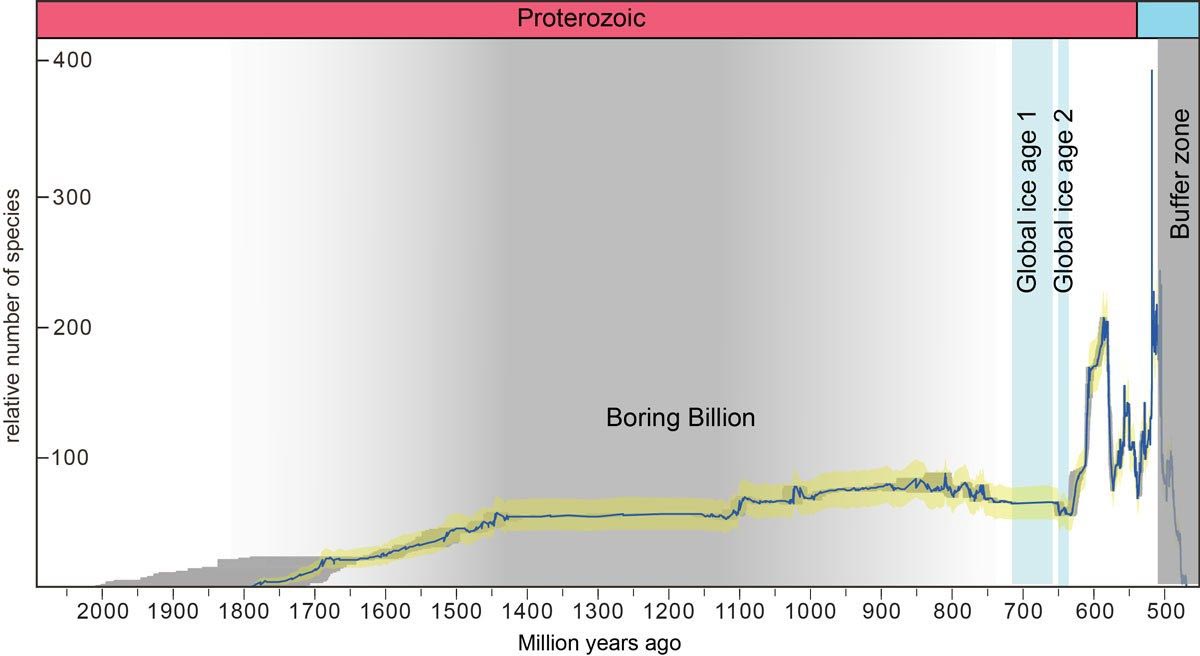
- The first eukaryotes arose no later than 1.8 billion years ago and gradually evolved to a stable level of diversity from about 1,450 million to 720 million years ago, a period aptly known as the “boring billion,” when species turnover rates were remarkably low.
- Eukaryotic species in the “boring billion” may have evolved slower and lasted longer than those came later.
- Then cataclysm: Snowball Earth, a spiral of plunging temperatures, sealed the planet in ice at least twice between 720 million and 635 million years ago. When the ice eventually thawed, evolutionary activity picked up, and things weren’t so boring anymore.
“The ice ages were a major factor that reset the evolutionary path in terms of diversity and dynamics,” Xiao said. “We see rapid turnover of eukaryotic species immediately after glaciation. That’s a major finding.”
The patterns, Xiao said, raise a lot of interesting questions, including:
- Why was eukaryotic evolution sluggish during the “boring billion”?
- What factors contributed to the increased pace of evolution after snowball ice ages?
- Was it environmental, such as climate changes and increases in atmospheric oxygen levels?
- Was it an evolutionary arms race between different organisms that could drive creatures to evolve quickly?
Future scientists can use the quantified pattern to answer these questions and better understand the complex interplay of life on Earth and the Earth itself.
Reference: “Quantifying the global biodiversity of Proterozoic eukaryotes” by Qing Tang, Wentao Zheng, Shuhan Zhang, Junxuan Fan, Leigh Anne Riedman, Xudong Hou, A. D. Muscente, Natalia Bykova, Peter M. Sadler, Xiangdong Wang, Feifei Zhang, Xunlai Yuan, Chuanming Zhou, Bin Wan, Ke Pang, Qing Ouyang, N. Ryan McKenzie, Guochun Zhao, Shuzhong Shen and Shuhai Xiao, 20 December 2024, Science.
DOI: 10.1126/science.adm9137
Never miss a breakthrough: Join the SciTechDaily newsletter.
Follow us on Google and Google News.
4 Comments
I would argue life was not boring, but actually the most exciting and interesting at the molecular level. So called complex life with is simplistic mass production of cells, and slow reproductive rates cannot really hold a candle to that. The complexity of our bodies and cell cell interactions is much less than the ingenuity baked into a single cell, and more a shortcut to only perceived dominance.
Nice photo. I think I am looking at a thrust-fold with an axial-plane cleavage.
A couple of Global Snowball events is interesting, and then between about 570Ma and 510Ma eukaryotic diversification drops of to about the boring billion level, with a couple of spikes. So do these spikes represent holes in our eukaryotic fossil collection, or are they real? What is the “Buffer zone”?
The most interesting question is why did the prokayotic mob decide to encapsulate their DNA, RNA, mitichondria and other bits that exist in the cell nucleus?
@Zack B, 100% right, all the action was at the molecular level, not boring at all, just hard to see all that action in fossils. Also I would say, measuring “species origination” and “species extinction” means little if the definition of species is arbitrary. The paper says “To avoid inflation of species richness, synonyms, ontogenetic variations, and taphonomic alterations were carefully examined.” but that doesn’t sound objective.
@ Mike P. Avoiding attributing fragments of the same organism to different species is a very important task where the subjective and objective intertwine. One researchers mutltiple species are analysed as being fragments of a single organism by another.