

Wild orangutans use multi-layered recursive vocal patterns that vary with danger, challenging the idea that only humans use complex, structured communication.
In a groundbreaking study from the University of Warwick, researchers have discovered that wild orangutans produce vocalizations with a layered complexity once believed to be unique to human communication. This finding suggests that the roots of this sophisticated language feature may lie deep in our evolutionary past.
To understand this, consider the sentence: “This is the dog that chased the cat that killed the rat that ate the cheese.” It’s a straightforward example of repeated verb-noun phrases—“chased the cat,” “ate the cheese”—organized in a way that demonstrates a concept known as recursion.
Recursion involves embedding language elements within each other to create a coherent and meaningful structure. Much like Russian nesting dolls, recursion allows us to use a limited set of building blocks to construct an infinite variety of increasingly complex messages.
Challenging assumptions about human uniqueness
It is widely believed that nested communication is a unique feature of human language, allowing us greater complexity of thought, but research from The University of Warwick, published in Annals of The New York Academy of Sciences, tells a different story.
Dr. Chiara De Gregorio, Research Fellow at The University of Warwick, who performed this work alongside Adriano Lameira (also Warwick) and Marco Gamba (University of Torino), said: “When analysing the vocal data of alarm calls from female Sumatran orangutans, we found that the rhythmic structure of orangutans’ sounds made were self-embedded across three levels – an impressive third-order recursion. Finding this feature in orangutan communication challenges the idea that recursion is uniquely human.”
Recursion in orangutan alarm calls
The three-layered (recursive) structure of the orangutan’s calls was as follows:
- Orangutans produced individual sounds that formed small combinations, making up the first layer.
- These combinations were then grouped into larger bouts, creating a second layer.
- Finally, the bouts were organized into even larger series, forming a third layer. Each level followed a consistent rhythmic pattern.
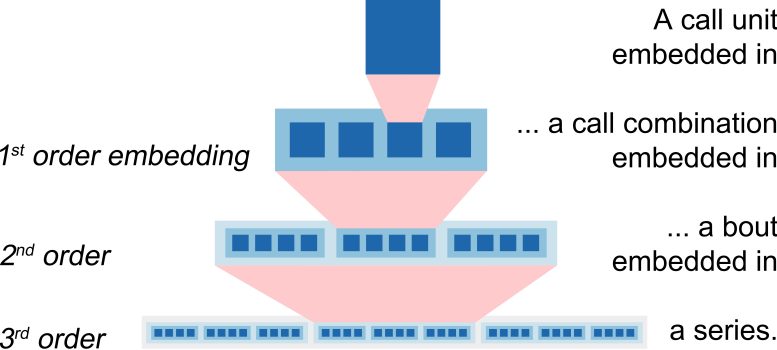
Just like a musical piece with repeating patterns, orangutans nested one rhythm inside another, and then another, creating a sophisticated multi-layered vocal structure, not thought possible by non-human great apes.
Vocal rhythm varies by threat level
This pattern wasn’t accidental because orangutans also changed the rhythm of their alarm calls depending on the type of predator they encounter: When they saw a real threat, like a tiger, their calls were faster and more urgent. When they saw something that seemed like a threat but lacked the credibility of a real danger (like a cloth with colourful spots), their calls were slower and less regular.
This ability to adapt vocal rhythms to different dangers shows that orangutans aren’t just making noise, they are using structured vocal recursion to carry meaningful information about the outside world.
“This discovery shows that the roots of one of the most distinctive features of human language — recursion – was already present in our evolutionary past,” adds lead author Dr. De Gregorio. “Orangutans are helping us understand how the seeds of language structure might have started growing millions of years ago.”
This research presents the first empirical support for the idea that these powerful recursive capacities could have been selected for and evolved incrementally in a much earlier ancestor.
Reference: “Third-order self-embedded vocal motifs in wild orangutans, and the selective evolution of recursion” by Chiara De Gregorio, Marco Gamba and Adriano R. Lameira, 16 May 2025, Annals of the New York Academy of Sciences.
DOI: 10.1111/nyas.15373
Never miss a breakthrough: Join the SciTechDaily newsletter.
Follow us on Google and Google News.