
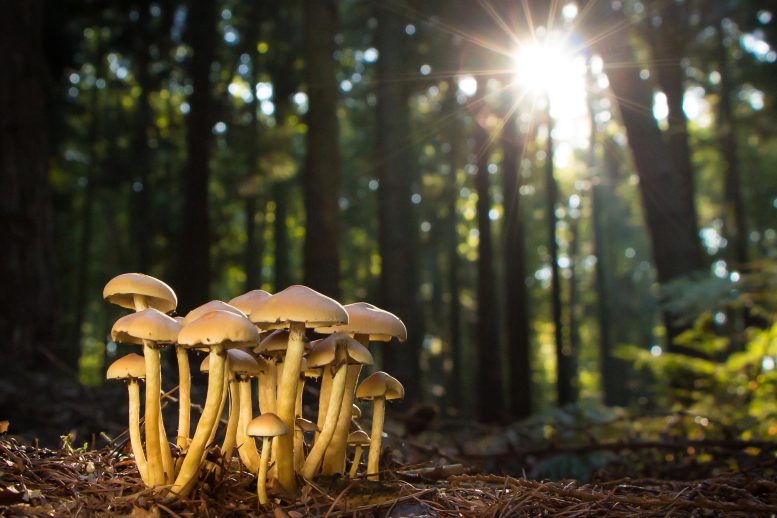
University of Alberta expert challenges popular claims about the “wood-wide web.”
The idea that forest trees can “talk” to each other, share resources with their seedlings — and even protect them — through a connective underground web of delicate fungal filaments tickles the imagination.
The concept is so intriguing, it’s taken root in popular media — even being raised in the popular Apple TV show Ted Lasso — and been dubbed the “wood-wide web,” but the science behind those ideas is unproven, cautions University of Alberta expert Justine Karst.
In a peer-reviewed article published today (February 13) in the journal Nature Ecology & Evolution that also shares their personal point of view, Karst and two colleagues contest three popular claims about the capabilities of underground fungi known as common mycorrhizal networks, or CMNs, that connect roots of multiple plants underground. Fungi are living organisms such as molds, yeast, and mushrooms.
Unpacking the Science Behind CMNs
“It’s great that CMN research has sparked interest in forest fungi, but it’s important for the public to understand that many popular ideas are ahead of the science,” says Karst, associate professor in the U of A’s Faculty of Agricultural, Life & Environmental Sciences.

While CMNs have been scientifically proven to exist, there is no strong evidence that they offer benefits to trees and their seedlings, the researchers suggest.
To evaluate the popular claims, Karst and co-authors Melanie Jones of the University of British Columbia Okanagan and Jason Hoeksema of the University of Mississippi reviewed evidence from existing field studies.
They found that one of the claims, that CMNs are widespread in forests, isn’t supported by enough scientific evidence. Not enough is known about CMN structure and its function in the field, “with too few forests mapped.”
The second claim, that resources such as nutrients are transferred by adult trees to seedlings through CMNs and that they boost survival and growth, was also found to be questionable.
A review of 26 studies, including one in which Karst is a co-author, established that while resources can be transferred underground by trees, CMNs don’t necessarily bring about that flow, and seedlings typically don’t benefit from CMN access. Overall, their review revealed roughly equal evidence that connecting to a CMN would improve or hamper seedlings, with neutral effects most commonly reported.
The third claim, that adult trees preferentially send resources or “warning signals” of insect damage to young trees through CMNs, is not backed up by a single peer-reviewed, published field study, Karst and her co-authors note.
The Risks of Overstating CMN Science
The researchers say overblown information can shape and distort the public narrative about CMNs, and that could, in turn, affect how forests are managed.
“Distorting science on CMNs in forests is a problem because sound science is critical for making decisions on how forests are managed. It’s premature to base forest practices and policies on CMNs per se, without further evidence. And failing to identify misinformation can erode public trust in science.”
Reference: “Positive citation bias and overinterpreted results lead to misinformation on common mycorrhizal networks in forests” by Justine Karst, Melanie D. Jones and Jason D. Hoeksema, 13 February 2023, Nature Ecology & Evolution.
DOI: 10.1038/s41559-023-01986-1
Never miss a breakthrough: Join the SciTechDaily newsletter.
Follow us on Google and Google News.
4 Comments
lol, maybe my comment on Saturday’s story with the 2022 study got that “(February 13)” date in brackets. Impressive speed here, a single day from study to story.
There are beautiful ideas in science-fiction regarding the mycorrhizal networks, that they can transfer information, thus possibly even create an emergent consciousness of a sort like neurons do, that the fungi and trees of the world potentially turn the very earth into a sentient being which deserves respect. There are other ideas too, that it could be sapient, or in outer space, or teleport people, have people living in it, and remembering everything, and otherwise is just God. Either way it’s science fiction, and science fiction sometimes becomes science fact, but not today. There are religions based on sci-fi, but good of the ecologists to remind the environmentalists to stop basing political and conservation decisions on their newage religion before they ruin everything.
Perhaps not science fiction, but unsubstantiated ideas. The ideas are valuable as a diection for further research, and to get away from the view of trees as isolated individuals.
Guess they never actually spent time with mushrooms
Maybe scientists should spend more time looking into it more. It’s easy to say there’s no scientific proof to back up any of these subjects. Maybe it’s because our scientists are to busy. One would think these subjects would have done been thoroughly investigated in today’s modern times. Shouldn’t we already know this stuff? That’s the real scientific question.