
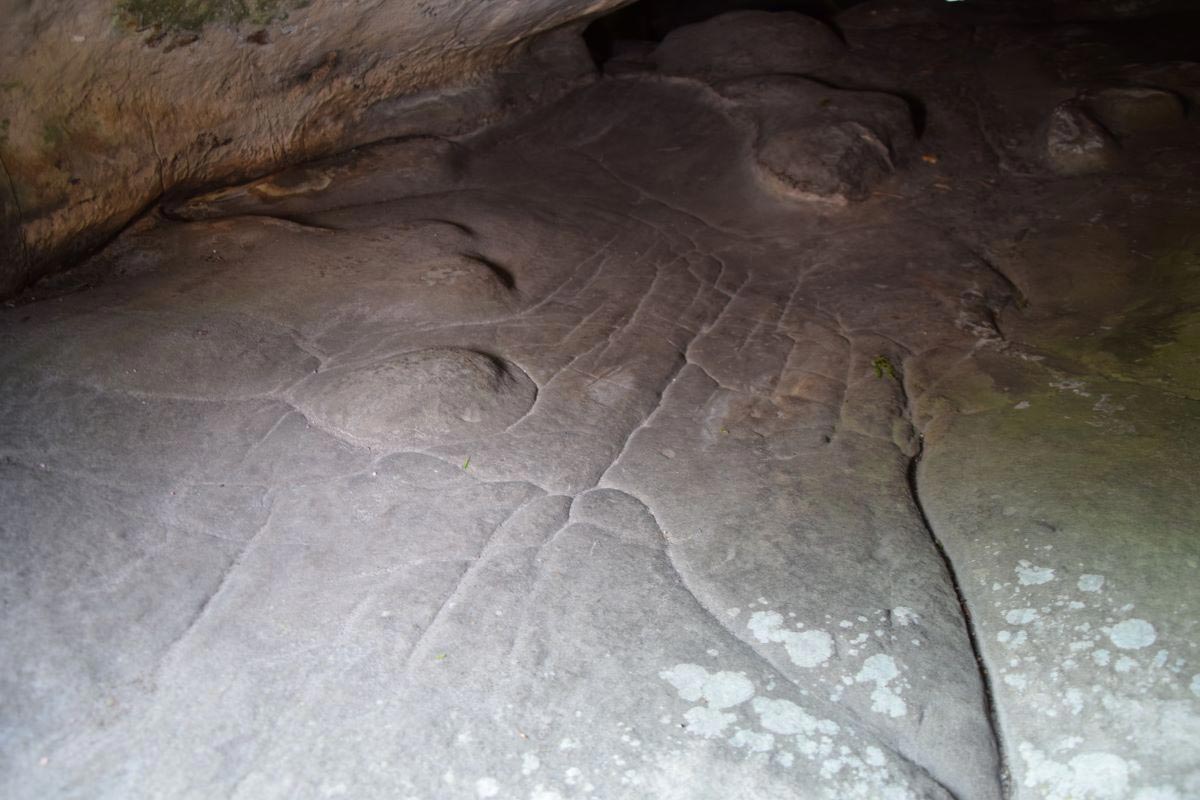
Researchers uncovered a 13,000-year-old sandstone model in France’s Ségognole 3 rock shelter, possibly the world’s oldest 3D map. The miniature landscape reflects natural water flows, revealing early humans’ advanced environmental understanding and engineering skills.
Researchers have uncovered what could be the world’s oldest three-dimensional map, etched into a quartzitic sandstone megaclast in the Paris Basin.
The Ségognole 3 rock shelter, recognized since the 1980s for its Late Palaeolithic engravings of two horses flanking a depiction of a female pubic symbol, has now been found to contain a miniature representation of the surrounding landscape.
Dr. Anthony Milnes from the University of Adelaide’s School of Physics, Chemistry, and Earth Sciences, participated in the research led by Dr. Médard Thiry from the Mines Paris – PSL Centre of Geosciences.
Dr. Thiry’s earlier research, following his first visit to the site in 2017, established that Palaeolithic people had “worked” the sandstone in a way that mirrored the female form, and opened fractures for infiltrating water into the sandstone that nourished an outflow at the base of the pelvic triangle.
New research suggests that part of the floor of the sandstone shelter which was shaped and adapted by Palaeolithic people around 13,000 years ago was modelled to reflect the region’s natural water flows and geomorphological features.
A Functional Representation of Nature
“What we’ve described is not a map as we understand it today — with distances, directions, and travel times — but rather a three-dimensional miniature depicting the functioning of a landscape, with runoff from highlands into streams and rivers, the convergence of valleys, and the downstream formation of lakes and swamps,” Dr. Milnes explains.
“For Palaeolithic peoples, the direction of water flows and the recognition of landscape features were likely more important than modern concepts like distance and time.
“Our study demonstrates that human modifications to the hydraulic behavior in and around the shelter extended to modeling natural water flows in the landscape in the region around the rock shelter. These are exceptional findings and clearly show the mental capacity, imagination, and engineering capability of our distant ancestors.”

Thanks to his extensive research on the origins of Fontainebleau sandstone, Dr Thiry recognised several fine-scale morphological features that could not have formed naturally, suggesting they were modified by early humans.
“Our research showed that Palaeolithic humans sculpted the sandstone to promote specific flow paths for infiltrating and directing rainwater which is something that had never been recognised by archaeologists,” Thiry says.
“The fittings probably have a much deeper, mythical meaning, related to water. The two hydraulic installations — that of the sexual figuration and that of the miniature landscape — are two to three meters from each other and are sure to relay a profound meaning of the conception of life and nature, which will never be accessible to us.”
Interdisciplinary Collaboration and Implications
Milnes and Thiry’s latest study, published in the Oxford Journal of Archaeology, discovered the presence of three-dimensional modeling by closely examining fine-scale geomorphological features.
“This completely new discovery offers a better understanding and insight into the capacity of these early humans,” Thiry says.
Before this discovery, the oldest known three-dimensional map was understood to be a large portable rock slab engraved by people of the Bronze Age around 3000 years ago. This map depicted a local river network and earth mounds, reflecting a more modern map concept used for navigation.
Dr. Milnes says that collaborating across disciplines — such as archaeology, geology, and geomorphology — is vital in science.
“We believe the most productive research outcomes are found at the boundaries between disciplines,” Dr. Milnes says.
“Re-evaluating field studies and conducting frequent site visits are important. It’s clear from our ongoing project that insights and interpretations do not appear immediately but emerge through new observations and interdisciplinary discussions,” Dr. Thiry suggests.
Reference: “Palaeolithic Map Engraved for Staging Water Flows in a Paris Basin Shelter” by Médard Thiry and Anthony Milnes, 22 December 2024, Oxford Journal of Archaeology.
DOI: 10.1111/ojoa.12316
Never miss a breakthrough: Join the SciTechDaily newsletter.
Follow us on Google and Google News.