
Close Menu
    Facebook X (Twitter) Instagram
    SciTechDaily
    • Biology
    • Chemistry
    • Earth
    • Health
    • Physics
    • Science
    • Space
    • Technology
    Facebook X (Twitter) Pinterest YouTube RSS
    SciTechDaily
    Home»Health»Yale Study Shows Key Protein In Pancreatic Cancer Growth May Also Be Its Undoing
    Health

    Yale Study Shows Key Protein In Pancreatic Cancer Growth May Also Be Its Undoing

    By Renee Elizabeth Gaudette, Yale UniversityMarch 14, 20161 Comment3 Mins Read
    Facebook Twitter Pinterest Telegram LinkedIn WhatsApp Email Reddit
    Share
    Facebook Twitter LinkedIn Pinterest Telegram Email Reddit
    A New Target for Attacking Pancreatic Cancer
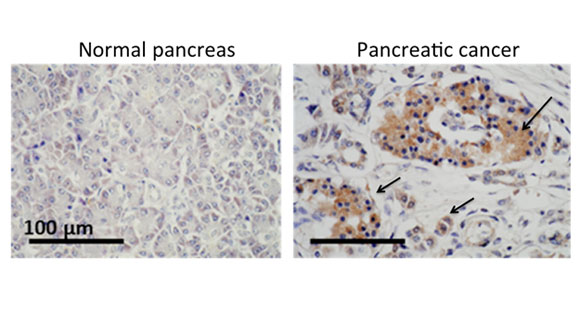
    Marked increased expression of renalase (brownish stain) in pancreatic cancer cells compared to normal pancreas cells. Photo credit: Desir Lab

    In a newly published study, Yale scientists reveal that the overexpression of a protein called renalase in pancreatic cancer plays a critical role in spurring the cancer’s growth while also providing a possible new target for attacking the tumors it helps develop.

    Pancreatic cancer is one of the deadliest cancers, causing about 40,000 deaths annually in the U.S. It is difficult to detect, and most cases are diagnosed at later stages. While there has been some progress in using chemotherapy against the disease, it remains largely resistant to known therapies. The overall five-year survival rate for patients is less than 5%.

    This is why the study’s lead author, Gary Desir, M.D., professor of Medicine, is so encouraged by the findings. Desir is no stranger to renalase, having discovered and named it in 2005 in his Yale lab.

    “We discovered renalase while searching for a mechanism that could explain the very high incidence of heart disease in patients with failure,” Desir said. “We named this previously unknown protein that circulated in plasma at very high levels renalase. We chose that name because the kidney (renal) makes a lot of it, and it functions as an enzyme (ase) to metabolize adrenaline.”

    From the beginning, Desir and his team were interested in exploring whether renalase in the circulating in the blood could serve as a biomarker for cancer after noting many cancer cells synthesized and secreted it. As they developed methods to synthesize renalase by making antibodies to measure its expression, they determined that it functions as a growth factor with a critical role in pancreatic cancer.

    This led to the discovery that renalase’s behavior held clues to its vulnerability as a target for new drugs.

    “We have discovered that pancreatic cancer cells misuse the renalase pathway to help them proliferate, and we have developed monoclonal antibodies of renalase that can kill pancreatic cancer cells and treat tumors in mice,” Desir said. “Patient outcomes for pancreatic cancer are dismal, and we’re encouraged by these findings.”

    Other study authors were: Xiaojia Guo, Lindsay Hollander, Douglas MacPherson, Ling Wang, Heino Velazquez, John Chang, Robert Safirstein, Charles Cha, and Fred Gorelick

    Reference: “Inhibition of renalase expression and signaling has antitumor activity in pancreatic cancer” by Xiaojia Guo, Lindsay Hollander, Douglas MacPherson, Ling Wang, Heino Velazquez, John Chang, Robert Safirstein, Charles Cha, Fred Gorelick and Gary V. Desir, 14 March 2016, Scientific Reports.
    DOI: 10.1038/srep22996

    Never miss a breakthrough: Join the SciTechDaily newsletter.
    Follow us on Google and Google News.

    Cancer Cell Biology Medicine Yale University
    Share. Facebook Twitter Pinterest LinkedIn Email Reddit

    Related Articles

    New Research Shows Cellular Clean-Up Can Also Sweep Away Forms of Cancer

    Yale Researchers Reveal Genes Behind Aggressive Ovarian and Endometrial Cancers

    Researchers Identify a New Way to Suppress Lung Tumors

    Yale Study Reveals How a Cancer Gene Promotes Tumor Growth

    Immune Therapy Drug Prolongs Survival in Advanced Lung Cancer Patients

    New Strategy to Better Protect Cancer Patients from the Flu

    A New Paradigm for Cancer Research, One That Focuses on Improving Efficacy and Value

    Yale Researchers Reveal How HIV Spreads in Real Time

    Yale Researchers Discover New Cancer Cell Vulnerability

    1 Comment

    1. Madanagopal.V.C. on March 18, 2016 11:02 pm

      Pancreas is a wonder body of the animals where a number of different type of cells like alpha cells , Beta cells etc are created in one organ and it is also capable of conversion and proliferation of these cells to different extent. For example, in DM-Type I , the beta cells are almost depleted and increased storage of glycogen in liver is caused by the alpha cells. Being multi-functional it is also liable to be cancer prone like prostrate glands, mammary glands bone marrow etc. Attempt to regulate the protein renalase , related to renal function in the pancreas is good to protect the organ , since renalase is both protective and destructive. thank You.

      Reply
    Leave A Reply Cancel Reply

    • Facebook
    • Twitter
    • Pinterest
    • YouTube

    Don't Miss a Discovery

    Subscribe for the Latest in Science & Tech!

    Trending News

    Your Blood Pressure Reading Could Be Wrong Because of One Simple Mistake

    Astronomers Stunned by Ancient Galaxy With No Spin

    Physicists May Be on the Verge of Discovering “New Physics” at CERN

    Scientists Solve 320-Million-Year Mystery of Reptile Skin Armor

    Scientists Say This Daily Walking Habit May Be the Secret to Keeping Weight Off After Dieting

    New Therapy Rewires the Brain To Restore Joy in Depression Patients

    Giant Squid Detected off Western Australia in Stunning Deep-Sea Discovery

    Popular Sugar-Free Sweetener Linked to Liver Disease, Study Warns

    Follow SciTechDaily
    • Facebook
    • Twitter
    • YouTube
    • Pinterest
    • Newsletter
    • RSS
    SciTech News
    • Biology News
    • Chemistry News
    • Earth News
    • Health News
    • Physics News
    • Science News
    • Space News
    • Technology News
    Recent Posts
    • Dante’s Inferno May Secretly Be About a Planet-Destroying Asteroid Strike
    • Mixing Edible Cannabis and Alcohol May Impair Driving More Than Scientists Expected
    • Scientists Reverse Stroke Damage Using Stem Cells in Breakthrough Study
    • Eating One Egg a Day Could Cut Alzheimer’s Risk by 27%
    • Hidden Warm Water Beneath Antarctica Could Rapidly Raise Global Sea Levels
    Copyright © 1998 - 2026 SciTechDaily. All Rights Reserved.
    • Science News
    • About
    • Contact
    • Editorial Board
    • Privacy Policy
    • Terms of Use

    Type above and press Enter to search. Press Esc to cancel.