
Both plant-based and animal-based diets supported equal muscle growth during resistance training when protein intake was adequate.
A new study examined how muscle protein synthesis responds to a nine-day diet combined with weight training, asking three key questions:
- Does the source of protein—plant-based or animal-based—affect muscle gain?
- Does it matter whether protein intake is evenly spread throughout the day?
- And does a moderate but sufficient amount of daily protein influence these outcomes?
According to the researchers, the answer to all three questions is “no.”
The results were published in the journal Medicine and Science in Sports and Exercise.
“There has long been a belief, or what you might call current dogma, that animal-based proteins are superior, especially when it comes to building muscle,” said Nicholas Burd, a professor of health and kinesiology at the University of Illinois Urbana-Champaign, who led the study with former graduate student Andrew Askow. This belief was grounded in previous research, which showed that a single meal of animal protein stimulated muscle protein synthesis more than a vegan meal. “And so, our general hypothesis based on these previous studies was that the animal-based eating pattern would be more effective at supporting the muscle-building response,” Burd said.
But measurements taken after a single meal might not reflect the effects of consuming a balanced vegan diet over time, Burd said.
Limits of earlier research
One previous clinical trial had looked at muscle responses in vegans and omnivores who ate a laboratory diet and engaged in weight training for 10 weeks. That study found no significant differences in muscle protein synthesis over time. However, volunteers in that study consumed 1.6-1.8 grams of protein per kilogram of body weight per day, which is much higher than what is needed to maximize muscle protein synthesis and build bigger muscles with weight lifting, Burd said. It also gave those on the vegan diet the bulk of their plant protein in supplements, which is not a realistic recreation of how vegans normally eat, he said.
Burd and his colleagues wanted to know whether the habitual consumption of a varied vegan or meat-based diet of whole foods — rather than ingestion of just a single meal or getting one’s protein from limited sources — would influence the rate of muscle protein synthesis over time. They also wanted to test the hypothesis that a moderate protein intake — in the range of 1.1-1.2 grams of protein per kilogram of body weight per day — should be distributed evenly throughout the day to maximize muscle growth.
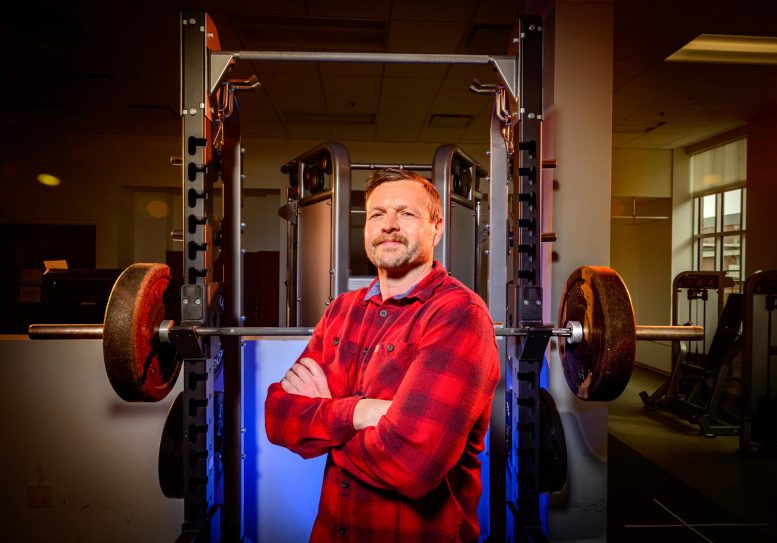
A previous study from Burd’s lab found that protein intakes higher than 1.1 g/kg per day make no difference to the rate of muscle protein synthesis when weight training. This amount of protein also is more in line with a typical American diet, and testing what people normally eat is important, he said.
How the experiment was conducted
For the new study, the team recruited 40 healthy, physically active 20-40-year-old adults. The participants underwent a seven-day “habituation diet” to standardize their nutritional status prior to the clinical trial. Then they were randomly assigned to either a vegan or omnivorous diet. The research team provided all meals, some of which were eaten in the lab while most were consumed at home. Roughly 70% of the protein for the omnivorous meals was obtained from animal sources: beef, pork, chicken, dairy, eggs. The vegan diet balanced the amino acid content of the meals, ensuring that participants consumed complete proteins.
The vegan and omnivorous groups were each divided again into those who ate roughly the same amount of protein at each of three meals and those whose protein intake varied across five meals throughout the day, with a larger proportion of protein consumed toward the end of the day.
All participants engaged in a series of muscle-strengthening activities in the lab every three days. They also wore accelerometers to keep track of their activity levels when not in the lab.
Tracking protein synthesis in real time
Each day, participants drank “heavy” water, which was labeled with deuterium, a stable isotope of hydrogen. The deuterium atoms “exchanged with hydrogen atoms within amino acids to make them heavy and served as tracers” that allowed the team to trace their incorporation into muscle tissue, Burd said. Biopsies of tissue from a leg muscle were taken at the beginning and end of the trial.
Burd was initially surprised to see that there were no differences in rates of muscle protein synthesis between those eating vegan or omnivorous diets. He was also surprised to see that protein distribution across the day had no effect on the rate of muscle building, given results from past studies of acute responses to dietary interventions and weight training.
“It was thought that it was better to get a steady-state delivery of nutrients throughout the day,” he said. “I also thought that if you’re getting a lower quality protein, in terms of its digestibility and amino acid content, that perhaps distribution would make a difference. And surprisingly, we showed it doesn’t matter.”
Now, Burd says, if anyone asks him what’s the best type of food they should eat for muscle building, he’ll tell them: “It’s the kind you put in your mouth after exercise. As long as you’re getting sufficient high-quality protein from your food, then it really doesn’t make a difference.”
Reference: “Impact of Vegan Diets on Resistance Exercise-Mediated Myofibrillar Protein Synthesis in Healthy Young Males and Females: A Randomized Controlled Trial” by Andrew T. Askow, Takeshi M. Barnes, Zan Zupancic, Max T. Deutz, Kevin J.M. Paulussen, Colleen F. McKenna, Amadeo F. Salvador, Alexander V. Ulanov, Scott A. Paluska, Jared W. Willard, Steven J. Petruzzello and Nicholas A. Burd, 4 April 2025, Medicine & Science in Sports & Exercise.
DOI: 10.1249/MSS.0000000000003725
The Beef Checkoff program, overseen by the National Cattlemen’s Beef Board, supported this research.
Never miss a breakthrough: Join the SciTechDaily newsletter.
Follow us on Google and Google News.
4 Comments
BS at its worse.
I know, from personal experience, this article is flat out inaccurate if not intentionally deceiving.
Animal protein has benefits (amino acids, creatine) that cannot be replicated by plant based protein; and they are essential to building muscle.
Animal proteins don’t have to come from meat. The article clearly says that the two groups consumed the same proteins. There are many lifelong vegetarians – they aren’t collapsing to the ground due to deficient muscles.
Humans can get all the same proteins from plants that meats have. (Plants are where the animals you eat get all their amino acids from to build muscle.) Creatine is not required in your diet to build muscle as it is made by your own body, (the animals you eat also make creatine in their owns bodies) and both meat-eating and plant-only body builders often supplement creatine for extra gains.