
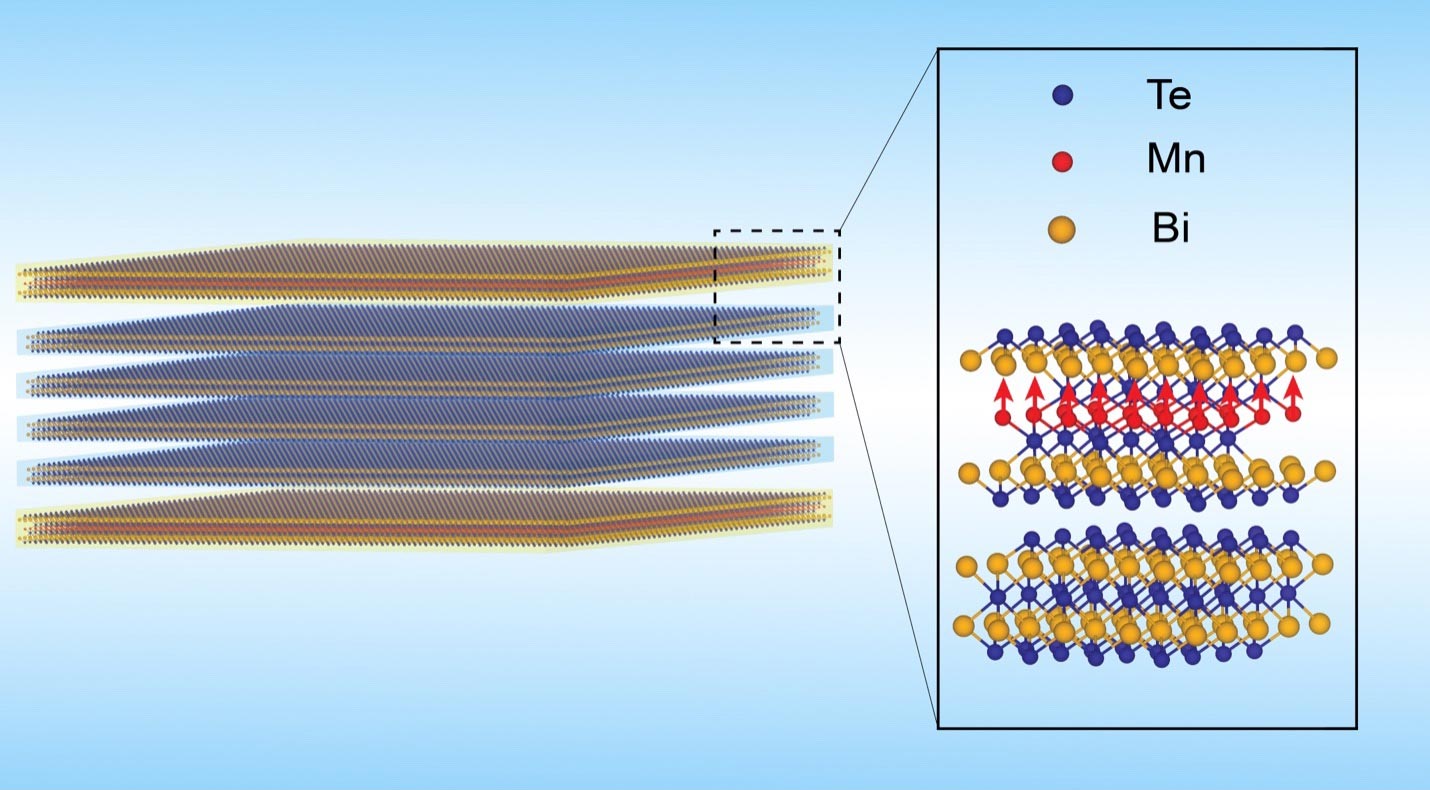
Researchers have developed a new “sandwich” structure material that exhibits the quantum anomalous Hall effect, enabling electrons to travel with almost no resistance at higher temperatures.
This breakthrough could significantly enhance computing power while dramatically reducing energy consumption. The structure is based on a layered approach with bismuth telluride and manganese bismuth telluride, promising faster and more efficient future electronic devices.
Quantum Material Innovations
Scientists continually strive to boost computer power while minimizing energy consumption. A significant breakthrough would be discovering a material that conducts electrons with near-zero resistance at standard operating temperatures. In this study, researchers identified a promising candidate in a layered “sandwich” structure exhibiting the quantum anomalous Hall (QAH) effect. This rare phenomenon allows electrons, aligned in the same spin direction, to travel along the edges of a material with almost no resistance.
Advancing Computer Efficiency Through Electron Spin
Powerful computers offer substantial benefits, yet they incur high energy costs. The sandwich structure explored in this research paves the way for devices that leverage electron spin, leading to systems that are both faster and more energy-efficient. Additionally, this research enriches our understanding of the atomic-level interactions in layered material stacks. This insight is crucial for scientists and engineers aiming to develop structures that push zero-resistance materials toward higher temperatures.
Enhancing Materials for Quantum Computing
This research studied bismuth telluride (Bi2Te3), a topological insulator. This means that the material is electrically insulating in its interior but can conduct electrical currents on its surfaces. To turn a topological insulator (which includes both spin-up and spin-down currents) into a QAH insulator (with currents of just one type of spin), it is necessary to induce magnetic order in the material. Adding dilute amounts of magnetic dopants can be a challenging process that actually results in magnetic disorder, greatly suppressing the temperature at which the QAH effect can be observed.
A better strategy is to sandwich the topological insulator with ferromagnetic layers, inducing magnetic order via proximity effects. One promising architecture involves a sandwich structure with single layers of the ferromagnetic insulator, manganese bismuth telluride (MnBi2Te4), on either side of layers of the ultrathin topological insulator, Bi2Te3.
Exploring New Quantum Effects at DOE Facilities
At the Advanced Light Source, a Department of Energy (DOE) Office of Science light source user facility, researchers synthesized this sandwich structure with a process called molecular beam epitaxy, where atomic layers are carefully built up one at a time from sources of the different constituent materials. The samples were then transferred to an interconnected experimental chamber to probe the system’s electronic behavior using ultraviolet light.
By examining the electrons that are emitted from the surface in response to the incident light, the researchers found features consistent with the predicted QAH effect, indicating that this quantum material sandwich is a good candidate for supporting the QAH effect at elevated temperatures.
For more on this research, see Unlocking Lossless Electronics With an Innovative Quantum “Sandwich.”
Reference: “Large Magnetic Gap in a Designer Ferromagnet–Topological Insulator–Ferromagnet Heterostructure” by Qile Li, Chi Xuan Trang, Weikang Wu, Jinwoong Hwang, David Cortie, Nikhil Medhekar, Sung-Kwan Mo, Shengyuan A. Yang and Mark T. Edmonds, 08 March 2022, Advanced Materials.
DOI: 10.1002/adma.202107520
Funding for this research included the Australian Research Council, Australia’s Nuclear Science and Technology Organisation, and the Singapore Ministry of Education. The research used resources at the Advanced Light Source, a Department of Energy Office of Science user facility.
Never miss a breakthrough: Join the SciTechDaily newsletter.
Follow us on Google and Google News.
1 Comment
My thought is the layering is maximizing the Edge effect of electrons while minimizing the effect of dark electrons that make up solid material .