
Close Menu
    Facebook X (Twitter) Instagram
    SciTechDaily
    • Biology
    • Chemistry
    • Earth
    • Health
    • Physics
    • Science
    • Space
    • Technology
    Facebook X (Twitter) Pinterest YouTube RSS
    SciTechDaily
    Home»Science»230 Million Year Old Arthropods Found Preserved in Amber
    Science

    230 Million Year Old Arthropods Found Preserved in Amber

    By SciTechDailyAugust 30, 2012No Comments3 Mins Read
    Facebook Twitter Pinterest Telegram LinkedIn WhatsApp Email Reddit
    Share
    Facebook Twitter LinkedIn Pinterest Telegram Email Reddit
    amber-preserved-arthropods-triassic
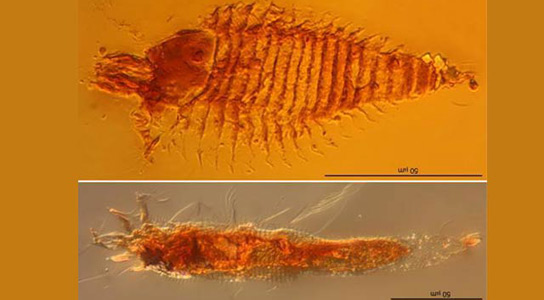
    Amber preserved arthropods from Triassic period.

    Arthropods from the Triassic period have been discovered preserved in amber. They are 100 million years older than previous amber inclusions. The two mites and one fly were found in millimeter-scale droplets of amber from northeastern Italy.

    Researchers published their findings in the journal Proceedings of the National Academy of Sciences. Arthropods are invertebrate animals including insects, arachnids, and crustaceans. The specimens were preserved with microscopic fidelity, allowing the estimation of the amount of evolutionary change over millions of years. Arthropods are more than 400 million years old, but before now the oldest record of these animals in amber dates to about 130 million years, in the Cretaceous period.
    arthropods-in-amber
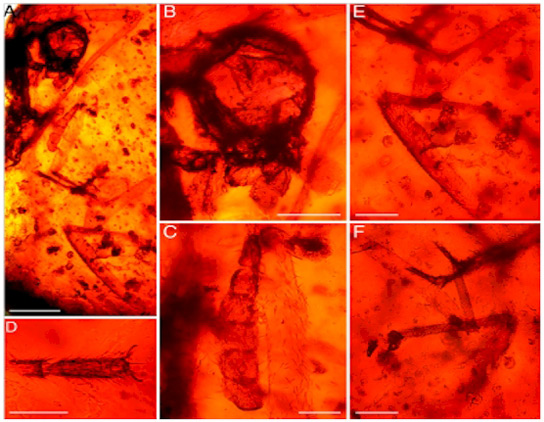
    Photomicrographs of Diptera specimen in Dolomite Triassic amber, (A) Entire specimen with dissociated appendages. (B) Head, detail. (C) Detail of antenna and adjacent leg, showing oval sensory area, possibly Johnston’s organ. (D) Detail of dissociated distitarsus. (E) (F) Dissociated legs

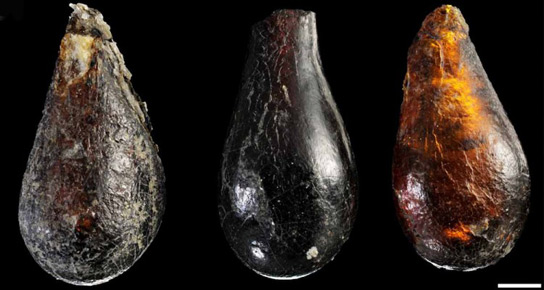
    The amber droplets range between 2 to 6 mm in length, were buried in the Dolomite Alps of northeastern Italy and excavated by Eugenio Ragazzi and Guido Roghi of the University of Padova. Over 70,000 droplets were screened for inclusions by a team of German scientists led by Alexander Schmidt, of the Georg-August University in Göttingen.

    Two of the specimens are a new species of mites, Triasacarus fedelei and Ampezzoa triassica. They are the oldest fossils of a group called Eriophyoidea, which has about 3,500 living species, all of which feed on plants and sometimes form abnormal growth called galls on their bodies.
    amber-droplets

    T. fedelei and A. triassica fed on a now-extinct conifer, but 97% of today’s gall mites feed on flowering plants. These mites existed before the appearance of flowering plants. The mites seemed to have evolved and endured even when flowering plants entered the environment. The fly couldn’t be identified because some of its body parts weren’t well preserved.

    There was a huge change in flora and fauna in the Triassic, because it was right after one of the most acute extinction pulses in the geological time record, the Permian-Triassic extinction event, which occurred 252.28 Ma. This could help elucidate how life continued to evolve.

    Reference: “Arthropods in amber from the Triassic Period” by Alexander R. Schmidt, Saskia Jancke, Evert E. Lindquist, Eugenio Ragazzi, Guido Roghi, Paul C. Nascimbene, Kerstin Schmidt, Torsten Wappler and David A. Grimaldi, 27 August 2012, Proceedings of the National Academy of Sciences.
    DOI: 10.1073/pnas.1208464109

    Never miss a breakthrough: Join the SciTechDaily newsletter.
    Follow us on Google and Google News.

    Amber Arthropod Paleontology Triassic
    Share. Facebook Twitter Pinterest LinkedIn Email Reddit

    Related Articles

    Dinosaur Ancestors Trekked 10,000 Miles Through “Hell” on Earth

    Three-Eyed “Sea-Moth” Predator From 506 Million Years Ago Stuns Scientists

    Real-Life Monster: Scientists Discover Strange Wasp From 99 Million Years Ago

    Stunning 450-Million-Year-Old Fossil Preserved in Fool’s Gold Reveals Evolution’s Secrets

    Like Nothing Seen Before – New Type of Wasp Discovered With Mysterious, Cloud-Like Structures at Ends of Antennae

    Solving a Paleontological Puzzle: Why Do We Find So Much Amber in Cretaceous Rocks?

    Ancient Giants Uncovered: Fossil Site Sheds Light on Arthropod Dominance 470 Million Years Ago

    33 Million Years Old: The Largest Flower Preserved in Amber

    Amber Captured Cretaceous Period Spider Attacking a Wasp

    Leave A Reply Cancel Reply

    • Facebook
    • Twitter
    • Pinterest
    • YouTube

    Don't Miss a Discovery

    Subscribe for the Latest in Science & Tech!

    Trending News

    Breakthrough Bowel Cancer Trial Leaves Patients Cancer-Free for Nearly 3 Years

    Natural Compound Shows Powerful Potential Against Rheumatoid Arthritis

    100,000-Year-Old Neanderthal Fossils in Poland Reveal Unexpected Genetic Connections

    Simple “Gut Reset” May Prevent Weight Gain After Ozempic or Wegovy

    2.8 Days to Disaster: Scientists Warn Low Earth Orbit Could Suddenly Collapse

    Common Food Compound Shows Surprising Power Against Superbugs

    5 Simple Ways To Remember More and Forget Less

    The Atomic Gap That Could Cost the Semiconductor Industry Billions

    Follow SciTechDaily
    • Facebook
    • Twitter
    • YouTube
    • Pinterest
    • Newsletter
    • RSS
    SciTech News
    • Biology News
    • Chemistry News
    • Earth News
    • Health News
    • Physics News
    • Science News
    • Space News
    • Technology News
    Recent Posts
    • Powerful Antioxidant Found To Play a Key Role in Proper Protein Folding
    • MIT Laser Breakthrough Lets Scientists Watch Drugs Enter the Brain in Real Time
    • Study Reveals Malaria’s Hidden Role in Human Evolution
    • Scientists Print Artificial Neurons That Can Talk to the Brain
    • Bowel and Ovarian Cancers Are Dramatically Rising in Young Adults and Scientists Aren’t Sure Why
    Copyright © 1998 - 2026 SciTechDaily. All Rights Reserved.
    • Science News
    • About
    • Contact
    • Editorial Board
    • Privacy Policy
    • Terms of Use

    Type above and press Enter to search. Press Esc to cancel.