
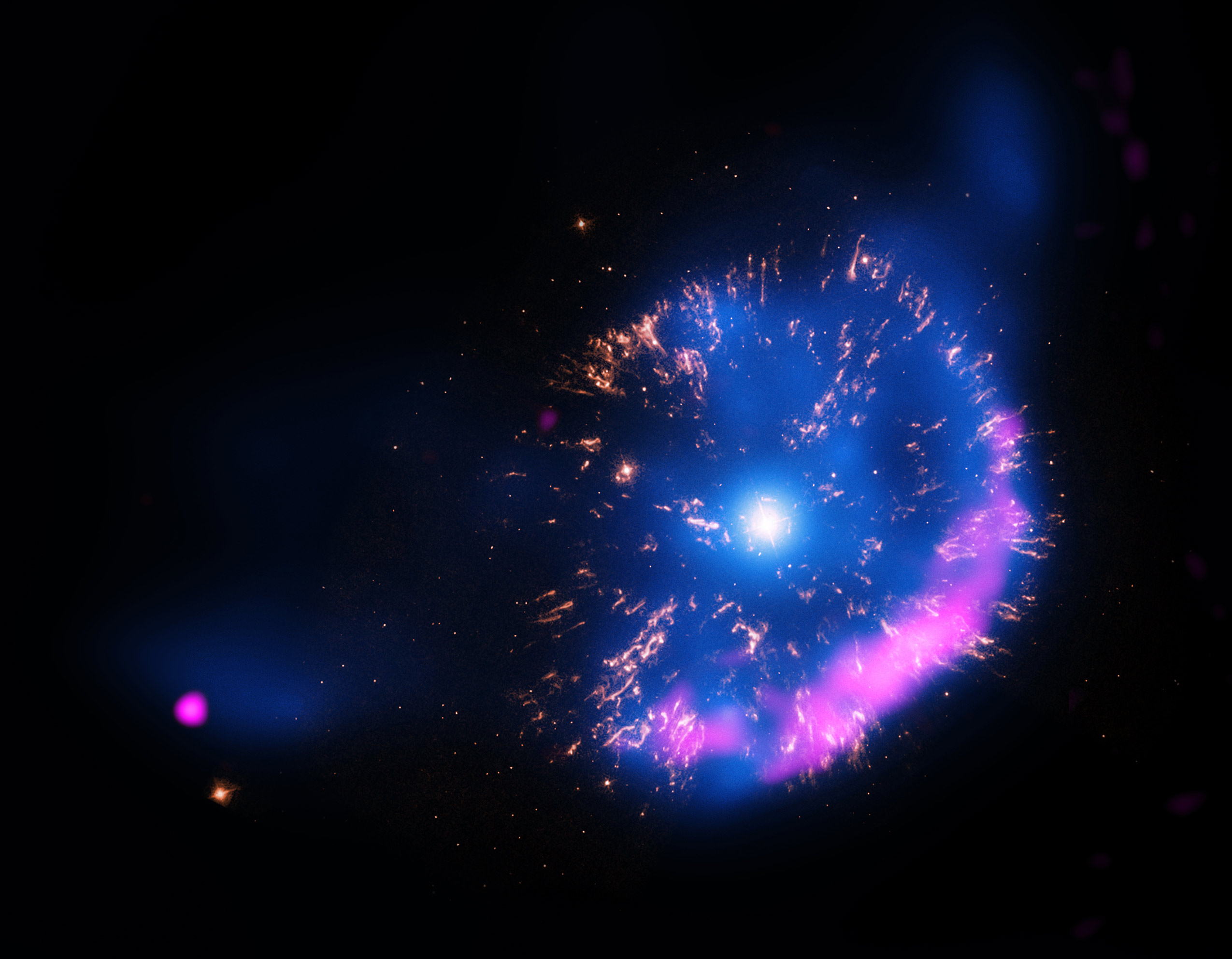
Astronomers used data from the Chandra X-ray Observatory to observe the differences in GK Persei over a span of nearly 14 years, providing clues to the dynamics of other, much larger stellar eruptions.
In Hollywood blockbusters, explosions are often among the stars of the show. In space, explosions of actual stars are a focus for scientists who hope to better understand their births, lives, and deaths and how they interact with their surroundings.
Using NASA’s Chandra X-ray Observatory, astronomers have studied one particular explosion that may provide clues to the dynamics of other, much larger stellar eruptions.
A team of researchers pointed the telescope at GK Persei, an object that became a sensation in the astronomical world in 1901 when it suddenly appeared as one of the brightest stars in the sky for a few days, before gradually fading away in brightness. Today, astronomers cite GK Persei as an example of a “classical nova,” an outburst produced by a thermonuclear explosion on the surface of a white dwarf star, the dense remnant of a Sun-like star.
A nova can occur if the strong gravity of a white dwarf pulls material from its orbiting companion star. If enough material, mostly in the form of hydrogen gas, accumulates on the surface of the white dwarf, nuclear fusion reactions can occur and intensify, culminating into a cosmic-sized hydrogen bomb blast. The outer layers of the white dwarf are blown away, producing a nova outburst that can be observed for a period of months to years as the material expands into space.
Classical novas can be considered to be “miniature” versions of supernova explosions. Supernovas signal the destruction of an entire star and can be so bright that they outshine the whole galaxy where they are found. Supernovas are extremely important for cosmic ecology because they inject huge amounts of energy into the interstellar gas, and are responsible for dispersing elements such as iron, calcium and oxygen into space where they may be incorporated into future generations of stars and planets.
Although the remnants of supernovas are much more massive and energetic than classical novas, some of the fundamental physics is the same. Both involve an explosion and creation of a shock wave that travels at supersonic speeds through the surrounding gas.
The more modest energies and masses associated with classical novas means that the remnants evolve more quickly. This, plus the much higher frequency of their occurrence compared to supernovae, makes classical novas important targets for studying cosmic explosions.
Chandra first observed GK Persei in February 2000 and then again in November 2013. This 13-year baseline provides astronomers with enough time to notice important differences in the X-ray emission and its properties.
This new image of GK Persei contains X-rays from Chandra (blue), optical data from NASA’s Hubble Space Telescope (yellow), and radio data from the National Science Foundation’s Very Large Array (pink). The X-ray data show hot gas and the radio data show emission from electrons that have been accelerated to high energies by the nova shock wave. The optical data reveal clumps of material that were ejected in the explosion. The nature of the point-like source on the lower left is unknown.
Over the years that the Chandra data span, the nova debris expanded at a speed of about 700,000 miles per hour (313,000 meters per second). This translates to the blast wave moving about 90 billion miles during that period.
One intriguing discovery illustrates how the study of nova remnants can provide important clues about the environment of the explosion. The X-ray luminosity of the GK Persei remnant decreased by about 40% over the 13 years between the Chandra observations, whereas the temperature of the gas in the remnant has essentially remained constant, at about one million degrees Celsius. As the shock wave expanded and heated an increasing amount of matter, the temperature behind the wave of energy should have decreased. The observed fading and constant temperature suggests that the wave of energy has swept up a negligible amount of gas in the environment around the star over the past 13 years. This suggests that the wave must currently be expanding into a region of much lower density than before, giving clues to stellar neighborhood in which GK Persei resides.
A paper describing these results appeared in the March 10th issue of The Astrophysical Journal. The authors were Dai Takei (RIKEN, Spring-8 Center Japan), Jeremy Drake (Smithsonian Astrophysical Observatory), Hiroya Yamaguichi (Goddard Space Flight Center), Patrick Slane (Smithsonian Astrophysical Observatory), Yasunobu Uchimaya (Rikkyo University, Japan), Satoru Katsuda (Japanese Aerospace Exploration Agency).
NASA’s Marshall Space Flight Center in Huntsville, Alabama, manages the Chandra program for NASA’s Science Mission Directorate in Washington. The Smithsonian Astrophysical Observatory in Cambridge, Massachusetts, controls Chandra’s science and flight operations.
Reference: “X-ray Fading and Expansion in the ‘Miniature Supernova Remnant’ of GK Persei” by D. Takei, J. J. Drake, H. Yamaguchi, P. Slane, Y. Uchiyama and S. Katsuda, 10 March 2015, The Astrophysical Journal.
DOI: 10.1088/0004-637X/801/2/92
Never miss a breakthrough: Join the SciTechDaily newsletter.
Follow us on Google and Google News.
1 Comment
Lithium based cloudy collections over Tamilnadu may produce more Killer lightning whistler waves during 2020 as observed in Libra Quantum mechanical sector producing lightning and whistler killer waves
Companion star feeding a gas shroud around a white dwarf producing lithium charged ionization responsible for Halls whistler lightning effect making an explosion on the surrounding producing lightning explosion
Hence atypical fusion technology could be developed by shrouding lithium ions to simulate a gas thrust producing whistler wave explosions to ignite the plasma
they discovered that the outburst is producing a large amount of lithium (Li; Note 1). Lithium is a key element in the study of the chemical evolution of the universe because it likely was and is produced in several ways: through Big Bang nucleosynthesis, in collisions between energetic cosmic rays and the interstellar medium, inside stellar interiors, and as a result of novae and supernova explosions. This new observation provides the first direct evidence for the supply of Li from stellar objects to the galactic medium.
A classical nova explosion is thought to occur on the surface of a white dwarf (center right) with a close companion star (center left; a sun-like main sequence or more evolved star). When the distance between two stars is close enough, the outer gas of the companion starts to accumulate on the surface of the white dwarf via an accretion disk. The thicker gas layer on the white dwarf increases its temperature and density. Then, nuclear reactions occur with a different way from those inside stars. In the case of stellar interiors, the huge energy produced by nuclear reactions in the core is balanced by the gravity of the surrounding gas, and then the reaction becomes stable. However, the nuclear reaction in a thin gas layer on the surface of a white dwarf has a different result. It becomes a runaway nuclear reaction, and results in an explosion that blows away the gas layer.
Two types of radial spins one vertical and one horizontal producing differentiated collection of mass proving the Eintstein’s reference planes:
After the explosion, the material in the region around the white dwarf is very hot and has a very high density. The light radiated by the white dwarf passes through some of the gaseous blobs blown away by the explosion, and that light reaches observers. Each element in the blobs absorbs the light at a specific wavelength. Because each blob has a different velocity (~1000 km/s), the nova spectrum shows many groups of weak absorption lines created by various elements.
Two types of radial spins one vertical and one horizontal producing differentiated collection of mass proving the Eintstein’s reference planes after an spacial nova explosion could be evolved