
Close Menu
    Facebook X (Twitter) Instagram
    SciTechDaily
    • Biology
    • Chemistry
    • Earth
    • Health
    • Physics
    • Science
    • Space
    • Technology
    Facebook X (Twitter) Pinterest YouTube RSS
    SciTechDaily
    Home»Space»Earth’s Van Allen Radiation Belt’s Charged Electrons Heading for Space Not Surface
    Space

    Earth’s Van Allen Radiation Belt’s Charged Electrons Heading for Space Not Surface

    By SciTechDailyJanuary 30, 20122 Comments2 Mins Read
    Facebook Twitter Pinterest Telegram LinkedIn WhatsApp Email Reddit
    Share
    Facebook Twitter LinkedIn Pinterest Telegram Email Reddit
    van-allen-radiation-belts
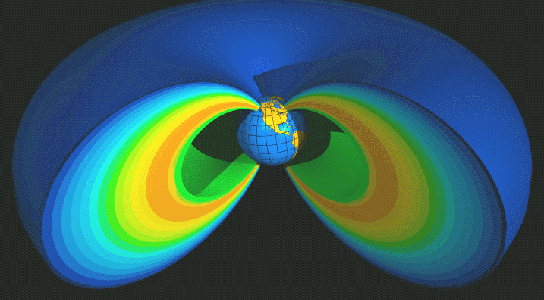
    Artist’s illustration of Van Allen belts. Credit: NASA

    The increase in solar activity has become quite obvious on Earth, thanks to the increase in auroras caused by geomagnetic storms, but while astronomers had previously believed that the Earth might be stripped temporarily of its radiation belts, causing the charged electrons to inundate the atmosphere, new data has shown that the deadly particles will actually be blown back into space.

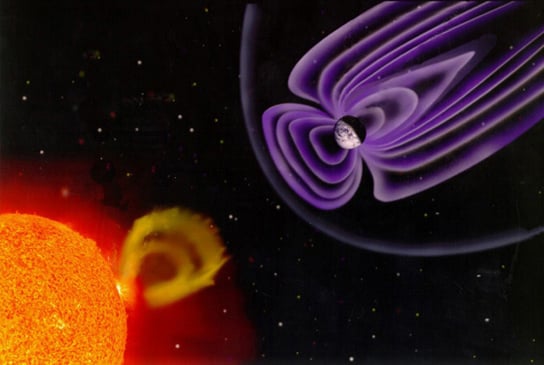
    The Van Allen radiation belts circling Earth include streams of highly charged electrons. When the particles from the sun collide with the magnetic field that shields Earth from the worst effects, the resulting geomagnetic storms can decrease the number of dangerous electrons.
    geomagnetic-storm-radiation
    Credit: NASA

    These charged electrons can create havoc on telecommunications satellites and post a danger to astronauts in space, but astronomers had yet to find where these particles ended up. Each geomagnetic storm results in a strange dip, also known as dropouts, in the number of charged particles in the radiation belts. These dropouts happen a few times a year, but when the sun enters an active phase, as it is now, this can happen several times each month.

    Scientists from the University of California, Los Angeles, observed a geomagnetic storm in January 2011 with their instruments. They noticed intense solar activity pushes against the outer edge of the Earth’s magnetic field, sliding the lines across, allowing the electrons to escape into space.

    The findings were published in the journal Nature Physics. Coronal mass ejections from Sol can deplete the Earth’s outer radiation belt, but the belt is resupplied within a few days. Eleven different satellites, including NASA’s five Themis spacecraft and two weather satellites operated by the National Oceanic and Atmospheric Administration and the European Organization for the Exploitation of Meteorological Satellites were pooled together to capture a complete picture of the interaction.

    The upcoming launch of NASA’s Radiation Belt Storm Probes Mission, scheduled for later this year in August, may help further the studies.

    Never miss a breakthrough: Join the SciTechDaily newsletter.
    Follow us on Google and Google News.

    Astronomy Electrons NASA Particles Radiation
    Share. Facebook Twitter Pinterest LinkedIn Email Reddit

    Related Articles

    NASA Explains Space Radiation and Its Effects on the Human Body

    NASA’s Spitzer Space Telescope Finds Solid Buckyballs in Space

    Hubble Discovers NGC 1073, A Barred Spiral Galaxy Similar to Milky Way

    The Bolshoi Simulation: Boxing the Universe

    NASA’s GRAIL Mission Returns Video From Far Side of the Moon

    NASA’s THEMIS Satellite Records Effect of Geomagnetic Storms on Radiation Belts

    NASA’s Kepler Mission Discovers 11 New Extrasolar Systems with 26 Exoplanets

    NASA’s NuSTAR is One Step Closer to Launching

    Hubble Observes Rare Blue Stars in Andromeda’s Core

    Leave A Reply Cancel Reply

    • Facebook
    • Twitter
    • Pinterest
    • YouTube

    Don't Miss a Discovery

    Subscribe for the Latest in Science & Tech!

    Trending News

    Enormous Prehistoric Insects Puzzle Scientists

    Scientists Develop Bioengineered Chewing Gum That Could Help Fight Oral Cancer

    After 37 Years, the World’s Longest-Running Soil Warming Experiment Uncovers a Startling Climate Secret

    NASA Satellite Captures First-Ever High-Res View of Massive Pacific Tsunami

    ADHD Isn’t Just a Deficit: Study Reveals Powerful Hidden Strengths

    Scientists Discover Stem Cells That Could Regrow Teeth and Bone

    Early Cannabis Use May Stall Key Brain Skills in Teens

    Popular Vitamin D Supplement Has “Previously Unknown” Negative Effect, Study Finds

    Follow SciTechDaily
    • Facebook
    • Twitter
    • YouTube
    • Pinterest
    • Newsletter
    • RSS
    SciTech News
    • Biology News
    • Chemistry News
    • Earth News
    • Health News
    • Physics News
    • Science News
    • Space News
    • Technology News
    Recent Posts
    • Quantum Breakthrough: New Algorithm Solves “Impossible” Materials in Seconds
    • Could the Universe’s Hidden Shape Solve One of Physics’ Biggest Mysteries?
    • Rewriting Dinosaur Evolution: Scientists Unearth Remarkable 150-Million-Year-Old Stegosaur Skull
    • Scientists Identify Two Simple Treatments for Cancer-Related Cognitive Impairment
    • Omega-3 Supplements Linked to Cognitive Decline in Surprising New Study
    Copyright © 1998 - 2026 SciTechDaily. All Rights Reserved.
    • Science News
    • About
    • Contact
    • Editorial Board
    • Privacy Policy
    • Terms of Use

    Type above and press Enter to search. Press Esc to cancel.