
Close Menu
    Facebook X (Twitter) Instagram
    SciTechDaily
    • Biology
    • Chemistry
    • Earth
    • Health
    • Physics
    • Science
    • Space
    • Technology
    Facebook X (Twitter) Pinterest YouTube RSS
    SciTechDaily
    Home»Biology»Flying Squirrels Can Adjust Speed and Flight Dynamically
    Biology

    Flying Squirrels Can Adjust Speed and Flight Dynamically

    By SciTechDailyDecember 28, 2012No Comments2 Mins Read
    Facebook Twitter Pinterest Telegram LinkedIn WhatsApp Email Reddit
    Share
    Facebook Twitter LinkedIn Pinterest Telegram Email Reddit
    Flying Squirrels Can Adjust Speed and Flight Dynamically
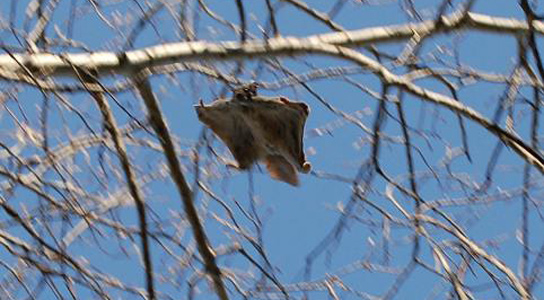
    Flying squirrels can actively control their flight speed and direction by manipulating the furry membrane between their wrists and ankles. Credit: Angie spuc/Wikicommons

    Flying squirrels, a tribe of 44 species of the family Sciuridae, might look reckless as they fling themselves through the air, but scientists have reported that there is a certain measure of finesse involved. The squirrels are able to actively manipulate the furry membrane that stretches between their wrists and ankles to control the speed and direction of their flight.

    The scientists published their findings in the Journal of the Royal Society Interface. Flying squirrels, Pteromyini, aren’t capable of powered flight. Instead, they glide between trees, and are capable of obtaining lift whilst gliding. The flights can be up to 90 m. The direction and speed of the animal are changed by the positions of its two arms and legs, largely controlled by small cartilaginous wrist bones. The fluffy tail stabilizes the flight and acts as an adjunct airfoil, even working as an air brake when landing on a tree trunk.

    The scientists set up video cameras in a Maine forest and analyzed the recordings of the animals lured to a feeder. Their glide-path trajectories were compared with aerodynamic simulations. Rather than cruising through the air at constant speeds, the squirrels continuously modulated their speed and direction to attain distance and lift. This contradicts aerodynamic models of the evolution of flight, which assumes that a transition from gliding to flapping would be too mechanically awkward and unstable.

    The squirrels have the sensitivity and physical ability to adjust their membranes to fly more precisely. This could indicate that gliders may have indeed been the evolutionary precursors to creatures that flap, like bats and birds.

    Reference: “Glide performance and aerodynamics of non-equilibrium glides in northern flying squirrels (Glaucomys sabrinus)” by Joseph W. Bahlman, Sharon M. Swartz, Daniel K. Riskin and Kenneth S. Breuer, 6 March 2013, Journal of the Royal Society Interface.
    DOI: 10.1098/rsif.2012.0794

    Never miss a breakthrough: Join the SciTechDaily newsletter.
    Follow us on Google and Google News.

    Aeronautics Flight Wildlife Zoology
    Share. Facebook Twitter Pinterest LinkedIn Email Reddit

    Related Articles

    Scientists Finally Solve the Mystery of South Africa’s Tiny Leopards

    Scientists Capture Extremely Rare Half-Female, Half-Male Bird on Film

    The Mysterious Case of the Disappearing White-Lipped Peccaries

    Elephants Are More Likely to Die at the Hands of Humans Than From Natural Causes

    Birdsongs Elicit “Emotional” Response From Birds

    Barbed Porcupine Quills Could Help Enhance Various Biomedical Devices

    Humans Are a Greater Disturbance to Elk Than Natural Predators

    Kitti’s Hog-Nosed Bat Is World’s Smallest Mammal

    Bonobo Great Apes Are Domesticating Themselves

    Leave A Reply Cancel Reply

    • Facebook
    • Twitter
    • Pinterest
    • YouTube

    Don't Miss a Discovery

    Subscribe for the Latest in Science & Tech!

    Trending News

    Scientists Discover Bizarre 100-Million-Year-Old Insect With Giant Claws

    Scientists Discover “Good” Gut Microbes That Could Protect Against Autism and ADHD

    Scientists Reveal That Eating Almonds Every Day Could Transform Your Gut, Metabolism, and Appetite

    Scientists May Have Solved Two of Fusion Energy’s Biggest Problems at Once

    Scientists Discover Hidden “Switch” That Burns Fat and Could Treat Bone Disease

    After 50 Years of Mystery, Researchers Identify New Human Blood Group

    Beyond Pain Relief: Scientists Discover a Protein That Could Stop Osteoarthritis in Its Tracks

    Scientists Discover Why Alcohol Prevents the Liver From Healing, Even After You Quit

    Follow SciTechDaily
    • Facebook
    • Twitter
    • YouTube
    • Pinterest
    • Newsletter
    • RSS
    SciTech News
    • Biology News
    • Chemistry News
    • Earth News
    • Health News
    • Physics News
    • Science News
    • Space News
    • Technology News
    Recent Posts
    • Scientists Discover “Immature” Brain Cells That May Defy Alzheimer’s
    • Children of Centenarians Share One Surprising Habit That May Boost Longevity
    • Scientists Discover Cheap, Natural Remedy for High Blood Pressure
    • Archaeologists Discover Prehistoric Mountain Cave Packed With Mysterious Green Mineral
    • This Common Houseplant Is Secretly Using Advanced Geometry
    Copyright © 1998 - 2026 SciTechDaily. All Rights Reserved.
    • Science News
    • About
    • Contact
    • Editorial Board
    • Privacy Policy
    • Terms of Use

    Type above and press Enter to search. Press Esc to cancel.