
Close Menu
    Facebook X (Twitter) Instagram
    SciTechDaily
    • Biology
    • Chemistry
    • Earth
    • Health
    • Physics
    • Science
    • Space
    • Technology
    Facebook X (Twitter) Pinterest YouTube RSS
    SciTechDaily
    Home»Technology»Metamaterial Lens Has Ten Times More Power than Any Current Lens
    Technology

    Metamaterial Lens Has Ten Times More Power than Any Current Lens

    By University of SydneyOctober 29, 2013No Comments4 Mins Read
    Facebook Twitter Pinterest Telegram LinkedIn WhatsApp Email Reddit
    Share
    Facebook Twitter LinkedIn Pinterest Telegram Email Reddit
    Metamaterial Lens Has Ten Times More Power than Any Current Lens
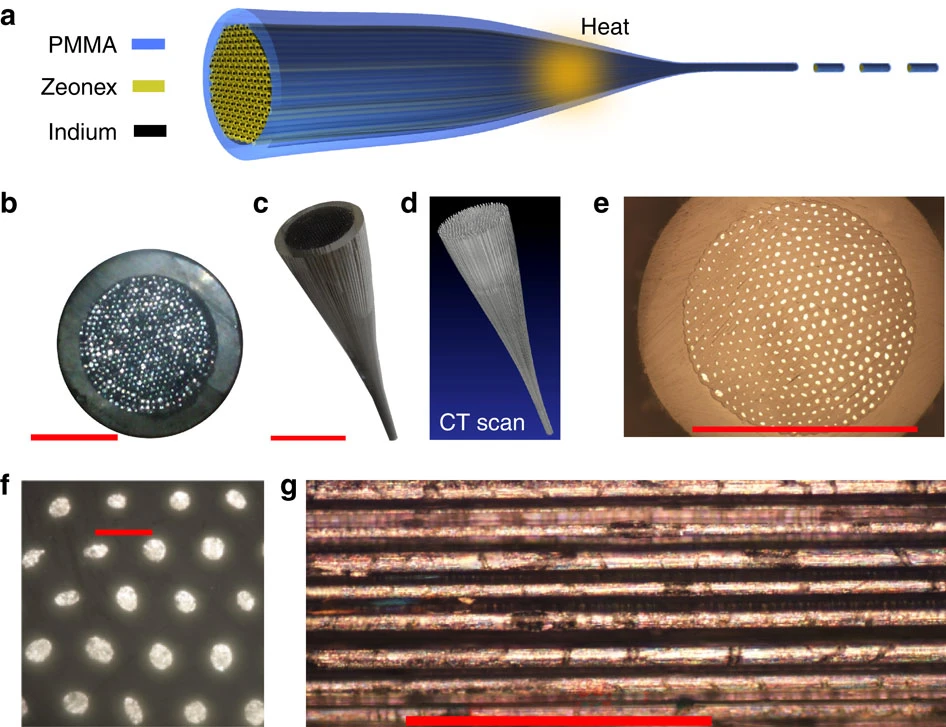
    (a) A centimeter-sized preform is assembled by stacking indium wires surrounded by Zeonex29 (a polymer with low absorption at terahertz frequencies) into a hollow polymethyl methacrylate (PMMA) tube. This is heated and drawn to the fiber, forming a tapered transition region where the polymer is viscous and the metal is liquid. The end product is a fiber containing a long continuous array of metal microwires. The fiber can be cut into a large number of smaller-length devices. (b) Top-view photograph of the preform cross-section. Scale bar: 10 mm. (c) Photograph and (d) X-ray CT scan of the taper used in this work. Scale bar: 8 mm. (e) × 10 (scale bar: 1 mm) and (f) × 40 (scale bar: 50 μm) magnified microscope image of a metamaterial fiber cross-section. (g) Typical side view of the straight fiber section, showing wire continuity and good uniformity over the length scales considered. Scale bar: 500 μm. Credit: Alessandro Tuniz, et al.

    Researchers from the University of Sidney have developed a metamaterial lens that has ten times the resolution of any current lens.

    A lens with ten times the resolution of any current lens, making it a powerful new tool for the biological sciences has been developed by researchers at the University of Sydney.

    “This advance means we can unlock previously inaccessible information on the structure of molecules, their chemical make-up, and the presence of certain proteins,” said Alessandro Tuniz, lead author of an article on the lens published in Nature Communications today.

    Tuniz, a postdoctoral associate at the University, said, “This opens up an entirely new tool for biological studies. It could allow earlier skin cancer diagnosis, because smaller melanomas can be recognized. For breast cancer, it can also be used to more accurately check that all traces of a tumor have been cut out during surgery.”

    The four-member research team from the University’s School of Physics, including Alessandro Tuniz, are all authors on the paper. They created the lens using fiber optic manufacturing technology.

    The lens is a metamaterial – a material with completely new properties not found in nature.

    Making the lens was not a matter of making a better form of the lenses already in existence but of making a lens which uses light waves in a way not previously possible.

    “Creating metamaterials is a cutting-edge area of science with a massive range of potential uses from aerospace to solar power, telecommunications to defense,” said researcher Dr Boris Kuhlmey.

    “The major challenge is making these materials on a scale that is useful. This is one of the first times a metamaterial with a real world application, quickly able to be realized, has been feasible. Within the next two to three years, new terahertz microscopes that are ten times more powerful than current ones will be possible using our metamaterial.

    “We know of only two or three other cases worldwide, including for wireless internet and MRI applications, where metamaterials could also be put into practice in the next couple of years.”

    The potential to create a new high-power lens, able to see much finer details than using conventional lenses was spotted almost a decade ago. It has taken until now to make the lens on a useful scale, a thousand times smaller than the early experimental models.

    “The difficulty was making large quantities of matter structured on a micrometric scale,” said Alessandro Tuniz.

    The new lens, made of plastic and metal, uses terahertz waves, electromagnetic waves with frequencies higher than microwaves but lower than infrared radiation and visible light. It operates in a region of the spectrum where very few other optical tools are available and all of them have limitations, in particular in terms of resolution.

    “If we think of this in comparison to an X-ray which allows us to see inside objects at a high resolution but with associated danger from radiation, by contrast, our metamaterial lens allows us not only to see through some opaque materials, but also to gather information on their chemical composition, and even information on interaction between certain molecules, without the danger of X-rays,” Tuniz said.

    This means the lens is perfectly suited to analyzing the delivery of drugs to cells, which is crucial to medical research.

    This research was undertaken with the Freiburg Materials Research Center from the University of Freiburg and supported by the Australian Research Council, and the Australian National Fabrication Facility using commonwealth and NSW government funding.

    Reference: “Metamaterial fibres for subdiffraction imaging and focusing at terahertz frequencies over optically long distances” by Alessandro Tuniz, Korbinian J. Kaltenecker, Bernd M. Fischer, Markus Walther, Simon C. Fleming, Alexander Argyros and Boris T. Kuhlmey, 28 October 2013, Nature Communications.
    DOI: 10.1038/ncomms3706

    Never miss a breakthrough: Join the SciTechDaily newsletter.
    Follow us on Google and Google News.

    Lens Materials Science Metamaterials University of Sydney
    Share. Facebook Twitter Pinterest LinkedIn Email Reddit

    Related Articles

    ‘Digital Metamaterials’ Bring Invisibility Cloaks Closer to Reality

    Nanoparticle Thin Films That Self-Assemble in One Minute

    New Nanostructured Material Mimics the Wettability of a Rose Petal

    Thermal Cloak Molds the Flow of Heat Around an Object

    New Metamaterial Doubles the Range of Light That Can Be Manipulated

    Scientists Create “Ghost-Illusion” Cloaking Device

    Shape-Remembering Hydrogels Made Out of Synthetic DNA

    Duke University Creates “Perfect” Microwave Cloak

    Scientists Change the Color of Gold

    Leave A Reply Cancel Reply

    • Facebook
    • Twitter
    • Pinterest
    • YouTube

    Don't Miss a Discovery

    Subscribe for the Latest in Science & Tech!

    Trending News

    Breakthrough Bowel Cancer Trial Leaves Patients Cancer-Free for Nearly 3 Years

    Natural Compound Shows Powerful Potential Against Rheumatoid Arthritis

    100,000-Year-Old Neanderthal Fossils in Poland Reveal Unexpected Genetic Connections

    Simple “Gut Reset” May Prevent Weight Gain After Ozempic or Wegovy

    2.8 Days to Disaster: Scientists Warn Low Earth Orbit Could Suddenly Collapse

    Common Food Compound Shows Surprising Power Against Superbugs

    5 Simple Ways To Remember More and Forget Less

    The Atomic Gap That Could Cost the Semiconductor Industry Billions

    Follow SciTechDaily
    • Facebook
    • Twitter
    • YouTube
    • Pinterest
    • Newsletter
    • RSS
    SciTech News
    • Biology News
    • Chemistry News
    • Earth News
    • Health News
    • Physics News
    • Science News
    • Space News
    • Technology News
    Recent Posts
    • Powerful Antioxidant Found To Play a Key Role in Proper Protein Folding
    • MIT Laser Breakthrough Lets Scientists Watch Drugs Enter the Brain in Real Time
    • Study Reveals Malaria’s Hidden Role in Human Evolution
    • Scientists Print Artificial Neurons That Can Talk to the Brain
    • Bowel and Ovarian Cancers Are Dramatically Rising in Young Adults and Scientists Aren’t Sure Why
    Copyright © 1998 - 2026 SciTechDaily. All Rights Reserved.
    • Science News
    • About
    • Contact
    • Editorial Board
    • Privacy Policy
    • Terms of Use

    Type above and press Enter to search. Press Esc to cancel.