
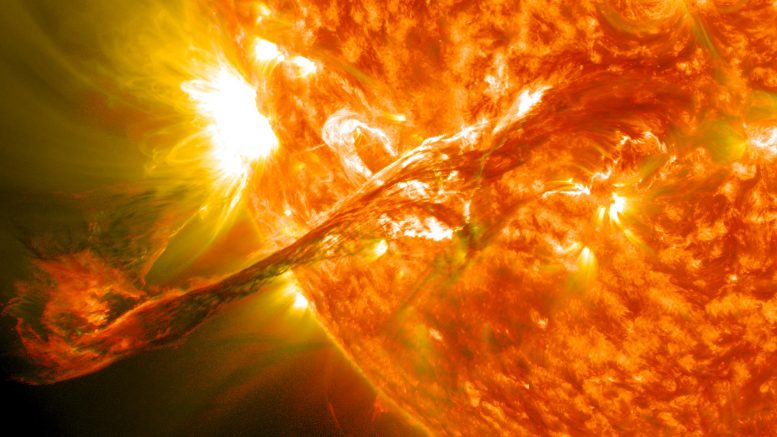
New research from the University of Leeds and University of Chicago reveals a model of Sun’s magnetic field.
Researchers at the Universities of Leeds and Chicago have uncovered an important mechanism behind the generation of astrophysical magnetic fields such as that of the Sun.
Scientists have known since the 18th Century that the Sun regularly oscillates between periods of high and low solar activity in an 11-year cycle, but have been unable to fully explain how this cycle is generated.
In the ‘Information Age’, it has become increasingly important to be able to understand the Sun’s magnetic activity, as it is the changes in its magnetic field that are responsible for ‘space weather’ phenomena, including solar flares and coronal mass ejections. When this weather heads in the direction of Earth it can damage satellites, endanger astronauts on the International Space Station, and cause power grid outages on the ground.
The research, published in the journal Nature, explains how the cyclical nature of these large-scale magnetic fields emerges, providing a solution to the mathematical equations governing fluids and electromagnetism for a large astrophysical body.
Sparked by a medium-sized (C-class) flare, a long, magnetic filament burst out from the Sun, producing one of the best shows that SDO has seen (August 31, 2012). Viewed in the 304 Angstrom wavelength of extreme ultraviolet light, the filament strand gets stretched outwards until it finally breaks and heads off to the left. Some of the particles from this eruption did hit Earth with a glancing blow on September 3, generating some beautiful aurora. The video clip covers four hours of activity.
The mechanism, known as a dynamo, builds on a solution to a reduced set of equations first proposed in the 1950s which could explain the regular oscillation but which appeared to break down when applied to objects with high electrical conductivity. The mechanism takes into account the ‘shear’ effect of mass movement of the ionized gas, known as plasma, which makes up the Sun. More importantly, it does so in the extreme parameter regime that is relevant to astrophysical bodies.
“Previously, dynamos for large, highly conducting bodies such as the Sun would be overwhelmed by small-scale fluctuations in the magnetic field. Here, we have demonstrated a new mechanism involving a shear flow, which served to damp these small-scale variations, revealing the dominant large-scale pattern”, said Professor Steve Tobias, from the University of Leeds’ School of Mathematics, a co-author of the research.
What is more, this mechanism could be used to describe other large, spinning astronomical bodies with large-scale magnetic fields such as galaxies.
The dynamo was developed through simulations using the high-performance computing facilities located at the University of Leeds.
“The fact that it took 50 years and huge supercomputers shows how complicated the dynamo process really is,” said Prof Fausto Cattaneo, from the University of Chicago’s Department of Astronomy and Astrophysics.
The presence of spots on the Sun has been known since antiquity, and further analyzed after the invention of the telescope by Galileo in the 16th Century. However, their cyclic nature, with periods of high activity (lots of sunspots) and low activity (few sunspots) following each other, was not identified until the 18th Century. At the start of the 20th Century it was then recognized that these sunspots were the result of the Sun’s magnetic field. Since then much effort has been devoted to understanding what processes lead to the formation of sunspots and the origin of their cyclic behavior.
“Shear-driven dynamo waves at high magnetic Reynolds Number” by S.M. Tobias and F. Cattaneo is published in the journal Nature on 23rd May 2013.
Reference: “Shear-driven dynamo waves at high magnetic Reynolds number” by S. M. Tobias and F. Cattaneo, 22 May 2013, Nature.
DOI: 10.1038/nature12177
This work was partially supported by the Science and Technology Facilities Council (STFC) and by the National Science Foundation-sponsored Center for Magnetic Self-Organisation at the University of Chicago.
Never miss a breakthrough: Join the SciTechDaily newsletter.
Follow us on Google and Google News.