
Close Menu
    Facebook X (Twitter) Instagram
    SciTechDaily
    • Biology
    • Chemistry
    • Earth
    • Health
    • Physics
    • Science
    • Space
    • Technology
    Facebook X (Twitter) Pinterest YouTube RSS
    SciTechDaily
    Home»Technology»NASA Testing Helicopter Rotor System for Capsule Reentry
    Technology

    NASA Testing Helicopter Rotor System for Capsule Reentry

    By SciTechDailyOctober 29, 20126 Comments3 Mins Read
    Facebook Twitter Pinterest Telegram LinkedIn WhatsApp Email Reddit
    Share
    Facebook Twitter LinkedIn Pinterest Telegram Email Reddit
    Capsule Flying Back to Earth With Rotor Blade System
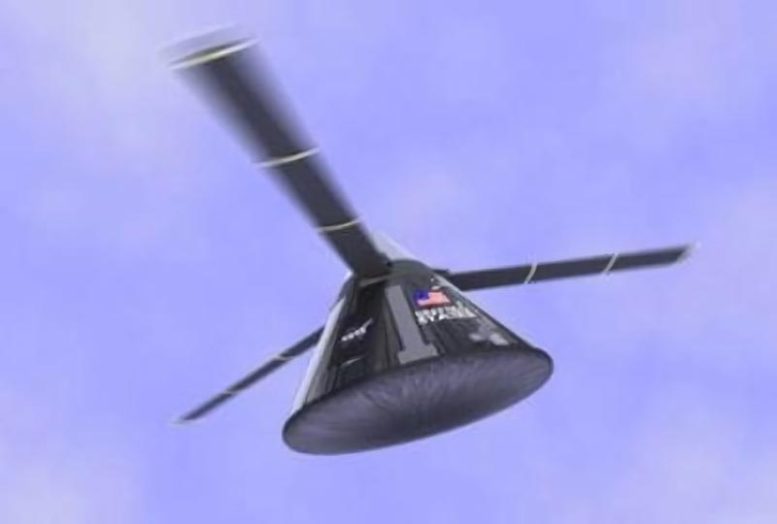
    An artist’s concept shows a capsule flying back to Earth with a rotor blade system instead of parachutes. The rotors deploy from the side of the capsule once the fall has slowed to subsonic speeds. Credit: NASA

    A team of researchers took their scale models of space capsules to the Vehicle Assembly Building (VAB) at NASA’s Kennedy Space Center in Florida in order to test out a new rotor system that could be used instead of parachutes when capsules perform their re-entry into the atmosphere.

    This design could give the capsule the stability and control of a helicopter, but it wouldn’t be powered. The wind passing over the rotors as the capsule descends would make the blades turn, which is known as auto-rotation and it has been proven repeatedly on helicopters, but has yet to be tried on spacecraft.

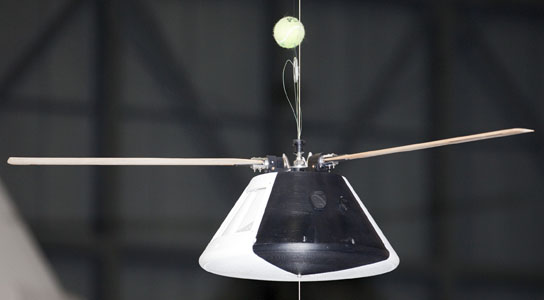
    The purpose of this test is to study how the rotor starts to spin, states Jeff Hagen, an engineer at Johnson Space Center in Houston. The test was carried out at the VAB, from atop the 16th level. The two-pound model capsule was hung on a line, 480 feet (146 meters) above the concrete floor. The radio-control unit allowed the scientists to change the rotor’s pitch and slowed the fall four times as an unpowered craft.
    Rotor Landing for Capsules
    A model capsule seen ahead of drop tests inside the Vehicle Assembly Building at NASA’s Kennedy Space Center in Florida to test a rotor system landing design. Credit: NASA/Kim Shiflett

    This could give real spacecraft a soft landing, with enough control so that they could touch down anywhere in the world, instead of the ocean. The landings would also be targeted. This system would also fit in nicely with spent rocket boosters, since the rotors could be built into the booster frame and unfurled as the stage descends to the surface. This would be controllable and the landing would save the engines.

    The development team had noted that some bombs have fins that flick open safely at high speeds. The returning spacecraft would use a similar mechanism to those fins. The biggest difference would be that the capsule’s blades would start spinning almost immediately.

    This idea isn’t new since NASA researchers worked on a similar concept for the Apollo capsule, but engineers opted for a parachute return in order to shorten development time. Further testing would involve taking prototype capsules high into the air with balloons and dropping them, as well as trying out small capsules to return samples from the ISS.

    Never miss a breakthrough: Join the SciTechDaily newsletter.
    Follow us on Google and Google News.

    Helicopter NASA
    Share. Facebook Twitter Pinterest LinkedIn Email Reddit

    Related Articles

    Robonaut 2: A Robotic Space Station Crew Member

    NASA Explores OMEGA System for Alternative Aviation Fuels

    NuSTAR’s 9,000 Mirrors are Only 200 Microns Thick

    NASA Engineers Test J-2X Powerpack

    SCaN Testbed Headed for International Space Station Later This Year

    NASA Searching for Green Propellant Technology

    NASA Mobile Launcher Reacted as Expected During Move to Launch Pad 39B

    NASA Reviews Ideas for Greener Aircraft

    E-volo Multicopter Defies Gravity and Flies

    6 Comments

    1. stephen pattison on October 29, 2012 12:17 pm

      wouldn’t capsule counter-rotate because unlike a helicopter the capsule doesn’t have a tail rotor , or something to stop this effect ?

      Reply
      • figmint on June 10, 2014 10:06 am

        No the counter rotation of a hellecopter comes from the force the engine putts on the rotors. And Thisbe the rotors put the same force on the fuselage. Given that the air is spinning the rotors in this example, the counter force is also applied to the air. Now friction between the cappsole and the rotors can result in spinning.

        Reply
      • Fred on November 8, 2015 5:02 am

        No because it’s not moved by an engine, they rotate by wind which does not generate torque so the body does not spin šŸ˜‰

        Reply
        • Wendell on November 17, 2015 8:07 am

          It does not matter where the thrust comes from. If you move the rotor with an external force, the capsule will tend to move in the same direction as the rotor due to friction.

          Reply
    2. Carl K. on January 2, 2014 5:50 pm

      It doesn’t require a tail rotor because it is gliding (unpowered auto-rotation). Since there is no onboard motor applying torque to the rotor, there is no counter rotation of the capsule. Same principle as an autogyro.

      Reply
    3. AlainL on November 8, 2015 4:53 am

      Very nice… NASA just re-discovered what a gyrocopter is… exists since the 20’s :0))))

      And is used on scores of recreational gyros since the 60’s :0)))

      Reply
    Leave A Reply Cancel Reply

    • Facebook
    • Twitter
    • Pinterest
    • YouTube

    Don't Miss a Discovery

    Subscribe for the Latest in Science & Tech!

    Trending News

    New Study Reveals Why Ozempic Works Better for Some People Than Others

    Climate Change Is Altering a Key Greenhouse Gas in a Way Scientists Didn’t Expect

    New Study Suggests Gravitational Waves May Have Created Dark Matter

    Scientists Discover Why the Brain Gets Stuck in Schizophrenia

    Scientists Engineer ā€œTumor-Eatingā€ Bacteria That Devour Cancer From Within

    Even ā€œFailedā€ Diets May Deliver Long-Term Health Gains, Study Finds

    NIH Scientists Discover Powerful New Opioid That Relieves Pain Without Dangerous Side Effects

    Collapsing Plasma May Hold the Key to Cosmic Magnetism

    Follow SciTechDaily
    • Facebook
    • Twitter
    • YouTube
    • Pinterest
    • Newsletter
    • RSS
    SciTech News
    • Biology News
    • Chemistry News
    • Earth News
    • Health News
    • Physics News
    • Science News
    • Space News
    • Technology News
    Recent Posts
    • Household Cats Could Hold the Secret to Fighting Breast Cancer
    • Scientists Say This Natural Hormone Reverses Obesity by Targeting the Brain
    • This 15,000-Year-Old Discovery Changes What We Know About Early Human Creativity
    • 35-Million-Year-Old Mystery: Strange Arachnid Discovered Preserved in Amber
    • Revolutionary Gas Turbine Generates Power Without Air Compression
    Copyright © 1998 - 2026 SciTechDaily. All Rights Reserved.
    • Science News
    • About
    • Contact
    • Editorial Board
    • Privacy Policy
    • Terms of Use

    Type above and press Enter to search. Press Esc to cancel.