
Close Menu
    Facebook X (Twitter) Instagram
    SciTechDaily
    • Biology
    • Chemistry
    • Earth
    • Health
    • Physics
    • Science
    • Space
    • Technology
    Facebook X (Twitter) Pinterest YouTube RSS
    SciTechDaily
    Home»Space»New Cassini Image of Saturn’s Rings and the Icy Moon Enceladus
    Space

    New Cassini Image of Saturn’s Rings and the Icy Moon Enceladus

    By SciTechDailyJune 27, 2016No Comments1 Min Read
    Facebook Twitter Pinterest Telegram LinkedIn WhatsApp Email Reddit
    Share
    Facebook Twitter LinkedIn Pinterest Telegram Email Reddit
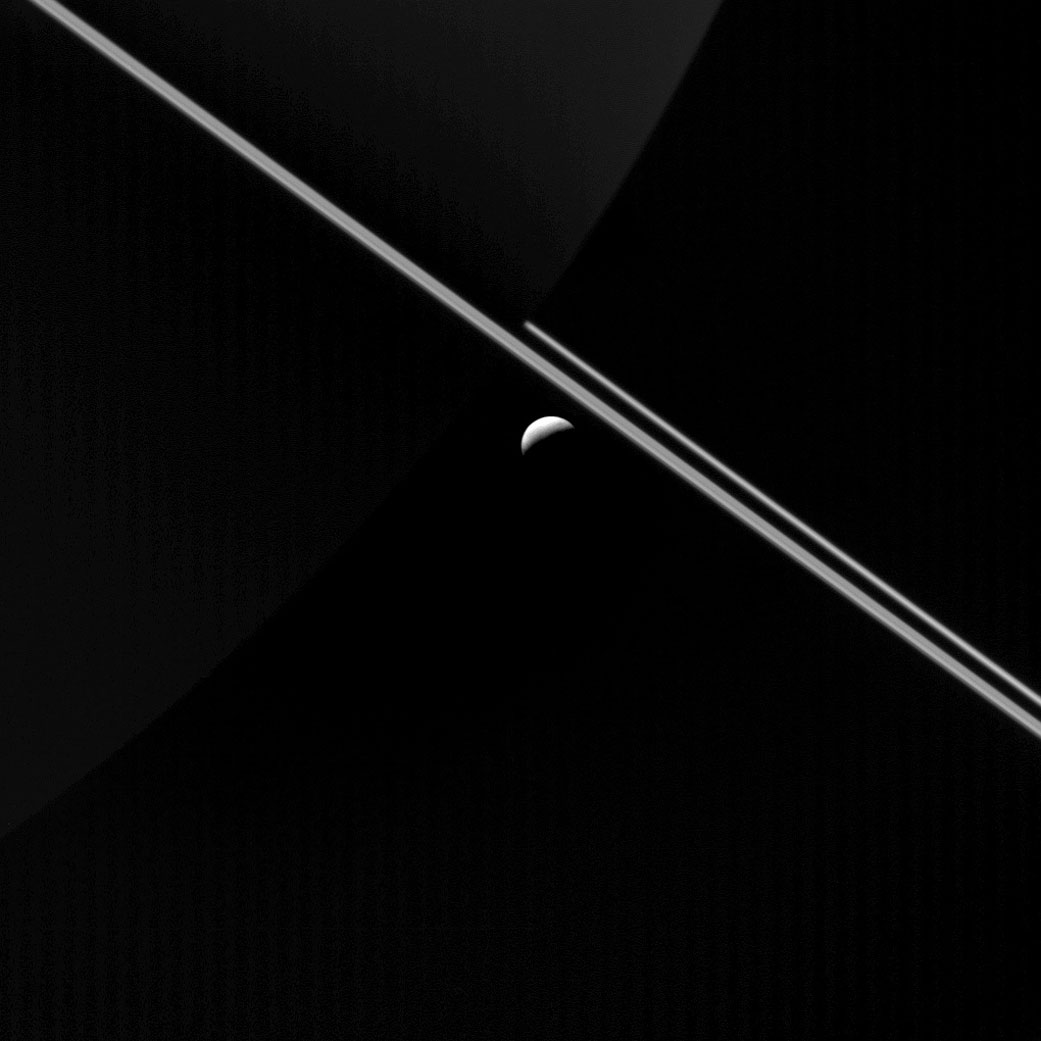
    Cassini Views Saturn's Rings and the Icy Moon Enceladus
    Saturn’s rings and the icy moon Enceladus. Credit: NASA/JPL-Caltech

    This newly released Cassini image shows Saturn’s rings and the icy moon Enceladus.

    At first glance, the most obvious features in this image from NASA’s Cassini spacecraft are Saturn’s rings and the icy moon Enceladus. Upon closer inspection, Saturn’s night side is also visible (near the top center), faintly illuminated by sunlight reflected off the rings.

    In this view, icy Enceladus (313 miles or 504 kilometers across) hangs in the space between Cassini and the giant planet.

    This view looks toward the sunlit side of the rings from 0.14 degrees above the ring plane. The image was taken in visible light with the Cassini spacecraft wide-angle camera on August 18, 2015.

    The view was acquired at a distance of approximately 87,000 miles (139,000 kilometers) from Enceladus. The image scale is 5 miles (8 kilometers) per pixel.

    Never miss a breakthrough: Join the SciTechDaily newsletter.
    Follow us on Google and Google News.

    Cassini-Huygens Mission Enceladus Planetary Science Saturn
    Share. Facebook Twitter Pinterest LinkedIn Email Reddit

    Related Articles

    Cassini Views Water Jets from Enceladus

    Cassini Views Dione and Enceladus

    Cassini’s Deepest-Ever Dive Through the Enceladus Plume

    NASA Prepares for Historic Flyby of Icy Saturn Moon Enceladus

    Cassini Spacecraft to Begin Flyby of Saturn’s Moon Enceladus

    Cassini Reveals Global Ocean in Saturn’s Moon Enceladus

    Activity on Enceladus Could Be ‘Curtain Eruptions’

    Astronomers Track Icy Tendrils Reaching into Saturn’s E Ring

    NASA Detects Ocean Inside Saturn’s Moon Enceladus

    Leave A Reply Cancel Reply

    • Facebook
    • Twitter
    • Pinterest
    • YouTube

    Don't Miss a Discovery

    Subscribe for the Latest in Science & Tech!

    Trending News

    Scientists May Have Solved a Long-Standing Melanoma Treatment Mystery

    This Flesh-Eating Fly Is Back in the U.S. – Scientists Are Tracking Where It Could Strike Next

    Scientists Have Uncovered a Troubling New Pattern Hidden in America’s Rivers

    “Entirely Surprising” – Scientists Have Found a Martian Meteorite Unlike Any Known Before

    “Find of the Year” – Archaeologists Discover the Smallest Ice Age Figurines Ever Found

    New Research Challenges Common Exercise Advice for Bone Health

    Avoiding These 3 Health Risks in Midlife Linked to 13 More Years Without Dementia

    Where Were All the Tiny Dinosaurs? Scientists May Finally Have an Answer

    Follow SciTechDaily
    • Facebook
    • Twitter
    • YouTube
    • Pinterest
    • Newsletter
    • RSS
    SciTech News
    • Biology News
    • Chemistry News
    • Earth News
    • Health News
    • Physics News
    • Science News
    • Space News
    • Technology News
    Recent Posts
    • FDA-Approved Drug Shows Promise for Reversing Osteoarthritis Damage
    • A 2-Billion-Year-Old Clue Challenges a Popular Earth Science Theory
    • Paleontologists Reconstruct 56-Million-Year-Old Forests – and Find a Chilling Warning for Today
    • Scientists Identify a Surprising 129-Day Limit for Predicting the Weather
    • The Ancient Mediterranean Diet Wasn’t What You Think
    Copyright © 1998 - 2026 SciTechDaily. All Rights Reserved.
    • Science News
    • About
    • Contact
    • Editorial Board
    • Privacy Policy
    • Terms of Use

    Type above and press Enter to search. Press Esc to cancel.