
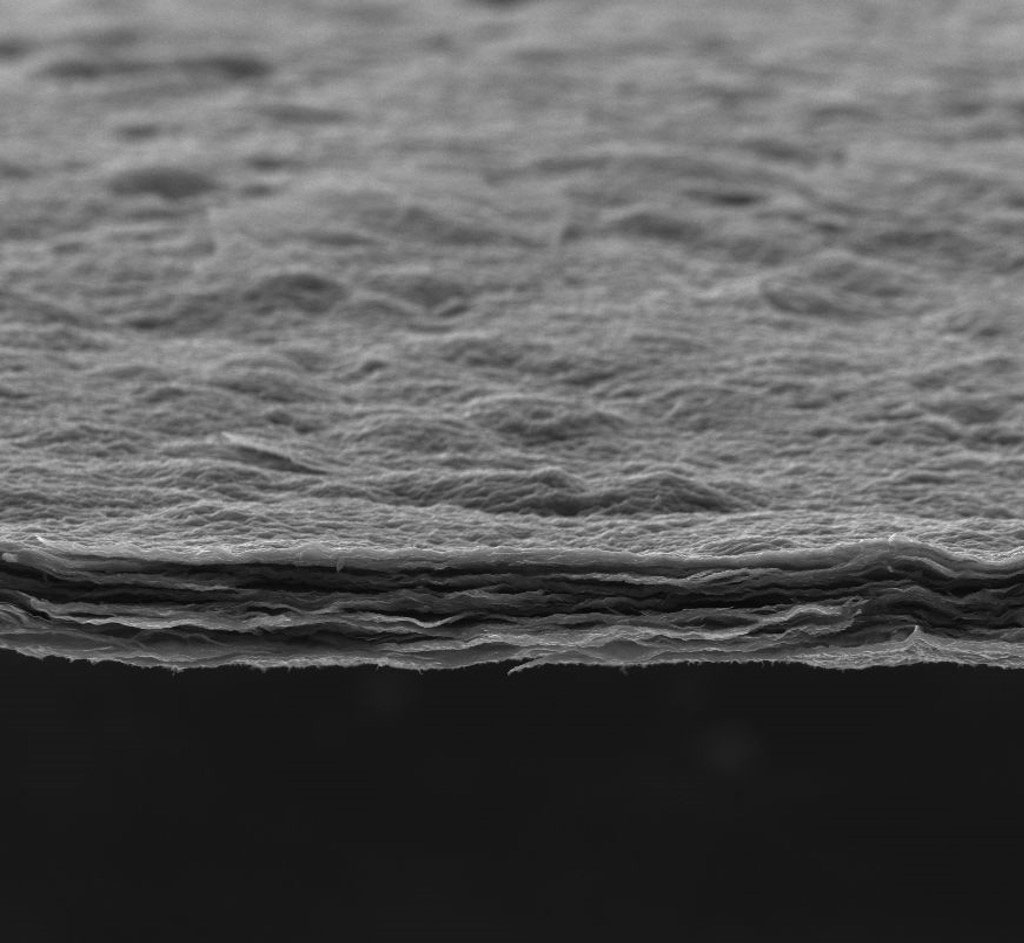
New research from Rice University reveals that graphene doped with nitrogen and augmented with cobalt atoms has proven to be an effective, durable catalyst for the production of hydrogen from water.
The Rice lab of chemist James Tour and colleagues at the Chinese Academy of Sciences, the University of Texas at San Antonio, and the University of Houston have reported the development of a robust, solid-state catalyst that shows promise to replace expensive platinum for hydrogen generation.
Catalysts can split water into its constituent hydrogen and oxygen atoms, a process required for fuel cells. The latest discovery, detailed in Nature Communications, is a significant step toward lower-cost catalysts for energy production, according to the researchers.
“What’s unique about this paper is that we show not the use of metal particles, not the use of metal nanoparticles, but the use of atoms,” Tour said. “The particles doing this chemistry are as small as you can possibly get.”
Even particles on the nanoscale work only at the surface, he said. “There are so many atoms inside the nanoparticle that never do anything. But in our process, the atoms driving catalysis have no metal atoms next to them. We’re getting away with very little cobalt to make a catalyst that nearly matches the best platinum catalysts.” In comparison tests, he said the new material nearly matched platinum’s efficiency to begin reacting at a low onset voltage, the amount of electricity it needs to begin separating water into hydrogen and oxygen.
The new catalyst is mixed as a solution and can be reduced to a paper-like material or used as a surface coating. Tour said single-atom catalysts have been realized in liquids, but rarely on a surface. “This way we can build electrodes out of it,” he said. “It should be easy to integrate into devices.”
The researchers discovered that heat-treating graphene oxide and small amounts of cobalt salts in a gaseous environment forced individual cobalt atoms to bind to the material.
Electron microscope images showed cobalt atoms widely dispersed throughout the samples.
They tested nitrogen-doped graphene on its own and found it lacked the ability to kick the catalytic process into gear. But adding cobalt in very small amounts significantly increased its ability to split acidic or basic water.
“This is an extremely high-performance material,” Tour said. He noted that platinum-carbon catalysts still boast the lowest onset voltage. “No question, they’re the best. But this is very close to it and much easier to produce and hundreds of times less expensive.”
Atom-thick graphene is the ideal substrate, Tour said, because of its high surface area, stability in harsh operating conditions, and high conductivity. Samples of the new catalyst showed a negligible decrease in activity after 10 hours of accelerated degradation studies in the lab.
Co-authors of the paper are Rice graduate students Huilong Fei and Gonglan Ye, postdoctoral researcher Nam Dong Kim, alumni Errol Samuel, and Zhiwei Peng, and Pulickel Ajayan, chair of the Department of Materials Science and NanoEngineering, the Benjamin M. and Mary Greenwood Anderson Professor in Engineering and a professor of chemistry at Rice; Juncai Dong and Dongliang Chen of the Beijing Synchrotron Radiation Facility at the Chinese Academy of Sciences, Beijing; research associate M. Josefina Arellano-Jiménez and José Yacamán, chairman of the Department of Physics, at the University of Texas at San Antonio; and graduate students Zhuan Zhu and Fan Qin and Jiming Bao, an associate professor of electrical and computer engineering, at the University of Houston.
Tour is the T.T. and W.F. Chao Chair in Chemistry as well as a professor of materials science and nanoengineering and of computer science.
The research was funded by the Air Force Office of Scientific Research Multidisciplinary University Research Initiative, the National Institute on Minority Health and Health Disparities from the National Institutes of Health, the Welch Foundation and the National Natural Science Foundation of China.
Reference: “Atomic cobalt on nitrogen-doped graphene for hydrogen generation” by Huilong Fei, Juncai Dong, M. Josefina Arellano-Jiménez, Gonglan Ye, Nam Dong Kim, Errol L.G. Samuel, Zhiwei Peng, Zhuan Zhu, Fan Qin, Jiming Bao, Miguel Jose Yacaman, Pulickel M. Ajayan, Dongliang Chen and James M. Tour, 21 October 2015, Nature Communications.
DOI: 10.1038/ncomms9668
Never miss a breakthrough: Join the SciTechDaily newsletter.
Follow us on Google and Google News.
1 Comment
Let’s see, for 10+ years now, we’ve been hearing about all the revolutionary things graphene will do for us. As of today, we have *zero* products with graphene in them revolutionizing the world.
You’ll have to forgive me for being unimpressed.