
Close Menu
    Facebook X (Twitter) Instagram
    SciTechDaily
    • Biology
    • Chemistry
    • Earth
    • Health
    • Physics
    • Science
    • Space
    • Technology
    Facebook X (Twitter) Pinterest YouTube RSS
    SciTechDaily
    Home»Space»New Method for Measuring Black Hole Spin Could Provide a Greater Understanding of Galaxy Growth
    Space

    New Method for Measuring Black Hole Spin Could Provide a Greater Understanding of Galaxy Growth

    By Royal Astronomical SocietyJuly 30, 2013No Comments4 Mins Read
    Facebook Twitter Pinterest Telegram LinkedIn WhatsApp Email Reddit
    Share
    Facebook Twitter LinkedIn Pinterest Telegram Email Reddit
    Astronomers Discover New Way of Measuring the Spin in Supermassive Black Holes
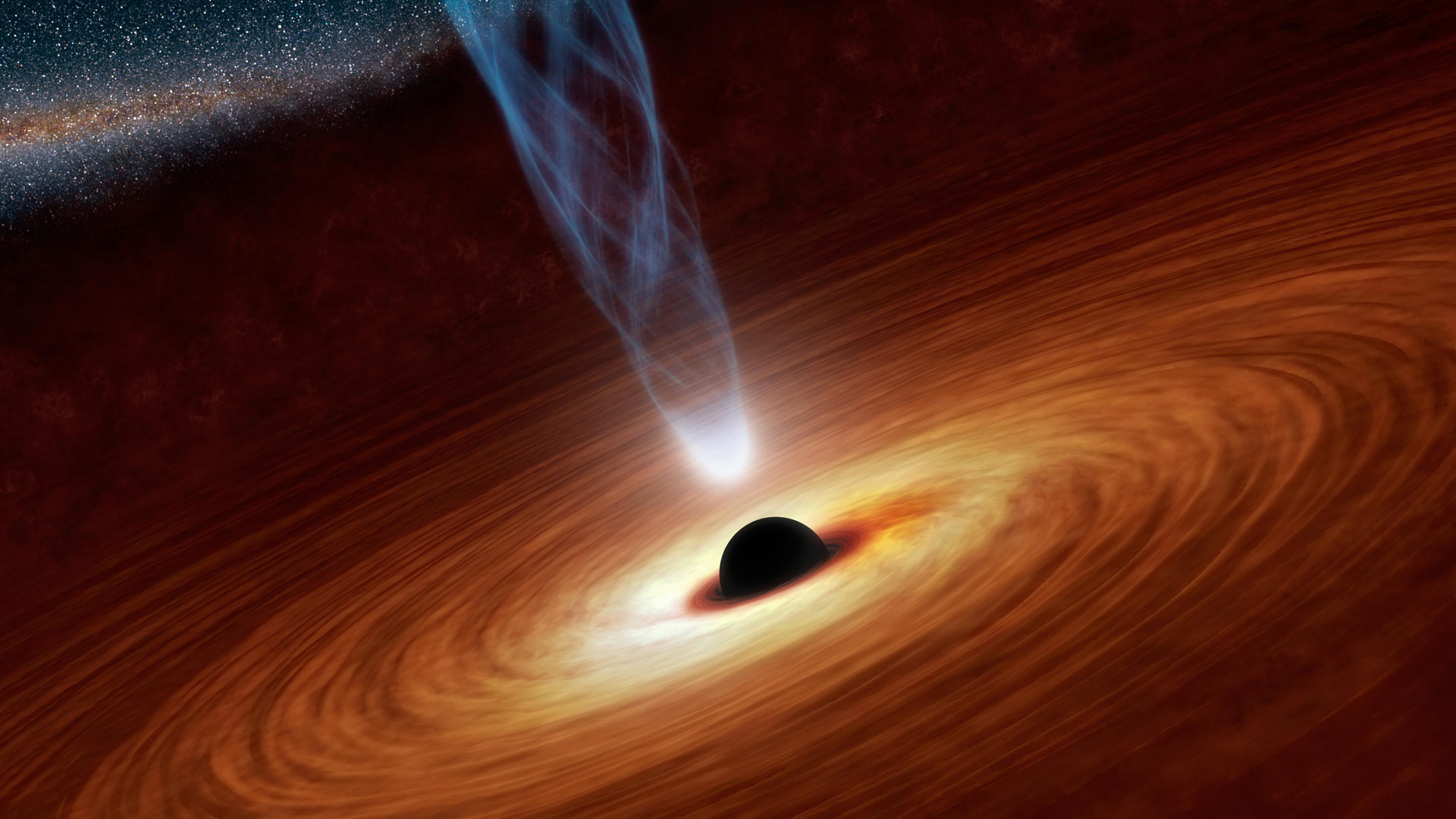
    An artist’s impression of a supermassive black hole at the center surrounded by matter flowing onto the black hole in what is termed an accretion disk. Also shown is an outflowing jet of energetic particles, believed to be powered by the black hole’s spin. Credit: NASA/JPL-Caltech.

    By being able to measure the distance between the black hole and the accretion disc, astronomers have developed a new method for measuring spin in black holes that could lead to a greater understanding of galaxy growth.

    Astronomers have found a new way of measuring the spin in supermassive black holes, which could lead to a better understanding of how they drive the growth of galaxies. The scientists at Durham University, UK, publish their work in a paper in the Oxford University Press journal Monthly Notices of the Royal Astronomical Society.

    The team of astronomers observed a black hole – with a mass 10 million times that of our Sun – at the center of a spiral galaxy 500 million light-years from Earth while it was feeding on the surrounding disc of material that fuels its growth and powers its activity.

    By viewing optical, ultra-violet, and soft X-rays generated by heat as the black hole fed, they were able to measure how far the disc was from the black hole.

    This distance depends on black hole spin as a fast spinning black hole pulls the disc in closer to itself, the researchers said. Using the distance between the black hole and the disc, the scientists were able to estimate the spin of the black hole.

    The scientists said that understanding spin could lead to a greater understanding of galaxy growth over billions of years.

    Black holes lie at the centers of almost all galaxies, and can spit out incredibly hot particles at high energies that prevent intergalactic gases from cooling and forming new stars in the outer galaxy. Scientists don’t yet understand why the jets are ejected into space, but the Durham experts believe that their power could be linked to the spin of the black hole. This spin is difficult to measure as it only affects the behavior of material really close to the black hole.

    Lead researcher Professor Chris Done, in the Department of Physics, at Durham University, said: “We know the black hole in the center of each galaxy is linked to the galaxy as a whole, which is strange because black holes are tiny in relation to the size of a galaxy. This would be like something the size of a large boulder (10m), influencing something the size of the Earth.

    “Understanding this connection between stars in a galaxy and the growth of a black hole, and vice-versa, is the key to understanding how galaxies form throughout cosmic time.

    “If a black hole is spinning it drags space and time with it and that drags the accretion disc, containing the black hole’s food, closer towards it. This makes the black hole spin faster, a bit like an ice skater doing a pirouette.

    “By being able to measure the distance between the black hole and the accretion disc, we believe we can more effectively measure the spin of black holes.

    “Because of this, we hope to be able to understand more about the link between black holes and their galaxies.”

    The Durham scientists were able to measure the spin of the black hole using soft X-ray, optical, and ultra-violet images captured by the European Space Agency’s XMM-Newton satellite.

    Reference: “A new way to measure supermassive black hole spin in accretion disc-dominated active galaxies” by Chris Done, C. Jin, M. Middleton and Martin Ward, 26 July 2013, Monthly Notices of the Royal Astronomical Society.
    DOI: 10.1093/mnras/stt1138
    arXiv:1306.4786

    Never miss a breakthrough: Join the SciTechDaily newsletter.
    Follow us on Google and Google News.

    Astronomy Astrophysics Black Hole Durham University Popular Royal Astronomical Society
    Share. Facebook Twitter Pinterest LinkedIn Email Reddit

    Related Articles

    The Center of Our Galaxy May Not Be a Black Hole

    Breaking a 50-Year Law: New Evidence Challenges Fundamental Black Hole Physics

    Astronomers Spot Possible Biggest Black Hole in the Universe

    Astronomers Discover Rapidly Growing Black Hole in Extreme Galaxy in the Very Early Universe

    Black Hole at Center of Milky Way Is Unpredictable and Chaotic – Mysterious Flares Erupt Every Day

    Artificial Intelligence Helps Resolve Long-Running Astrophysics Debate on Supermassive Black Holes

    New Research Finds That Supermassive Black Holes Could Form From Dark Matter

    First Confirmed Heartbeat of a Supermassive Black Hole Is Still Beating

    NASA’s NuSTAR Identifies Its First Ten Supermassive Black Holes

    Leave A Reply Cancel Reply

    • Facebook
    • Twitter
    • Pinterest
    • YouTube

    Don't Miss a Discovery

    Subscribe for the Latest in Science & Tech!

    Trending News

    Why Popular Diabetes Drugs Like Ozempic Don’t Work for Everyone: The “Genetic Glitch”

    Scientists Stunned After Finding Plant Thought Extinct for 60 Years

    Scientists Discover Tiny New Spider That Hunts Prey 6x Its Size

    Natural Component From Licorice Shows Promise for Treating Inflammatory Bowel Disease

    Scientists Warn: Popular Sweetener Linked to Dangerous Metabolic Effects

    Monster Storms on Jupiter Unleash Lightning Beyond Anything on Earth

    Scientists Create “Liquid Gears” That Spin Without Touching

    The Simple Habit That Could Help Prevent Cancer

    Follow SciTechDaily
    • Facebook
    • Twitter
    • YouTube
    • Pinterest
    • Newsletter
    • RSS
    SciTech News
    • Biology News
    • Chemistry News
    • Earth News
    • Health News
    • Physics News
    • Science News
    • Space News
    • Technology News
    Recent Posts
    • Ancient Bacteria Turned a DNA System Into a Cell Skeleton
    • Researchers Finally Solve 50-Year-Old Blood Group Mystery
    • Scientists Discover “Molecular Switch” That Fuels Alzheimer’s Brain Inflammation
    • Hidden Ocean Currents Revealed in Stunning Detail by AI
    • Trees Emit Tiny Lightning Flashes During Storms and Scientists Finally Prove It
    Copyright © 1998 - 2026 SciTechDaily. All Rights Reserved.
    • Science News
    • About
    • Contact
    • Editorial Board
    • Privacy Policy
    • Terms of Use

    Type above and press Enter to search. Press Esc to cancel.