
Close Menu
    Facebook X (Twitter) Instagram
    SciTechDaily
    • Biology
    • Chemistry
    • Earth
    • Health
    • Physics
    • Science
    • Space
    • Technology
    Facebook X (Twitter) Pinterest YouTube RSS
    SciTechDaily
    Home»Space»New VLT Image Shows Star Cluster NGC 6193 and Nebula NGC 6188
    Space

    New VLT Image Shows Star Cluster NGC 6193 and Nebula NGC 6188

    By European Southern ObservatoryMarch 17, 2015No Comments3 Mins Read
    Facebook Twitter Pinterest Telegram LinkedIn WhatsApp Email Reddit
    Share
    Facebook Twitter LinkedIn Pinterest Telegram Email Reddit
    New Image of the Ara OB1 Stellar Association
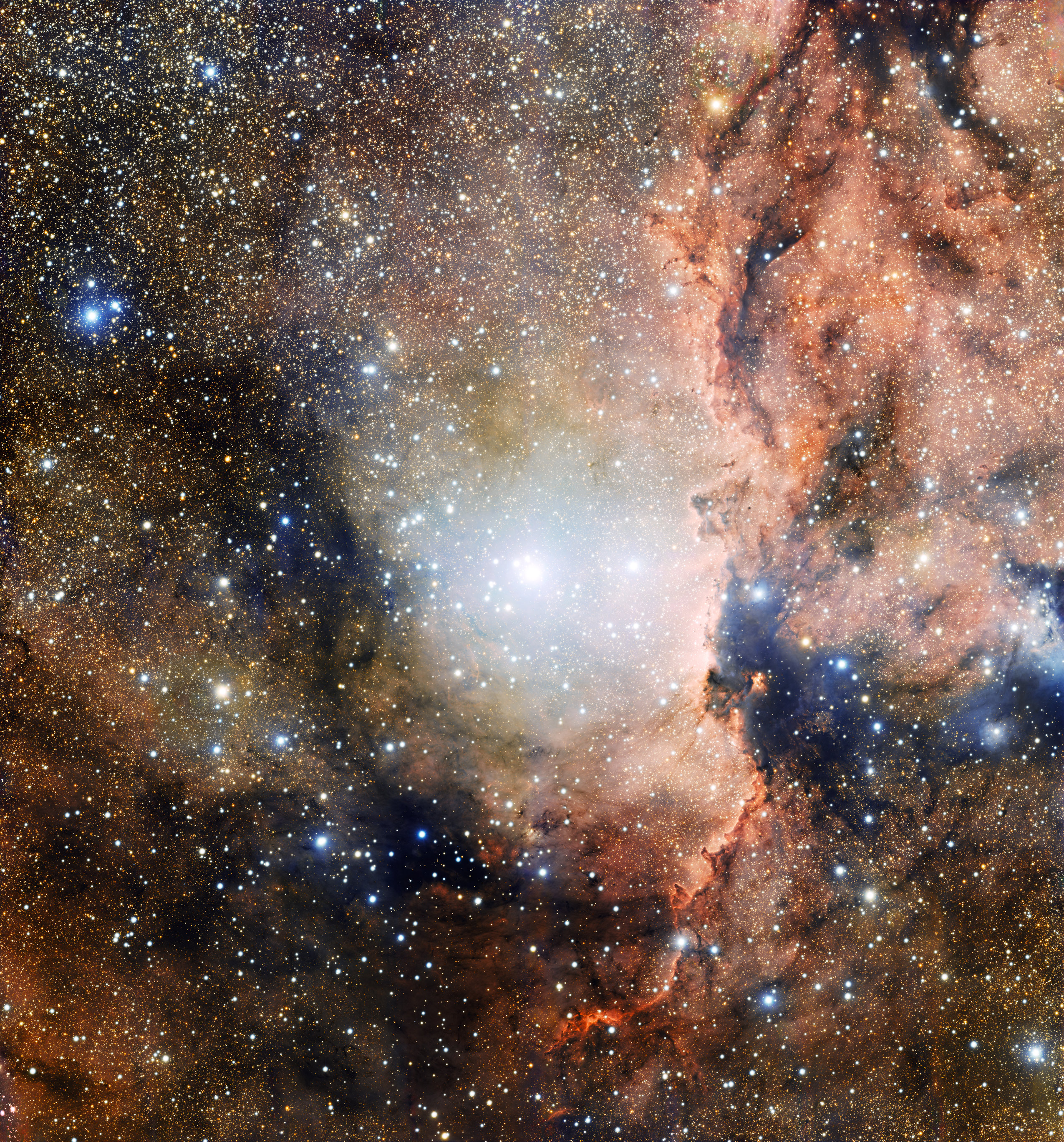
    This image, taken by OmegaCAM on the VLT Survey Telescope at Paranal Observatory, shows a section of the Ara OB1 stellar association. Credit: ESO

    This newly released image from the VLT Survey Telescope shows the young open cluster NGC 6193 in the center, and the emission nebula NGC 6188 to the right.

    This dramatic landscape in the southern constellation of Ara (The Altar) is a treasure trove of celestial objects. Star clusters, emission nebulae, and active star-forming regions are just some of the riches observed in this region lying some 4,000 light-years from Earth. This beautiful new image is the most detailed view of this part of the sky so far, and was taken using the VLT Survey Telescope at ESO’s Paranal Observatory in Chile.

    At the center of the image is the open star cluster NGC 6193, containing around thirty bright stars and forming the heart of the Ara OB1 association. The two brightest stars are very hot giant stars. Together, they provide the main source of illumination for the nearby emission nebula, the Rim Nebula, or NGC 6188, which is visible to the right of the cluster.

    A stellar association is a large grouping of loosely bound stars that have not yet completely drifted away from their initial formation site. OB associations consist largely of very young blue–white stars, which are about 100,000 times brighter than the Sun and between 10 and 50 times more massive.

    The Rim Nebula is the prominent wall of dark and bright clouds marking the boundary between an active star-forming region within the molecular cloud, known as RCW 108, and the rest of the association [1]. The area around RCW 108 is made up of mostly hydrogen — the primary ingredient in star formation. Such areas are also known as H II regions.

    The ultraviolet radiation and intense stellar wind from the stars of NGC 6193 seem to be driving the next generation of star formation in the surrounding clouds of gas and dust. As cloud fragments collapse they heat up and eventually form new stars.

    As the cloud creates new stars, it is simultaneously being eroded by the winds and radiation emitted by previous stars, and by violent supernova explosions. In this way, such star-forming H II regions tend to have a lifespan of just a few million years. Star formation is a very inefficient process, with only around 10% of the available material contributing to the process — the rest is blown off into space.

    The Rim Nebula also shows signs of being in the early phase of “pillar formation”, meaning that in the future it could end up looking similar to other well-known star-forming regions, such as the Eagle Nebula (Messier 16, containing the famous Pillars of Creation) and the Cone Nebula (part of NGC 2264).

    This single spectacular image was actually created from more than 500 individual pictures taken through four different color filters with the VLT Survey Telescope. The total exposure time was more than 56 hours. It is the most detailed view of this region yet achieved.

    Notes

    [1] Furthermore, this nebula has additional modest fame among astronomers, as a previous image was used as the cover of the DVD distribution of the collection of software for astronomers assembled by ESO: Scisoft, whose newest version was released a few weeks ago. It is therefore also known as the Scisoft Nebula.

    Never miss a breakthrough: Join the SciTechDaily newsletter.
    Follow us on Google and Google News.

    Astronomy European Southern Observatory Very Large Telescope
    Share. Facebook Twitter Pinterest LinkedIn Email Reddit

    Related Articles

    Pinwheel Firework: Stunning Telescope Image Captures Grand Design Spiral Galaxy

    Astronomers Discover Micronovae: A New Kind of Thermonuclear Stellar Explosion

    New Planet Discovered Next Door – Orbiting Proxima Centauri

    Mysterious Galactic Nomads: At Least 70 Rogue Planets Uncovered in Our Milky Way

    Surprise Planet Discovered Around Extreme Star Pair

    Supermassive Black Holes on a Collision Course: Closest Pair of Supermassive Black Holes to Earth Ever Discovered

    Strange 160 Mile-Long “Dog-Bone” Asteroid Kleopatra Captured in Detailed Images

    Astronomers Find Small Rocky Planet – Just Half the Mass of Venus

    Stunning Galactic Fireworks: New ESO Images Reveal Spectacular Features of Nearby Galaxies

    Leave A Reply Cancel Reply

    • Facebook
    • Twitter
    • Pinterest
    • YouTube

    Don't Miss a Discovery

    Subscribe for the Latest in Science & Tech!

    Trending News

    Breakthrough Bowel Cancer Trial Leaves Patients Cancer-Free for Nearly 3 Years

    Natural Compound Shows Powerful Potential Against Rheumatoid Arthritis

    100,000-Year-Old Neanderthal Fossils in Poland Reveal Unexpected Genetic Connections

    Simple “Gut Reset” May Prevent Weight Gain After Ozempic or Wegovy

    2.8 Days to Disaster: Scientists Warn Low Earth Orbit Could Suddenly Collapse

    Common Food Compound Shows Surprising Power Against Superbugs

    5 Simple Ways To Remember More and Forget Less

    The Atomic Gap That Could Cost the Semiconductor Industry Billions

    Follow SciTechDaily
    • Facebook
    • Twitter
    • YouTube
    • Pinterest
    • Newsletter
    • RSS
    SciTech News
    • Biology News
    • Chemistry News
    • Earth News
    • Health News
    • Physics News
    • Science News
    • Space News
    • Technology News
    Recent Posts
    • Scientists Discover Stem Cells That Could Regrow Teeth and Bone
    • Scientists Discover Natural Molecule That Stops Alzheimer’s Protein Clumps From Forming
    • Early Cannabis Use May Stall Key Brain Skills in Teens
    • Popular Vitamin D Supplement Has “Previously Unknown” Negative Effect, Study Finds
    • Powerful Antioxidant Found To Play a Key Role in Proper Protein Folding
    Copyright © 1998 - 2026 SciTechDaily. All Rights Reserved.
    • Science News
    • About
    • Contact
    • Editorial Board
    • Privacy Policy
    • Terms of Use

    Type above and press Enter to search. Press Esc to cancel.