
Close Menu
    Facebook X (Twitter) Instagram
    SciTechDaily
    • Biology
    • Chemistry
    • Earth
    • Health
    • Physics
    • Science
    • Space
    • Technology
    Facebook X (Twitter) Pinterest YouTube RSS
    SciTechDaily
    Home»Space»Rosetta Image Reveals Increased Activity on Comet 67P
    Space

    Rosetta Image Reveals Increased Activity on Comet 67P

    By Dr. Tony Phillips, Science@NASANovember 3, 20143 Comments3 Mins Read
    Facebook Twitter Pinterest Telegram LinkedIn WhatsApp Email Reddit
    Share
    Facebook Twitter LinkedIn Pinterest Telegram Email Reddit
    New Rosetta Image of Comet 67P
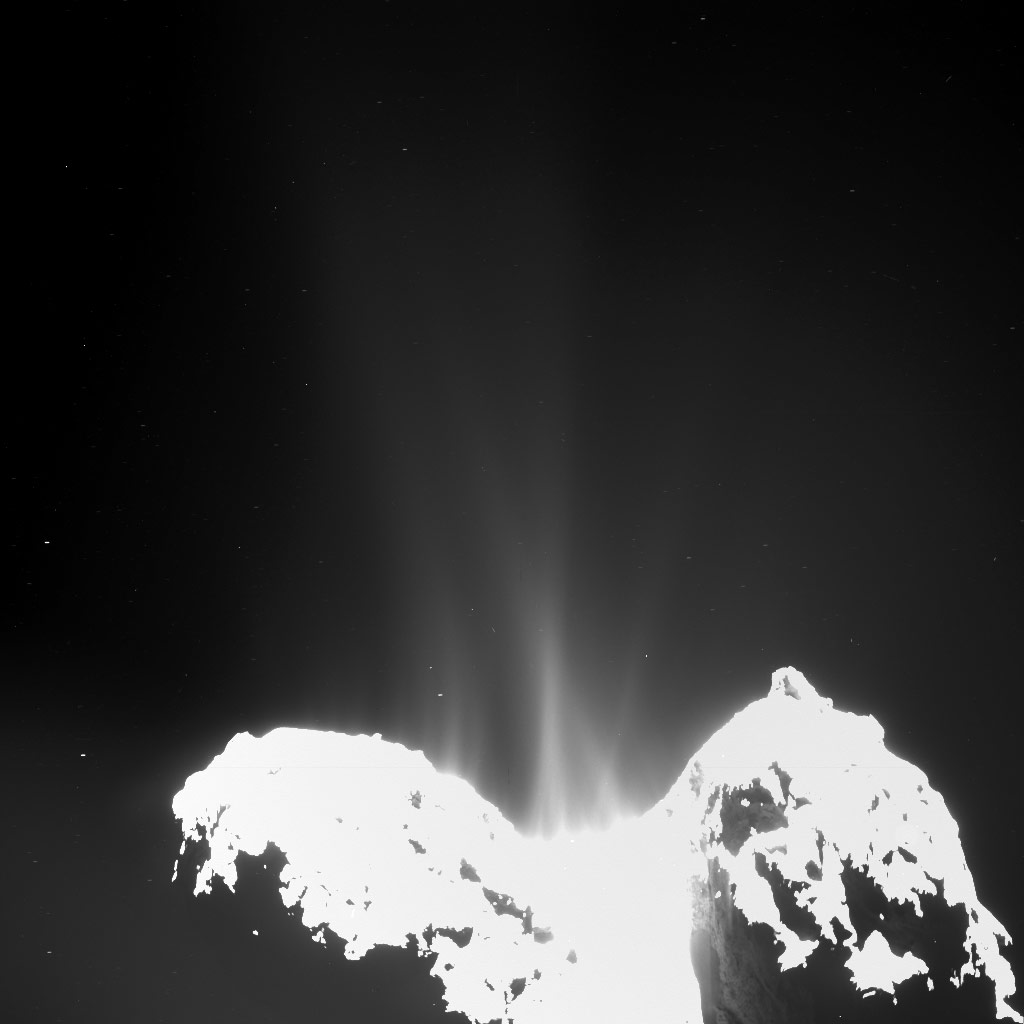
    This image of comet 67P/Churyumov-Gerasimenko, taken by Rosetta’s Optical, Spectroscopic, and Infrared Remote Imaging System (OSIRIS) on September 10, from a distance of 4.5 miles (7.2 kilometers), shows jets of dust and gas streaming into space from the neck of the comet’s nucleus. Credit: ESA/Rosetta/MPS/UPD/LAM/IAA/SSO/INTA/UPM/DASP/IDA

    As ESA’s Philae lander prepares for its November 12th landing on Comet 67P/Churyumov-Gerasimenko, the comet is showing signs of increased activity.

    Images of the comet nucleus, taken by Rosetta earlier in the summer, showed that the distinct jets of dust and gas emanating from the comet were originated from the neck region, which connects the comet’s two lobes. Images obtained by OSIRIS (Rosetta’s Optical, Spectroscopic, and Infrared Remote Imaging System) now show jets of dust along almost the entire length of the comet.

    Rosetta and Comet 67P are still more than 280 million miles (450 million kilometers) from the sun. Based on a rich history of ground-based observations, scientists have been expecting the comet’s activity to pick up noticeably once it comes within 186 million miles (300 million kilometers).

    On November 12, the Rosetta spacecraft will release its Philae lander at 3:03 a.m. EST / 1:03 a.m. PST (Earth Receive Time). Touchdown of Philae on Site J is expected about seven hours later, at around 11 a.m. EST / 8 a.m. PST. Rosetta is the first mission to attempt a soft landing on a comet.


    A simulated video of Philae touching down on Comet 67P. Credit: ESA

    While 67P’s overall activity is clearly increasing, the mission’s designated landing site, “J,” located on the head of the comet, still seems to be rather quiet. However, there is some indication that new active areas are waking up about half a mile (one kilometer) from J. These will allow the lander’s instruments to study the comet’s activity from an even closer distance.

    Launched in March 2004, Rosetta was reactivated in January 2014 after a record 957 days in hibernation. Composed of an orbiter and lander, Rosetta’s objectives since arriving at comet 67P/Churyumov-Gerasimenko earlier this month have been to study the celestial object up close in unprecedented detail, prepare for landing a probe on the comet’s nucleus in November and, following the landing, track the comet’s changes as it sweeps past the sun.

    Rosetta is a European Space Agency mission with contributions from its member states and NASA. Rosetta’s Philae lander is provided by a consortium led by the German Aerospace Center, Cologne; Max Planck Institute for Solar System Research, Gottingen; National Center of Space Studies of France (CNES), Paris; and the Italian Space Agency, Rome. NASA’s Jet Propulsion Laboratory in Pasadena, California, a division of the California Institute of Technology, manages the U.S. participation in the Rosetta mission for NASA’s Science Mission Directorate in Washington.

    Never miss a breakthrough: Join the SciTechDaily newsletter.
    Follow us on Google and Google News.

    Astronomy Comet Rosetta Spacecraft
    Share. Facebook Twitter Pinterest LinkedIn Email Reddit

    Related Articles

    Philae Lander Makes Soft Landing on Comet 67P

    Rosetta Spacecraft Picks Up a Mysterious “Song” From Comet 67P

    How to Land on a Comet Moving 40 Times Faster Than a Speeding Bullet

    A Close Up View of the Primary Landing Site on Comet 67P

    Rosetta “Selfie” with Comet 67P/Churyumov–Gerasimenko in the Background

    Astronomers Choose Primary Landing Site for Rosetta’s Lander

    Rosetta Orbiter Delivers First Batch of Science Data

    ESA Identifies Five Candidate Landing Sites on Comet 67P

    New Rosetta Image of 67P/Churyumov-Gerasimenko

    3 Comments

    1. Doncville on November 3, 2014 11:15 am

      Say hello to the electric comet age

      Reply
    2. Yarply on November 3, 2014 11:39 am

      I’ve seen pics of this comet and it looks like a big dry rock to me. also those jets are not acting as vapor and dust would.

      Reply
    3. vernon cunningham on November 3, 2014 11:46 am

      I wonder about the source of the physical activity on this comet. Since there seems to be a “neck” section and the two parts may not be identical matter, Is it possible that at some part the sections will be weakened at the point of joining, and separate into two bodies? That would be interesting to see.

      Reply
    Leave A Reply Cancel Reply

    • Facebook
    • Twitter
    • Pinterest
    • YouTube

    Don't Miss a Discovery

    Subscribe for the Latest in Science & Tech!

    Trending News

    Popular Sugar-Free Sweetener Linked to Liver Disease, Study Warns

    What Is Hantavirus? The Deadly Disease Raising Alarm Worldwide

    Scientists Just Discovered How the Universe Builds Monster Black Holes

    Scientists Unveil New Treatment Strategy That Could Outsmart Cancer

    A Simple Vitamin May Hold the Key to Treating Rare Genetic Diseases

    Scientists Think the Real Fountain of Youth May Be Hiding in Your Gut

    Ravens Don’t Follow Wolves, They Predict Them

    This Common Knee Surgery May Be Doing More Harm Than Good

    Follow SciTechDaily
    • Facebook
    • Twitter
    • YouTube
    • Pinterest
    • Newsletter
    • RSS
    SciTech News
    • Biology News
    • Chemistry News
    • Earth News
    • Health News
    • Physics News
    • Science News
    • Space News
    • Technology News
    Recent Posts
    • You May Have a Dangerous Type of Cholesterol Even if Your Tests Look Normal
    • Study Reveals Dangerous Flaw in AI Symptom Checkers
    • New MRI Breakthrough Captures Stunningly Clear Images of the Eye and Brain
    • Scientists Warn Sitting Too Much Can Harm Your Body in Surprising Ways
    • Your Blood Pressure Reading Could Be Wrong Because of One Simple Mistake
    Copyright © 1998 - 2026 SciTechDaily. All Rights Reserved.
    • Science News
    • About
    • Contact
    • Editorial Board
    • Privacy Policy
    • Terms of Use

    Type above and press Enter to search. Press Esc to cancel.