
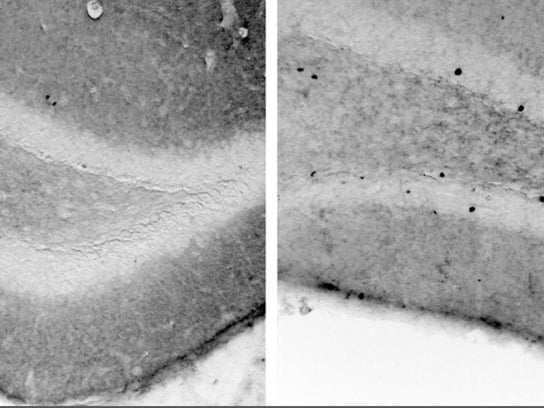
In a new study, neuroscientists examine how individual experiences influence the development of new neurons, leading to measurable changes in the brains of mice.
How do organisms evolve into individuals that are distinguished from others by their own personal brain structure and behavior? Scientists in Dresden, Berlin, Münster, and Saarbrücken have now taken a decisive step towards clarifying this question. Using mice as an animal model, they were able to show that individual experiences influence the development of new neurons, leading to measurable changes in the brain. The results of this study are published in Science on May 10th. The DFG-Center for Regenerative Therapies Dresden – Cluster of Excellence at the TU Dresden (CRTD), the Dresden site of the German Center for Neurodegenerative Diseases (DZNE), and the Max Planck Institute for Human Development in Berlin played a pivotal role in the study.
The adult brain continues to grow with the challenges that it faces; its changes are linked to the development of personality and behavior. But what is the link between individual experience and brain structure? Why do identical twins not resemble each other perfectly even when they grew up together? To shed light on these questions, the scientists observed forty genetically identical mice that were kept in an enclosure offering a large variety of activity and exploration options.
The animals were not only genetically identical, they were also living in the same environment,” explains principal investigator Gerd Kempermann, Professor for Genomics of Regeneration, CRTD, and site speaker of the DZNE in Dresden. “However, this environment was so rich that each mouse gathered its own individual experiences in it. Over time, the animals therefore increasingly differed in their realm of experience and behavior.”
New neurons for individualized brains
Each of the mice was equipped with a special micro-chip emitting electromagnetic signals. This allowed the scientists to reconstruct the mice’s movement profiles and quantify their exploratory behavior. The result: Despite a common environment and identical genes the mice showed highly individualized behavioral patterns. They reacted to their environment differently. In the course of the three-month experiment, these differences increased in size.
Though the animals shared the same life space, they increasingly differed in their activity levels. These differences were associated with differences in the generation of new neurons in the hippocampus, a region of the brain that supports learning and memory,” says Kempermann. “Animals that explored the environment to a greater degree also grew more new neurons than animals that were more passive.”
Adult neurogenesis, that is, the generation of new neurons in the hippocampus, allows the brain to react to new information flexibly. With this study, the authors show for the first time that personal experiences and ensuing behavior contribute to the „individualization of the brain.“ The individualization they observed cannot be reduced to differences in environment or genetic makeup.
Adult neurogenesis also occurs in the hippocampus of humans,” says Kempermann. “Hence we assume that we have tracked down a neurobiological foundation for individuality that also applies to humans.”
Impulses for discussion across disciplines
The finding that behavior and experience contribute to differences between individuals has implications for debates in psychology, education science, biology, and medicine,“ states Prof. Ulman Lindenberger, Director of the Center for Lifespan Psychology at the Max Planck Institute for Human Development (MPIB) in Berlin. “Our findings show that development itself contributes to differences in adult behavior. This is what many have assumed, but now there is direct neurobiological evidence in support of this claim. Our results suggest that experience influences the aging of the human mind.“
In the study, a control group of animals housed in a relatively unattractive enclosure was also examined; on average, neurogenesis in these animals was lower than in the experimental mice. „When viewed from educational and psychological perspectives, the results of our experiment suggest that an enriched environment fosters the development of individuality,“ comments Lindenberger.
Interdisciplinary Teamwork
The study is also an example of multidisciplinary cooperation — it was made possible because neuroscientists, ethologists, computer scientists, and developmental psychologists collaborated closely in designing the experimental set-up and applying new data analysis methods. Biologist Julia Freund from the CRTD Dresden and computer scientist Dr. Andreas Brandmaier from the MPIB in Berlin share the first authorship on the article. In addition to the DZNE, CRTD, and the MPIB, the German Research Center for Artificial Intelligence in Saarbrücken the Institute for Geoinformatics, and the Department of Behavioural Biology at the University of Münster were also involved in this project.
Reference: “Emergence of Individuality in Genetically Identical Mice” by Julia Freund, Andreas M. Brandmaier, Lars Lewejohann, Imke Kirste, Mareike Kritzler, Antonio Krüger, Norbert Sachser, Ulman Lindenberger and Gerd Kempermann, 10 May 2013, Science.
DOI: 10.1126/science.1235294
Never miss a breakthrough: Join the SciTechDaily newsletter.
Follow us on Google and Google News.