

Close Menu
    Facebook X (Twitter) Instagram
    SciTechDaily
    • Biology
    • Chemistry
    • Earth
    • Health
    • Physics
    • Science
    • Space
    • Technology
    Facebook X (Twitter) Pinterest YouTube RSS
    SciTechDaily
    Home»Biology»Study Suggests Europeans Are Closely Related
    Biology

    Study Suggests Europeans Are Closely Related

    By UC DavisMay 8, 20131 Comment4 Mins Read
    Facebook Twitter Pinterest Telegram LinkedIn WhatsApp Email Reddit
    Share
    Facebook Twitter LinkedIn Pinterest Telegram Email Reddit
    Genetics Genome Sequence Map
    A recent study shows that Europeans are closely related genealogically, with everyone in Europe tracing back to the same ancestors about a thousand years ago. This finding suggests that Europeans are essentially one big family.

    A newly published study suggests that Europeans are closely related, finding on a genealogical level that everyone in Europe traces back to nearly the same set of ancestors only a thousand years ago.

    From Ireland to the Balkans, Europeans are basically one big family, closely related to one another for the past thousand years, according to a new study of the DNA of people from across the continent.
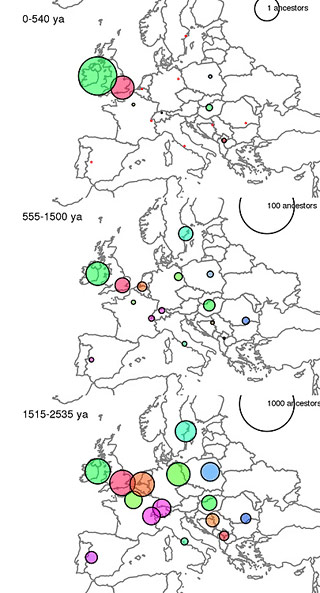
    Geography of Recent Genetic Ancestry Across Europe
    These maps show where the distant cousins of modern-day people in the United Kingdom live, (top being most recent). Bigger circles mean more ancestors. Credit: Peter Ralph/USC and Graham Coop/UC Davis

    The study, co-authored by Graham Coop, a professor of evolution and ecology at the University of California, Davis, is published on May 7 in the journal PLoS Biology.

    “What’s remarkable about this is how closely everyone is related to each other. On a genealogical level, everyone in Europe traces back to nearly the same set of ancestors only a thousand years ago,” Coop said.

    “This was predicted in theory over a decade ago, and we now have concrete evidence from DNA data,” Coop said, adding that such close kinship likely exists in other parts of the world as well.

    Coop and co-author Peter Ralph, now a professor at the University of Southern California, set out to study relatedness among Europeans in recent history, up to about 3,000 years ago. Drawing on the Population Reference Sample (POPRES) database, a resource for population and genetics research, they compared genetic sequences from more than 2,000 individuals.

    As expected, Coop and Ralph found that the degree of genetic relatedness between two people tends to be smaller the farther apart they live. But even a pair of individuals who live as far apart as the United Kingdom and Turkey — a distance of some 2,000 miles — likely are related to all of one another’s ancestors from a thousand years ago.

    Subtle local differences, which likely mark demographic shifts and historic migrations, exist on top of this underlying kinship, Ralph said. Barriers like mountain ranges and linguistic differences have also slightly reduced relatedness among regions.

    Coop noted, however, that these are all relatively small differences.

    “The overall picture is that everybody is related, and we are looking at only subtle differences between regions,” he said.

    To learn about these patterns, Ralph and Coop used ideas about the expected amount of genome shared between relatives of varying degrees of relatedness. For example, first cousins have grandparents in common and share long stretches of DNA.

    Ralph and Coop looked for shorter blocks of DNA that were shared between cousins separated by many more generations.

    Because the number of ancestors doubles with every generation, the chance of having identical DNA in common with more distant relatives quickly drops. But in large samples, rare cases of distant sharing could be detected. With their analysis, Coop and Ralph were able to detect these shared blocks of DNA in individuals spread across Europe, and calculate how long ago they shared an ancestor.

    Coop and Ralph hope to continue the work with larger and more detailed databases, including much finer-resolution data on where individuals lived within a country.

    However, Coop noted that while studies of genetic ancestry can shed light on history, they do not tell the whole story. Archaeology and linguistics also provide important information about how cultures and societies move and change.

    “These studies need to proceed hand in hand, to form a much fuller picture of history,” Coop said.

    Reference:  “The Geography of Recent Genetic Ancestry across Europe” by Peter Ralph and Graham Coop, 7 May 2013, PLoS Biology.
    DOI: 10.1371/journal.pbio.1001555

    Never miss a breakthrough: Join the SciTechDaily newsletter.
    Follow us on Google and Google News.

    Ecology Evolution Evolutionary Biology UC Davis
    Share. Facebook Twitter Pinterest LinkedIn Email Reddit

    Related Articles

    Newly Discovered Dinosaur (Mansourasaurus shahinae) Links Africa and Europe

    New Approach to Studying Biomarkers Helped Solve 500-Million-Year-Old Mystery

    Researchers Discover First-Known Hybrid Bird Species from the Amazon

    Fossils Reveal Dogs Evolved as the Climate Changed

    New Evolution Study Reveals Massive Genome Shift

    New Conifer Study Illustrates Twists of Evolution

    Barb Geometry of Asymmetrical Feathers Sheds Light on Evolution of Flight

    Insects Help Scientists Understand the Predictability of Evolution

    Evolution Shapes Ecology of Dammed Connecticut Lakes

    1 Comment

    1. JP Mahony / The Thinker on May 9, 2013 8:10 am

      I’ve been calling others ‘Cousin’ for decades. Gotta love those ‘bottlenecks’ periods.

      Reply
    Leave A Reply Cancel Reply

    • Facebook
    • Twitter
    • Pinterest
    • YouTube

    Don't Miss a Discovery

    Subscribe for the Latest in Science & Tech!

    Trending News

    Largest-Ever Study Finds Medicinal Cannabis Ineffective for Anxiety, Depression, PTSD

    250-Million-Year-Old Egg Solves One of Evolution’s Biggest Mysteries

    Living With Roommates Might Be Changing Your Gut Microbiome Without You Knowing

    Century-Old Cleaning Chemical Linked to 500% Increased Risk of Parkinson’s Disease

    What if Your Memories Never Happened? Physicists Take a New Look at the Boltzmann Brain Paradox

    One of the Universe’s Largest Stars May Be Getting Ready To Explode

    Scientists Discover Enzyme That Could Supercharge Ozempic-Like Weight Loss Drugs

    Popular Sweetener Linked to DNA Damage – “It’s Something You Should Not Be Eating”

    Follow SciTechDaily
    • Facebook
    • Twitter
    • YouTube
    • Pinterest
    • Newsletter
    • RSS
    SciTech News
    • Biology News
    • Chemistry News
    • Earth News
    • Health News
    • Physics News
    • Science News
    • Space News
    • Technology News
    Recent Posts
    • Scientists Say This Overlooked Organ Could Hold the Key to Longer Life
    • Want Less Stress? Landmark Study Points to a Simple Habit
    • Scientists Reveal Eating Fruits and Vegetables May Increase Your Risk of Lung Cancer
    • AI Reveals Explosive Growth of Floating Algae Across the World’s Oceans
    • 5.5 Million Bees Discovered Living Beneath a New York Cemetery
    Copyright © 1998 - 2026 SciTechDaily. All Rights Reserved.
    • Science News
    • About
    • Contact
    • Editorial Board
    • Privacy Policy
    • Terms of Use

    Type above and press Enter to search. Press Esc to cancel.