
Close Menu
    Facebook X (Twitter) Instagram
    SciTechDaily
    • Biology
    • Chemistry
    • Earth
    • Health
    • Physics
    • Science
    • Space
    • Technology
    Facebook X (Twitter) Pinterest YouTube RSS
    SciTechDaily
    Home»Earth»Yale Scientists Solve the Problem of Sea Ice Thickness Distribution
    Earth

    Yale Scientists Solve the Problem of Sea Ice Thickness Distribution

    By Jim Shelton, Yale UniversitySeptember 18, 2015No Comments3 Mins Read
    Facebook Twitter Pinterest Telegram LinkedIn WhatsApp Email Reddit
    Share
    Facebook Twitter LinkedIn Pinterest Telegram Email Reddit
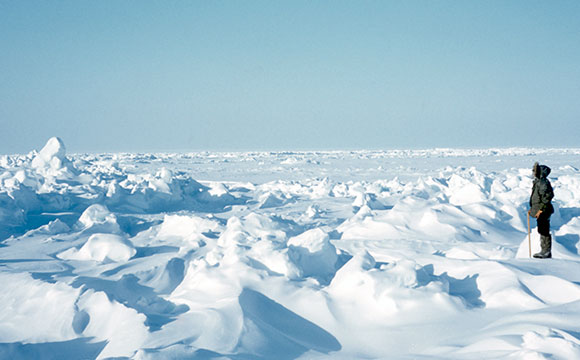
    Scientists Solve the Problem of Sea Ice Thickness Distribution
    Yale University researchers have utilized molecular concepts to treat frozen ice floes of the Arctic seas as colliding molecules in a fluid or gas, successfully addressing a longstanding inquiry regarding Arctic ice thickness.

    Using molecular concepts and treating the ice floes of the frozen seas like colliding molecules in a fluid or gas, researchers at Yale University have answered a 40-year-old question about Arctic ice thickness.

    Although today’s highly precise satellites do a fine job of measuring the area of sea ice, measuring the volume has always been a tricky business. The volume is reflected through the distribution of sea ice thickness — which is subject to a number of complex processes, such as growth, melting, ridging, rafting, and the formation of open water.

    For decades, scientists have been guided by a 1975 theory (by Thorndike et al.) that could not be completely tested, due to the unwieldy nature of sea ice thickness distribution. The theory relied upon a term that could not be related to the others, which represented the mechanical redistribution of ice thickness. As a result, the complete theory could not be mathematically tested.

    Enter Yale professor John Wettlaufer, inspired by the staff and students at the Geophysical Fluid Dynamics Summer Study Program at the Woods Hole Oceanographic Institution, in Massachusetts. Over the course of the summer, Wettlaufer and Yale graduate student Srikanth Toppaladoddi developed and articulated a new way of thinking about the space-time evolution of sea ice thickness.

    The resulting paper will appear in the September 17 edition of the journal Physical Review Letters.

    “The Arctic is a bellwether of the global climate, which is our focus. What we have done in our paper is to translate concepts used in the microscopic world into terms appropriate to this problem essential to climate,” said Wettlaufer, who is the A.M. Bateman Professor of Geophysics, Mathematics and Physics at Yale.

    Wettlaufer and co-author Toppaladoddi recast the old theory into an equation similar to a Fokker-Planck equation, a partial differential equation used in statistical mechanics to predict the probability of finding microscopic particles in a given position under the influence of random forces. By doing this, the equation could capture the dynamic and thermodynamic forces at work within polar sea ice.

    “We transformed the intransigent term into something tractable and — poof — solved it,” Wettlaufer said.

    The researchers said their equation opens up the study of this aspect of climate science to a variety of methods normally used in nonequilibrium statistical mechanics.

    Never miss a breakthrough: Join the SciTechDaily newsletter.
    Follow us on Google and Google News.

    Arctic Climate Science Earth Science Geophysics Ice Melt Yale University
    Share. Facebook Twitter Pinterest LinkedIn Email Reddit

    Related Articles

    Warmer Water Now Reaches Deep Into The Arctic Interior

    Machine Learning Helps Predict the Geothermal Heat Flux in Greenland

    Arctic Sea Ice Loss is Impacting Atlantic Ocean Water Circulation System

    Study Shows Greenland’s Undercut Glaciers Melting Faster than Thought

    CryoSat Satellite Shows Increased Volume of Arctic Sea Ice

    2015 Arctic Sea Ice Maximum Annual Extent is the Lowest on Record

    New Threat to East Antarctic Ice

    Study Reveals Oceanic Carbon Release Helped End the Ice Age

    New ScienceCast Video: The Cloudy Future of Arctic Sea Ice

    Leave A Reply Cancel Reply

    • Facebook
    • Twitter
    • Pinterest
    • YouTube

    Don't Miss a Discovery

    Subscribe for the Latest in Science & Tech!

    Trending News

    First-of-Its-Kind Discovery: Homer’s Iliad Found Embedded in a 1,600-Year-Old Egyptian Mummy

    Beyond Inflammation: Scientists Uncover New Cause of Persistent Rheumatoid Arthritis

    A Simple Molecule Could Unlock Safer, Easier Weight Loss

    Scientists Just Built a Quantum Battery That Charges Almost Instantly

    Researchers Unveil Groundbreaking Sustainable Solution to Vitamin B12 Deficiency

    Millions of People Have Osteopenia Without Realizing It – Here’s What You Need To Know

    Researchers Discover Boosting a Single Protein Helps the Brain Fight Alzheimer’s

    World-First Study Reveals Human Hearts Can Regenerate After a Heart Attack

    Follow SciTechDaily
    • Facebook
    • Twitter
    • YouTube
    • Pinterest
    • Newsletter
    • RSS
    SciTech News
    • Biology News
    • Chemistry News
    • Earth News
    • Health News
    • Physics News
    • Science News
    • Space News
    • Technology News
    Recent Posts
    • Breakthrough Technology Reveals New Treatment Targets for Cancer
    • Scientists Discover New Way To Make Drug-Resistant Cancer Treatable Again
    • This Simple Exercise Trick Builds Muscle With Less Effort, Study Finds
    • Middle Age Is Becoming a Breaking Point in America, Study Reveals
    • Scientists Discover How Coffee Impacts Memory, Mood, and Gut Health
    Copyright © 1998 - 2026 SciTechDaily. All Rights Reserved.
    • Science News
    • About
    • Contact
    • Editorial Board
    • Privacy Policy
    • Terms of Use

    Type above and press Enter to search. Press Esc to cancel.