
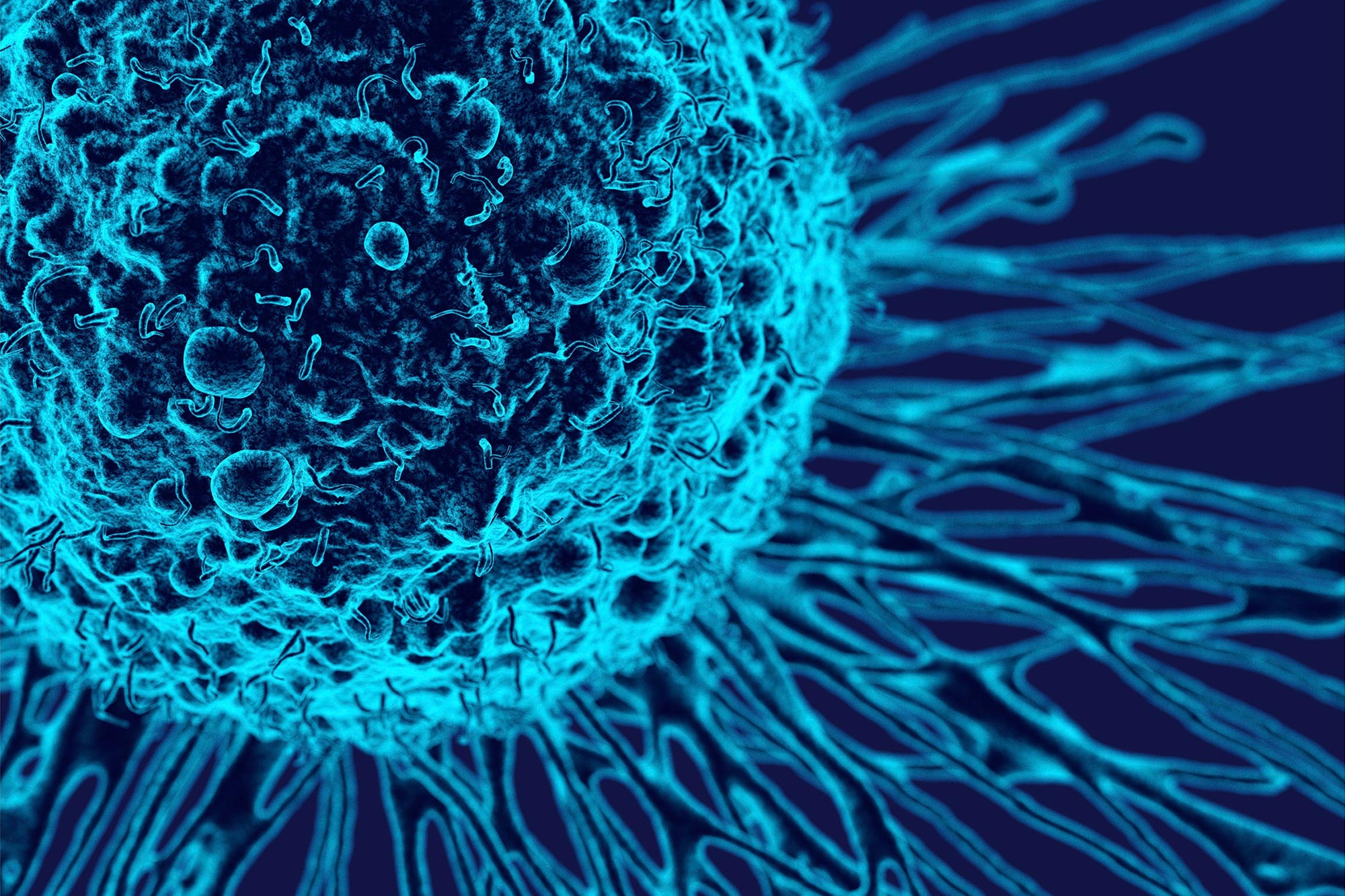
Nano-sized, tumor-targeting particles induced self-destruction of cancer cells in preclinical studies.
A new twist on a decades-old anticancer strategy has demonstrated significant potential against various cancer types in a preclinical study conducted by researchers at the Perelman School of Medicine at the University of Pennsylvania. The innovative method employs small extracellular vesicles (sEVs)—tiny capsules engineered from human cells—offering a promising new avenue for immunotherapy. This approach is now advancing toward further development and testing.
In a study published in Science Advances, the team detailed how sEVs were engineered to target a receptor called DR5 (death receptor 5), which is present on the surface of many tumor cells. Activating DR5 initiates a self-destruct process in these cells known as apoptosis. Despite over two decades of research, creating effective cancer therapies that target DR5 has remained a significant challenge.
The sEV-based approach surpassed the effectiveness of DR5-targeting antibodies, previously considered a leading strategy for this receptor.
The sEVs were efficient killers of multiple cancer cell types in lab-dish tests, and blocked tumor growth in mouse models, enabling much longer survival than DR5-targeting antibodies.
“This new strategy has a number of advantages compared to previous DR5-targeting strategies and other anticancer immunotherapies, and after these encouraging preclinical results, we’re developing it further for human clinical trials,” said senior author Xiaowei “George” Xu, MD, PhD, a professor of Pathology and Laboratory Medicine, and member of the Tara Miller Melanoma Center in Penn Medicine’s Abramson Cancer Center. “We’ve seen that many patients have benefited from advances in cancer immunotherapy but know there’s more to work to do. This is our motivation for seeking new strategies for cellular therapies, particularly in solid tumor cancers, like melanoma, where current immunotherapies only work for about half of patients.”
A better way to target DR5
The DR5 death receptor appears to have evolved, at least in part to destroy cells that are malignant, damaged. Although DR5 has seemed an attractive target for cancer treatments, those developed so far haven’t been successful in controlling tumor growth. Xu and his team used extracellular vesicles to target DR5 because these nano-sized capsules—about a million times smaller than a T cell—are naturally produced and secreted by virtually all cells. Extracellular vesicles carry molecules that can deliver messages to surrounding cells.
For this application, the team used sEVs made by natural killer (NK) cells, a type of immune cell that frequently has a cancer-fighting role. NK-derived sEVs are good at infiltrating tumors and typically contain molecules that are toxic to tumor cells. Xu and his team engineered the NK sEVs so that they have an antibody fragment that strongly binds to and activates DR5.
In lab-dish experiments, the sEVs specifically move towards and bind to DR5 and quickly killed cancer cell types that have high levels of DR5 expression, including melanoma, liver, and ovarian cancer cells. In experiments with mouse models of melanoma, breast, and liver cancers, the sEVs strongly suppressed tumor growth and prolonged survival.
Reversing tumor immunosuppression
Xu and his team observed in their experiments that the sEVs packed other antitumor punches: they attacked other DR5-expressing cells called cancer-associated fibroblasts and myeloid-derived suppressor cells, which tumors use to create an immune-suppressive environment around themselves. The sEVs also stimulated T cells, giving another boost to anticancer immune activation. Overall, sEVs apparent ability to disrupt the immunosuppressive environment suggests that they might succeed in solid tumors, where the hostile tumor microenvironment has proved challenging for many forms of immunotherapy.
Xu noted that sEVs can be manufactured and stored relatively easily, making them a potential “off-the-shelf” therapy that could be given to any patient and would not require retrieving cells from each patient, as is the case with other personalized cellular therapies.
Next, the team plans to refine the manufacturing process to scale production for clinical-grade sEVs and conduct safety studies to prepare for human clinical trials.
Reference: “Engineered extracellular vesicles with DR5 agonistic scFvs simultaneously target tumor and immunosuppressive stromal cells” by Yeye Guo, Huaishan Wang, Shujing Liu, Xiaogang Zhang, Xingyue Zhu, Lili Huang, Wenqun Zhong, Lei Guan, Yeqing Chen, Min Xiao, Lingling Ou, Jingbo Yang, Xiang Chen, Alexander C. Huang, Tara Mitchell, Ravi Amaravadi, Giorgos Karakousis, John Miura, Lynn Schuchter, Ahron Flowers, Qiuxian Zheng, Haiwei Mou, Phyllis Gimotty, Meenhard Herlyn, Wei Guo and Xiaowei Xu, 15 January 2025, Science Advances.
DOI: 10.1126/sciadv.adp9009
The study was funded by the National Institutes of Health (CA258113, CA261608, CA114046, CA284182). A patent application for this technology has been filed on behalf of the University of Pennsylvania.
Never miss a breakthrough: Join the SciTechDaily newsletter.
Follow us on Google and Google News.
21 Comments
I can’t not wait to see the world living cancer fear free
Men can ovulate and breast feed, surely our trusted Chinese scientists can manufacture medicine that cures any dis-ease! Trust the science because it’s safe and effective! Don’t you want to take granny to the concert?
This would be amazing… just like all previous “cancer cures” though I’m sure big pharma will never let it actually happen! We could have had cancer eradicated many times over the years but unfortunately curing people doesn’t make money. The money is in treating illnesses.
I agree with you!
Pretty sad all for the greed of money
They used the same chemo they have been using for the past 50 years on my son. Really!!?? They can’t figure out anything better? What do they do with all that donated money!!?? It did not work 😪
I have come to the conclusion. Decades of pleading for our donations without transparency and little in way of results.
Show of hands…
How many of you are stupid enough to NOT see that this is just another gambit to clot-shot you and your kids?
I’m waiting for them to announce a nanoparticle cocktail that’ll give me a 12 inch pecker.
Surely THAT ONE will be real… ‘
Hell yesssS
Why, oh why, did I bother to read the comments?
Comment sections often seem to negate any knowledge gained from these informative articles!
The cIickbait, usually meaningless, low/zero-information Diffusion AI generated, pictures that get displayed in Google News attracts them. If Sci-‘tech’ put up lead-illustrations that were actually illustrative (cells with receptors, capsules, arrows, signaling pathways, apoptosis-mechanisms, etc.), it would drop the web-traffic by >75%.
As Ia 59yo man, Isit here with Glioblastoma taking Chemo and Radiation.
I would do these clinical trials.
How does one get to have a chance of living.
Bruce: I have seen information that says a ketogenic diet might help: https://pmc.ncbi.nlm.nih.gov/articles/PMC9504425/
Also this:https://youtu.be/Spg3oGfFtA4?feature=shared
All the people I know who were suffering from cancer and went on these magic diets died of cancer.
Contact the writer or the many doctors involved at the college and send them an email asking to be added to a list for clinical study’s with that, your probably going to have to travel to participate in the study so be prepared for that. And lastly stop drinking tap water drink high PH between 8-9. And be prepared that you will have to do this indefinitely. 2md stop or damn near stop eating sugar and carbs which turn to sugar. As the glucose the sugar is concerted into is good for for the cancer cells. Which means bad for you. Many people neglect the fact that lifestyle and diet contribute. More to cancer than environmental causes at least for the moment, if we get nuked that obviously won’t be the case there will be more cancer cases than you have ever seen. For people within 1000 a 1,000 mile circle the current biggest radioactive substance that people come into contact with is Radon,, it’s very close to all land at or 100 feet or less above sea level. It comes up under most people’s homes everywhere on the south western United States. Go get a test at home Depot and do it yourself. It takes about 15 or so years for the cancer to have a big impact but most people don’t understand that it’s in almost every home that has a crawl space and no ground seal under the home.
Radon is caused by decaying granite.
The way to attack cancer is to starve it of Glucose and Glutamine. A PET scan is the diagnostic tool to find cancer and it looks for glucose. Cancer cells cannot live on ketones. Cancer is caused by repeated/chronic insults on your cells until the cell is damaged and it tries to save itself by reverting to fermentation. For example GERD on your throat.The damaged cell reboots into a stage that stops programmed, normal cell death (apoptosis). Lookup Dr Seyfried on youtube. It’s called the metabolic theory and it’s all about mitochondrial health.
Nano-sized, tumor-targeting particles induced self-destruction of cancer cells in preclinical studies
https://www.reddit.com/r/EverythingScience/comments/1i6d3n7/nanosized_tumortargeting_particles_induced/?rdt=48404
I kicked the cancer by getting high doses of vit. C I. V.s. (25 grams or more.) The natural paths health companies do it.