
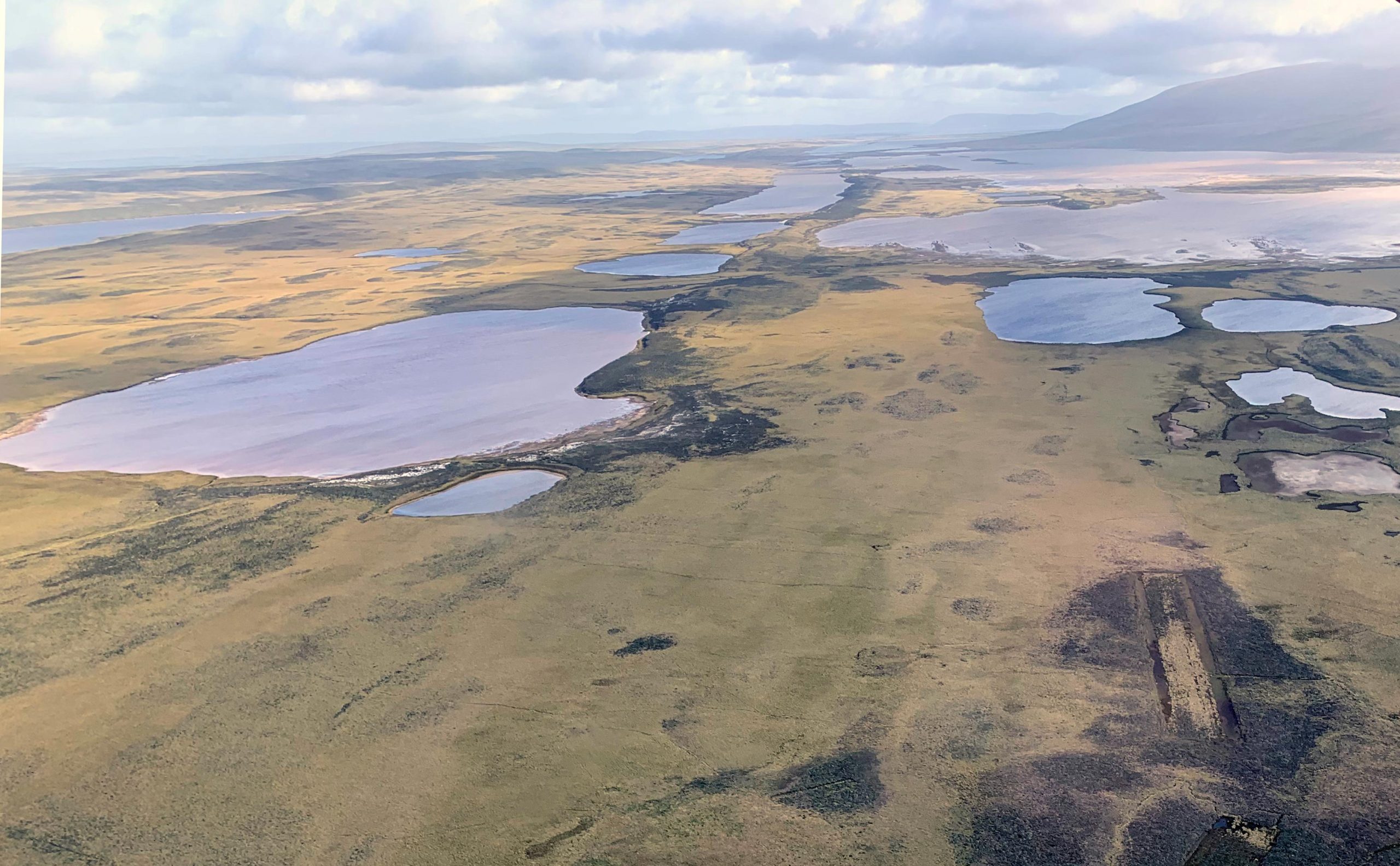
Ancient tree remains and pollen discovered in the Falkland Islands reveal a past rainforest environment, radically different from its current grassy plains, dating back up to 30 million years.
A team of scientists led by Dr. Zoë Thomas from the University of Southampton (UK) has found evidence that the treeless, rugged, grassland landscape of the Falkland Islands was home to a lush, diverse rainforest up to 30 million years ago.
The research, published in Antarctic Science, reveals that the South Atlantic archipelago was once covered in cool, wet woodland – similar to the present-day rainforests found in Tierra del Fuego, off the tip of South America.

Initial Clues and Excavation
The scientists conducted the research after clues to the whereabouts of buried remains of the ancient forest reached them via word-of-mouth in the tight-knit community of Port Stanley, the Falklands’ capital. Chance conversations led them to find perfectly preserved prehistoric tree remains and pollen at a building site in early 2020.
“We were in the Falklands carrying out research for a different project when a fellow researcher, based on the Island, mentioned they’d heard from a friend that something interesting had been dug up by a builder they knew,” explains Dr. Thomas, an expert in physical geography at the University of Southampton.
She continues, “Excavators at the site of a new care home in Stanley had cut into a deep peat layer which was filled with large tree trunks and branches. These were so well preserved, they looked like they’d been buried the day before, but they were in fact extremely old.
“Our interest was immediately piqued, as finding tree remains here was baffling. For at least thousands, probably millions of years, the Falkland Islands have not been able to sustain trees. It’s too windy and the soil too acidic. This raised the intriguing question of just how old the wood from this forest bed was?”

Analyzing Ancient Pollen and Tree Remains
With the help of members of the South Atlantic Environmental Research Institute (SAERI) in Port Stanley, samples of the peat layers and deposits were removed from the site at Tussac House near Stanley Harbour. These were carefully transported to Australia for laboratory testing at the University of New South Wales, where the sediment was meticulously sampled and the wood analyzed with specialized scanning electron microscopes.
The tree remains proved too old to obtain conclusive results from radiocarbon dating, so pollen spores were used instead. The scientists analyzed a variety of spores compacted and sealed in the same layers of peat as the wood. Pollen records led them to conclude the tree trunks and branches date to between 15 and 30 million years old.

Historical Climate of the Falkland Islands
The Falkland Islands are a British territory that lies 8,000 miles from the UK in the South Atlantic. Comprised of two main islands and 778 smaller ones, they cover an area just over half the size of Wales and are known for being wet, cold, and windswept, with fast-changing weather conditions. Their landscape is not dissimilar to Dartmoor in the UK.
Tens of millions of years ago the climate in the South Atlantic was much warmer and wetter than today and capable of supporting a rainforest environment. This would have been cooler than tropical rainforests we might typically think of – such as the Amazon rainforest – but still able to support a rich, diverse ecosystem of plant and animal life.

Implications of the Research
Many of the tree species growing on the Falklands at the time of the Tussac House sample are now extinct but would have seeded on the islands by being carried on the prevailing westerly winds from rainforests that covered much of the southern hemisphere, including what is now mainland South America.
Scientists can’t be sure what led to the eventual demise of the Islands’ rainforest and the transformation to peatlands, but it’s reasonable to speculate it was due to a change in climate and a move to colder and drier conditions.
Dr. Thomas comments: “It’s amazing to think that if we’d not had the chance to chat and engage with people in such a close community at that particular moment, we may never have recovered these pristinely preserved samples of tree.
“Until our visit and the construction worker’s find, no one had any idea that six meters under their feet were perfectly preserved relics of an ancient rainforest and exquisite fossilized pollen. I’m so grateful to the friendly Islanders who, by being so welcoming and open, gave us this unique opportunity to investigate.”
As for the future, Dr. Thomas says the islands are unlikely to see a return to a forest landscape anytime soon: “Current projections suggest the region will get warmer, but also drier – leading to concerns about the risk of erosion to the peatlands, which are sensitive to climate change.”
Reference: “Evidence for a floristically diverse rainforest on the Falkland archipelago in the remote South Atlantic during the mid- to late Cenozoic” by Zoë A. Thomas, Michael Macphail, Haidee Cadd, David J. Cantrill, David K. Hutchinson, Heather A. Haines, Karen Privat, Chris Turney, Stefanie Carter and Paul Brickle, 9 September 2024, Antarctic Science.
DOI: 10.1017/S0954102024000129
Never miss a breakthrough: Join the SciTechDaily newsletter.
Follow us on Google and Google News.
2 Comments
“Current projections suggest the region will get warmer, but also drier – leading to concerns about the risk of erosion to the peatlands, which are sensitive to climate change.”
As poor a job as the Global Circulation Models do for predicting temperatures (typically running warm), they do an even worse job at predicting precipitation. At regional scales, different models sometimes give opposite results — some predicting flooding, others drought. Warming should result in more evaporation and thus precipitation. Therefore, I’d put my money on more precipitation except where we already have dry deserts.
Seems the geological formative history does not support aging of peat bogs .as written, these preserved woody fragments are shallow burried…so, if glaciation 25,000 years ago aggressively attacked the sedimentary layers, how is it possible to justify the age of these bogs? Carbon dating is not without problems. Argon dating also problematic also. In a global flood, a scale of sedimentary deposition world wide is replicated on the Falklands. It is even possible, that rapid plate tectonics is not considered because geologists et al. Are indoctrinated with Uniformitarian presuppositions and indoctrinated with ancient age theory. Apply the young earth theory to see if a different conclusion will be reached! Bad or junk science ignores young earth precepts.