

A deep heat mass beneath the Appalachians appears to have started near a rift between Greenland and North America.
Its slow southward journey reveals that ancient tectonic events still influence the continent today.
Deep Heat Beneath the Appalachians Linked to Ancient Rift
A broad area of unusually warm rock located far below the Appalachian Mountains in the United States may be tied to the separation of Greenland and North America about 80 million years ago, according to new research from the University of Southampton.
The scientists involved argue that this feature is not a remnant of the older breakup between North America and Northwest Africa 180 million years ago, which had been the dominant explanation for many years.
The hot region, known as the Northern Appalachian Anomaly (NAA), spans about 350 kilometers (roughly 220 miles) and lies approximately 200 km (about 120 miles) beneath New England.
A Hot Zone That Formed Far From Where It Is Today
The study, published in Geology, indicates that the NAA originally developed around 1,800 km (about 1,120 miles) away, near the Labrador Sea as the crust began to split between Canada and Greenland. Over millions of years, this mass of hot, unstable rock slowly shifted to its current position at an estimated rate of about 20 km (around 12 miles) per million years.
Researchers from the University of Southampton, the Helmholtz Centre for Geosciences in Potsdam (GFZ), and the University of Florence collaborated on the project.
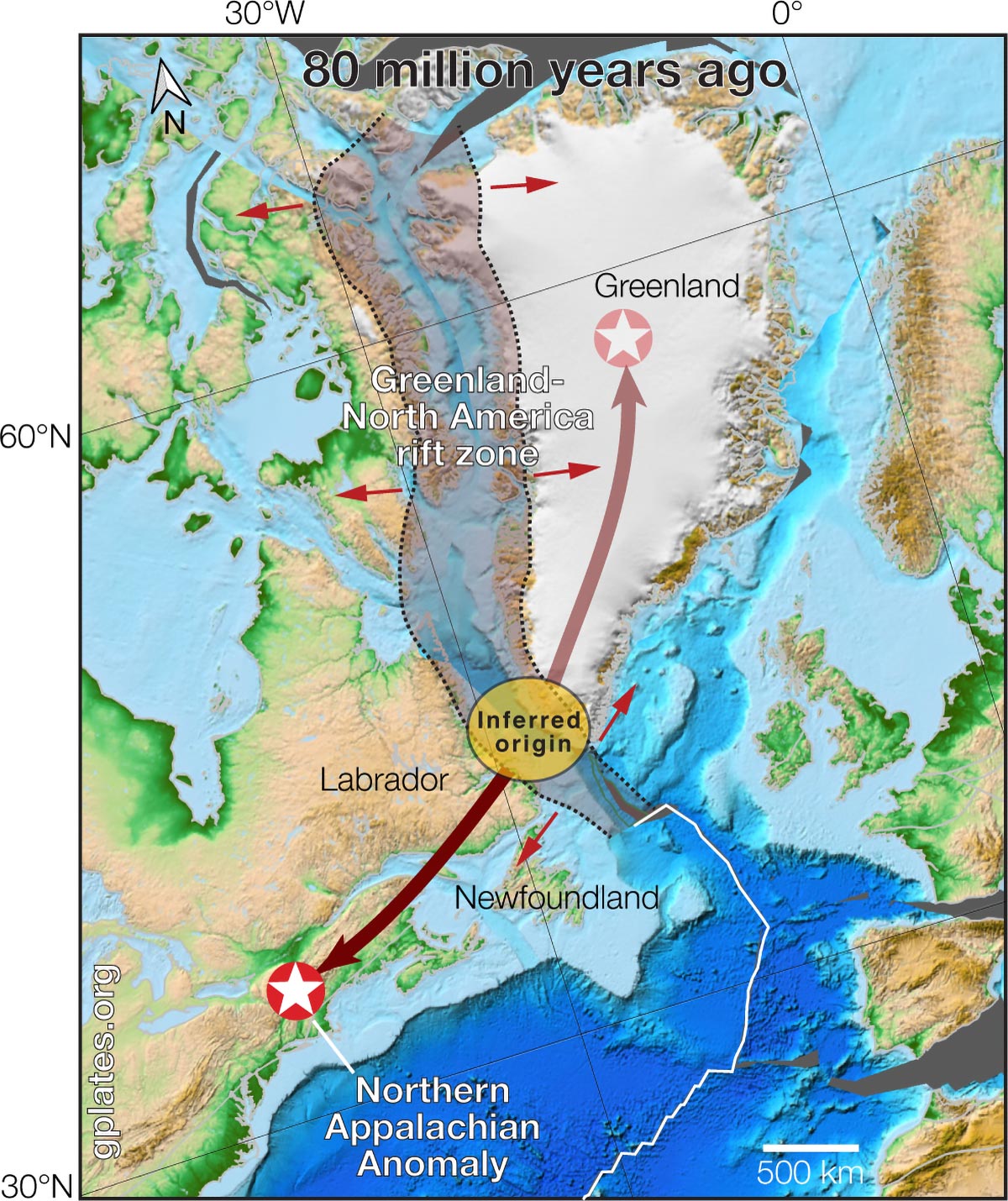
Tom Gernon, lead author and Professor of Earth Science at the University of Southampton, explained: “This thermal upwelling has long been a puzzling feature of North American geology. It lies beneath part of the continent that’s been tectonically quiet for 180 million years, so the idea it was just a leftover from when the landmass broke apart never quite stacked up.
“Our research suggests it’s part of a much larger, slow-moving process deep underground that could potentially help explain why mountain ranges like the Appalachians are still standing. Heat at the base of a continent can weaken and remove part of its dense root, making the continent lighter and more buoyant, like a hot air balloon rising after dropping its ballast. This would have caused the ancient mountains to be further uplifted over the past few million years.”
Exploring the ‘Mantle Wave’ Process
The team’s interpretation builds on a concept they recently introduced called ‘mantle wave’ theory, which was named a finalist for Science magazine’s 2024 Breakthrough of the Year.
This theory describes how hot, dense rock gradually detaches from the underside of tectonic plates after continents separate, moving somewhat like slow blobs in a lava lamp. These waves can ripple beneath continents for tens of millions of years and help account for rare volcanic events that bring diamonds to the surface, along with unusually elevated terrain in inland regions.
Using geodynamic simulations, seismic tomography (similar to a medical ultrasound but using seismic waves), and reconstructions of past plate positions, the researchers traced the NAA back to the period when the Labrador Sea opened and Greenland split from Canada between 90 and 80 million years ago.
Slow-Moving Mantle ‘Drips’ Beneath North America
Professor Sascha Brune, co-author and head of the Geodynamic Modelling Section at GFZ, said: “These convective instabilities cause chunks of rock, several tens of kilometers thick, to slowly sink from the base of the Earth’s outer layer known as the lithosphere. As the lithosphere thins, hotter mantle material rises to take its place, creating a warm region known as a thermal anomaly.
“Our earlier research shows that these ‘drips’ of rock can form in series, like domino stones when they fall one after the other, and sequentially migrate over time. The feature we see beneath New England is very likely one of these drips, which originated far from where it now sits.”
Based on the team’s analysis, the NAA appears to be drifting southwest across the North American lithosphere at about 20 kilometers (around 12 miles) per million years. Its current width of roughly 350 km (about 220 miles) and depth agree closely with what models predict for this type of instability. The researchers estimate that the center of the anomaly could eventually move beneath the New York region within roughly 15 million years.
A Matching Heat Feature Beneath Greenland
The study also identifies a similar region of anomalous heat under north-central Greenland that may have formed at the same time as the NAA, essentially acting as its geological counterpart. Both features may have emerged on opposite sides of the Labrador Sea as the continents separated.
Under Greenland, this deep heat source increases the warmth at the base of the thick ice sheet, affecting how the ice flows and melts. As Professor Gernon noted, “ancient heat anomalies continue to play a key role in shaping the dynamics of continental ice sheets from below.”
Ancient Rifting Still Influencing the Surface Today
Dr. Derek Keir, co-author and tectonics specialist at the University of Southampton and the University of Florence, said: “The idea that rifting of continents can cause drips and cells of circulating hot rock at depth that spread thousands of kilometers inland makes us rethink what we know about the edges of continents both today and in Earth’s deep past.”
The results add to earlier work suggesting that deep Earth processes can continue long after tectonic activity slows at the surface. These long-lasting instabilities influence uplift, erosion, and even patterns of volcanism, including in areas once considered geologically stable.
Professor Gernon added: “Even though the surface shows little sign of ongoing tectonics, deep below, the consequences of ancient rifting are still playing out. The legacy of continental breakup on other parts of the Earth system may well be far more pervasive and long-lived than we previously realized.”
Reference: “A viable Labrador Sea rifting origin of the Northern Appalachian and related seismic anomalies” by Thomas M. Gernon, Sascha Brune, Thea K. Hincks and Derek Keir, 29 July 2025, Geology.
DOI: 10.1130/G53588.1
Never miss a breakthrough: Join the SciTechDaily newsletter.
Follow us on Google and Google News.
1 Comment
“area of unusually warm rock”
WHAT TEMPERATURE????
And how warm “usually”????