
NASA’s DSOC, launching with the Psyche mission on October 12, seeks to revolutionize space communication by transitioning from radio waves to laser communication, promising enhanced data transmission capacities and paving the way for future advanced space missions.
Slated to launch on October 12 with the Psyche mission (weather permitting), DSOC will demonstrate technologies enabling the agency to transmit higher data rates from deep space.
NASA’s pioneering Deep Space Optical Communications (DSOC) experiment will be the first demonstration of laser, or optical, communications from as far away as Mars. Launching with NASA’s Psyche mission to a metal-rich asteroid of the same name on Thursday, October 12, DSOC will test key technologies designed to enable future missions to transmit denser science data and even stream video from the Red Planet.
Here are five things to know about this cutting-edge technology demonstration:
1. DSOC is the first time NASA will test how lasers could increase data transmission from deep space.
Until now, NASA has used only radio waves to communicate with missions that travel beyond the Moon. Much like fiber optics replacing old telephone lines on Earth as demand for data grows, going from radio communications to optical communications will allow increased data rates throughout the solar system, with 10 to 100 times the capacity of state-of-the-art systems currently used by spacecraft. This will better enable future human and robotic exploration missions, along with supporting higher-resolution science instruments.
Learn more about how DSOC will be used to test high-bandwidth data transmission beyond the Moon for the first time – and how it could transform deep space exploration. Credit: NASA/JPL-Caltech
2. The tech demo involves equipment both in space and on Earth.
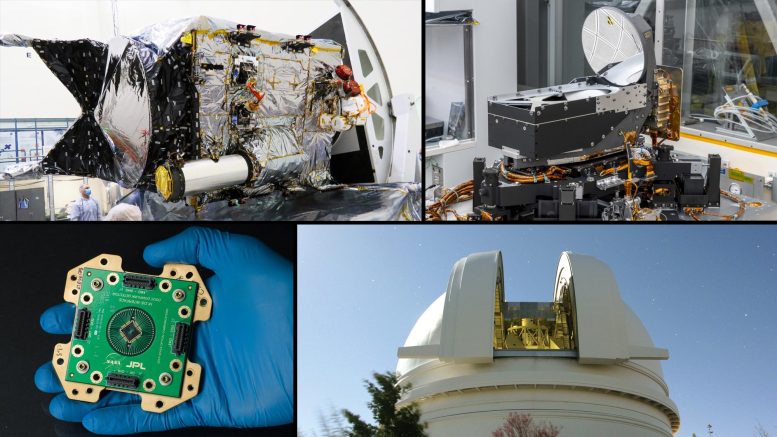
The DSOC flight laser transceiver is an experiment attached to NASA’s Psyche spacecraft, but Psyche relies on traditional radio communications for mission operations. The laser transceiver features both a near-infrared laser transmitter to send high-rate data to Earth and a sensitive photon-counting camera to receive a laser beam sent from Earth. But the transceiver is just one part of the technology demonstration.
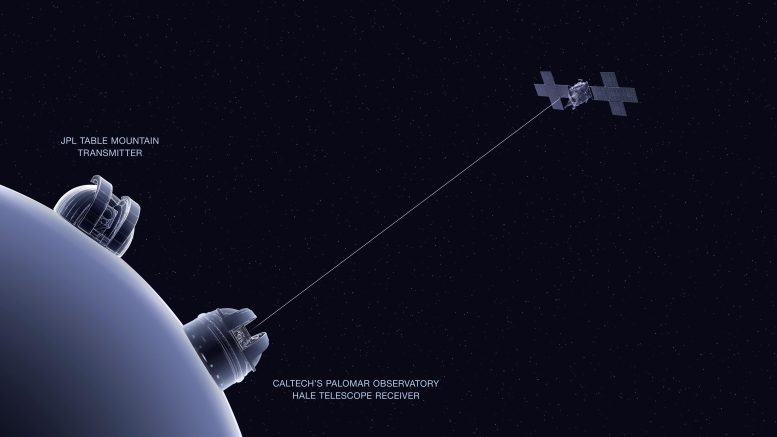
There is no dedicated infrastructure on Earth for deep space optical communications, so for the purposes of DSOC, two ground telescopes have been updated to communicate with the flight laser transceiver. NASA’s Jet Propulsion Laboratory in Southern California will host the operations team, and a high-power near-infrared laser transmitter has been integrated with the Optical Communications Telescope Laboratory at JPL’s Table Mountain facility near Wrightwood, California. The transmitter will deliver a modulated laser signal to DSOC’s flight transceiver and serve as a beacon, or pointing reference, so that the returned laser beam can be accurately aimed back to Earth.
Data sent from the flight transceiver will be collected by the 200-inch (5.1-meter) Hale Telescope at Caltech’s Palomar Observatory in San Diego County, California, which has been equipped with a special superconducting high-efficiency detector array.
3. DSOC will encounter unique challenges.
DSOC is intended to demonstrate high-rate transmission of data of distances up to 240 million miles (390 million kilometers) – more than twice the distance between the Sun and Earth – during the first two years of Psyche’s six-year journey to the asteroid belt.
The farther Psyche travels from our planet, the fainter the laser photon signal will become, making it increasingly challenging to decode the data. As an additional challenge, the photons will take longer to reach their destination, creating a lag of over 20 minutes at the tech demo’s farthest distance. Because the positions of Earth and the spacecraft will be constantly changing as the photons travel, the DSOC ground and flight systems will need to compensate, pointing to where the ground receiver (at Palomar) and flight transceiver (on Psyche) will be when the photons arrive.
4. Cutting-edge technologies will work together to make sure the lasers are on target and high-bandwidth data is received from deep space.
The flight laser transceiver and ground-based laser transmitter will need to point with great precision. Reaching their targets will be akin to hitting a dime from a mile away while the dime is moving. So the transceiver needs to be isolated from the spacecraft vibrations, which would otherwise nudge the laser beam off target. Initially, Psyche will aim the flight transceiver in the direction of Earth while autonomous systems on the flight transceiver assisted by the Table Mountain uplink beacon laser will control the pointing of the downlink laser signal to Palomar Observatory.
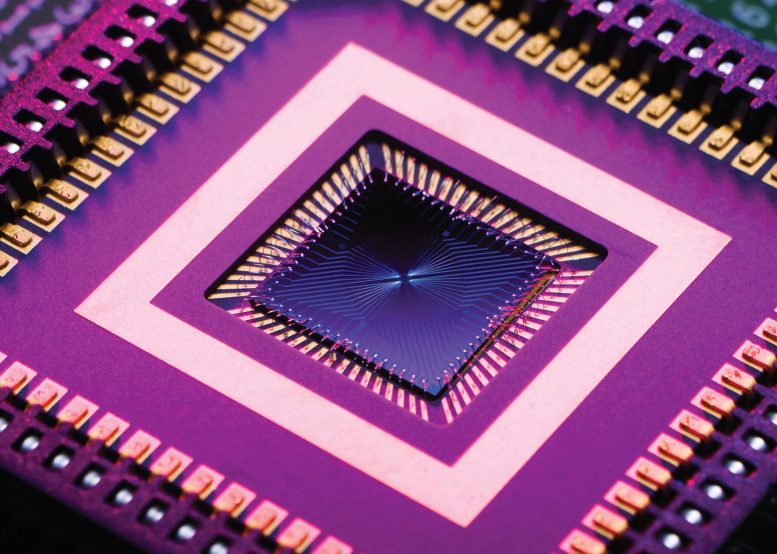
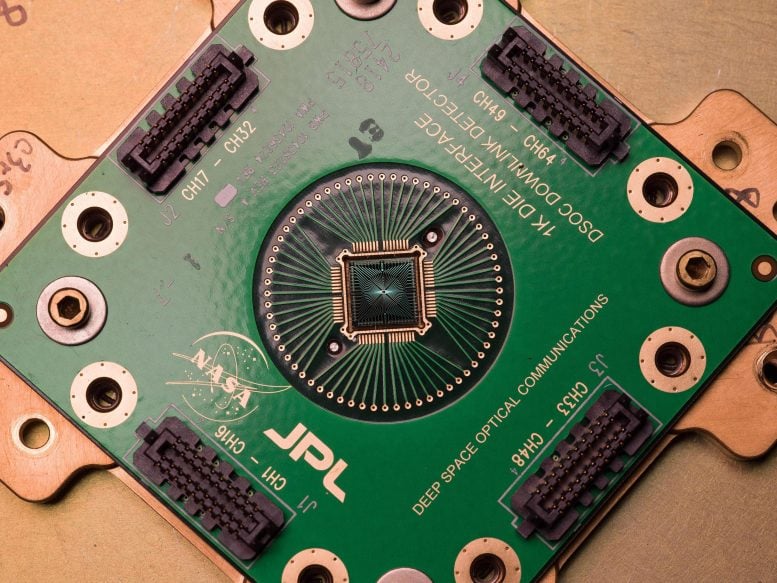
Integrated onto the Hale Telescope is a cryogenically cooled superconducting nanowire photon-counting array receiver, developed by JPL. The instrument is equipped with high-speed electronics for recording the time of arrival of single photons so that the signal can be decoded. The DSOC team even developed new signal-processing techniques to squeeze information out of the weak laser signals that will have been transmitted over tens to hundreds of millions of miles.
5. This is NASA’s latest optical communications project.
In 2013, NASA’s Lunar Laser Communications Demonstration tested record-breaking uplink and downlink data rates between Earth and the Moon. NASA’s Laser Communications Relay Demonstration was launched in 2021 to test high-bandwidth optical communications relay capabilities from geostationary orbit so that spacecraft don’t require a direct line of sight with Earth to communicate. And last year, NASA’s TeraByte InfraRed Delivery system downlinked the highest-ever data rate from a satellite in low-Earth orbit to a ground-based receiver.
DSOC is taking optical communications into deep space, paving the way for high-bandwidth communications beyond the Moon and 1,000 times farther than any optical communications test to date. If it succeeds, the technology could lead to high-data rate communications with streaming, high-definition imagery that will help support humanity’s next giant leap: when NASA sends astronauts to Mars.
More About the Mission
DSOC is the latest in a series of optical communication demonstrations funded by NASA’s Technology Demonstration Missions (TDM) program and the agency’s Space Communications and Navigation (SCaN) program. JPL, a division of Caltech in Pasadena, California, manages DSOC for TDM within NASA’s Space Technology Mission Directorate and SCaN within the agency’s Space Operations Mission Directorate.
The Psyche mission is led by Arizona State University. JPL is responsible for the mission’s overall management, system engineering, integration and test, and mission operations. Psyche is the 14th mission selected as part of NASA’s Discovery Program, managed by the agency’s Marshall Space Flight Center in Huntsville, Alabama. NASA’s Launch Services Program, based at the agency’s Kennedy Space Center, is managing the launch service. Maxar Technologies in Palo Alto, California, provided the high-power solar electric propulsion spacecraft chassis.
Never miss a breakthrough: Join the SciTechDaily newsletter.
Follow us on Google and Google News.
1 Comment
More Billions funneled to KKK CIA Nazi Spook Elin Minsk under the guise of science.
Try working in the Space Industry or at Cal Tech or Stanford with KKK CIA Nazi Brain Stealing Spooks. They are not Human and their Agenda is Genocide of Human people in Science and Engineering Maybe NASA and Space FX can come up with a mission to study that?
Psyche or more like Psycho-Paths.