
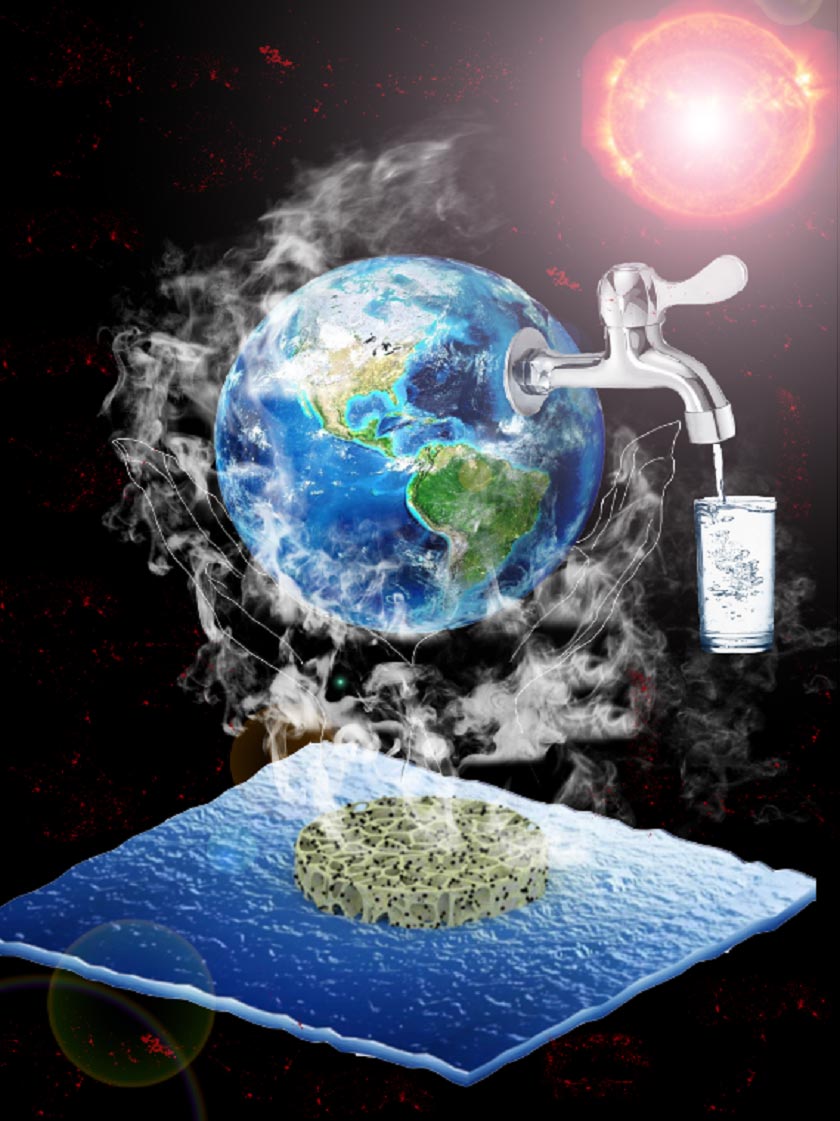
Scientists review some of the research behind a technology that could cauterize a growing global drinking water crisis.
A nascent but promising solution to the world’s water scarcity problems could be water purification via the direct solar steam generation technology. But while researchers are well on the path to making this technology practically applicable, the finish line remains a ways away. A new study in Elsevier’s Solar Energy Materials and Solar Cells takes us through a part of this incredible research journey, which involves device design strategies to optimize the steam generation process.
Without drinkable water there is no life. Yet, nearly 1.1 billion people worldwide lack access to fresh water and another 2.4 billion suffer from diseases borne by unclean drinking water. This is because while science has yielded advanced water treatment methods such as membrane distillation and reverse osmosis, these are often difficult to implement in developing countries owing to their high cost and low productivity.
A more nascent technology shows promise as an alternative for such regions of the world: direct solar steam generation (DSSG). DSSG involves harvesting the heat from the sun to convert water into vapor, thereby desalinating it or ridding it of other soluble impurities. The vapor is then cooled and collected as clean water for use.
This is a simple technology, but a key step, evaporation, is presenting roadblocks for its commercialization. With existing technology, evaporation performance has hit the theoretical limit. However, this is not sufficient for practical implementation. Measures to improve device design to minimize solar heat loss before it reaches bulk water, recycle latent heat in the water, absorb and utilize energy from the surroundings as well, and so on, have been taken to improve the evaporation performance beyond the theoretical limit and make this technology viable.
In a new paper published in Solar Energy Materials and Solar Cells, Professor Lei Miao from Shibaura Institute of Technology, Japan, along with colleagues Xiaojiang Mu, Yufei Gu, and Jianhua Zhou from Guilin University of Electronic Technology, China, review strategies formulated in the last two years to surpass this theoretical limit. “Our aim is to summarize the story of the development of new evaporation strategies, point out current deficiencies and challenges, and layout future research directions to hasten the practical application of the DSSG purification technology,” says Prof. Miao.
A pioneering strategy with which this evolutionary saga begins is the volumetric system, which, in lieu of bulk heating, uses a suspension of noble metals or carbon nanoparticles to absorb the sun’s energy, transfer heat to the water surrounding these particles, and generate steam. While this increases the absorbed energy of the system, there is much heat loss.
To address this issue, the “direct contact type” system was developed, in which a double-layer structure with pores of different sizes covers the bulk water. The top layer with larger pores serves as a heat absorber and vapor escape route and the bottom layer with smaller pores is used to transport water up from the bulk to the top layer. In this system, the contact between the heated top layer and the water is concentrated, and heat loss is reduced to about 15%.
The “2D water path” or “indirect contact type” system came next, which further lowered heat loss by avoiding contact between the solar energy absorber and bulk water. This paved the way for the eventual development of the “1D water path” system, which is inspired by the natural capillary-action-based water transport process in plants. This system displays an impressive evaporation rate of 4.11 kg (9.1 lb) m-2h-1, nearly thrice the theoretical limit, along with a heat loss of only 7%.
This was followed by the injection-control technique in which the controlled sprinkling of water as rain on the solar energy absorber allows its absorption in a manner mimicking that in soil. This results in an evaporation rate of 2.4 kg (5.3 lb) m-2h-1 with a conversion efficiency of 99% from solar energy to water vapor.
Parallelly, strategies to gain additional energy from the environment or from the bulk water itself, and recover the latent heat from high-temperature steam, have been under development to improve the evaporation rate. Techniques to reduce the energy required for evaporation in the first place are also being developed, such as hydratable and light-absorbing aerogels, polyurethane sponge with carbon black nanoparticles, and carbon dot (CD) coated wood to hold the sun’s energy and the water to be evaporated.
Several other such design strategies exist and several more are to come. Many pertinent issues—like the collection of the condensed water, durability of the materials, and stability during outdoor applications under fluctuating wind and weather conditions, remain to be addressed.
Yet the pace at which work on this technology is progressing makes it one to look forward to. “The path to the practical implementation of DSSG is riddled with problems,” says Prof. Miao. “But given its advantages, there is a chance that it will be one of the front-running solutions to our growing drinking water scarcity problem.”
Reference: “Strategies for breaking theoretical evaporation limitation in direct solar steam generation” by Xiaojiang Mu, Yufei Gu, Pengfei Wang, Anyun Wei, Yongzhi Tian, Jianhua Zhou, Yulian Chen, Jiahong Zhang, Zhiqiang Sun, Jing Liu, Lixian Sun, Sakae Tanemura and Lei Miao, 19 October 2020, Solar Energy Materials and Solar Cells.
DOI: 10.1016/j.solmat.2020.110842
Funding: National Key Research and Development Program of China, Guangxi Natural Science Foundation of China, Scientific Research and Technology Development Program of Guangxi.
Never miss a breakthrough: Join the SciTechDaily newsletter.
Follow us on Google and Google News.
5 Comments
Freshwater can be viably captured as a bit product of floating greenhouses on brackish, salt or other nonpotable water sources. Cooler/deeper source water is circulated through the structural tubing causing condensation for capture and returning warmed water to the source increasing efficiency system wide while solar thermal collectors route hot transfer fluids to an exchanger at shallow levels within the source water causing evaporation. Plant transpiration adds to this humid environment. In arid regions lacking fresh water food security and freshwater often go hand-in-hand. Sometimes solving one problem takes solving a larger set of problems.
…⛱ …
I have never understood why we have never used two convex lens in orbit to focus a beam of sunlight onto a reservoir of water on earth, narrowing the beam to produce extreme heat as one does with a magnifying glass to start a fire. The boiling water could thereby generate steam to power generators and produce electricity.
A modified solar thermal concave mirror design could used to generate steam from salt water and condensed to make potable water.
I am building a solar system using a dish with two inch mirrors and need a steam generator to produce electricity . My dish will track the sun send direct concentrated power to the generator
Do you have anything I can use ?