
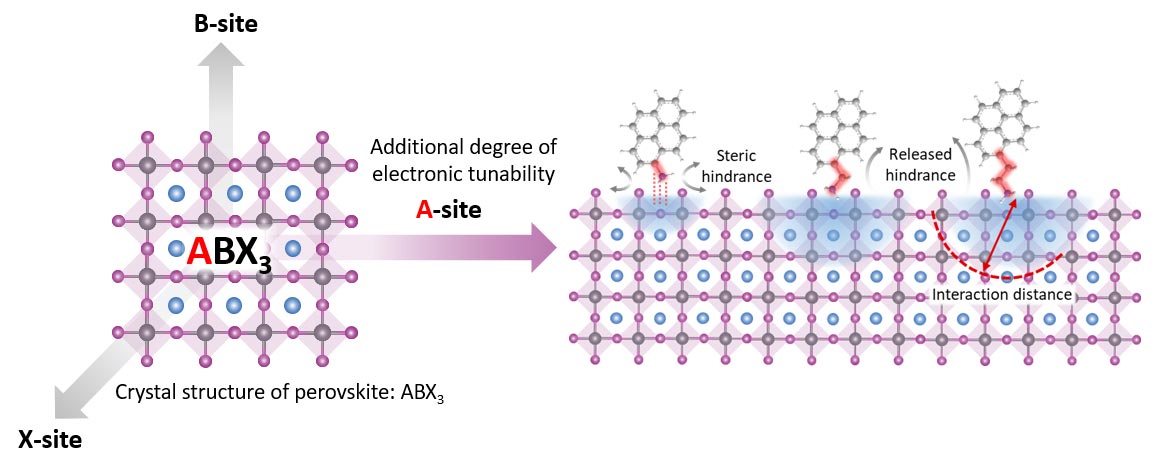
UCLA researchers have discovered a new way to boost perovskite solar cell efficiency by using custom organic molecules to enhance their electronic properties.
UCLA materials scientists and colleagues have discovered that perovskites, a class of promising materials that could be used for low-cost, high-performance solar cells and LEDs, have a previously unutilized molecular component that can further tune the electronic property of perovskites.
Named after Russian mineralogist Lev Perovski, perovskite materials have a crystal-lattice structure of inorganic molecules like that of ceramics, along with organic molecules that are interlaced throughout. Up to now, these organic molecules appeared to only serve a structural function and could not directly contribute to perovskites’ electronic performance.
Led by UCLA, a new study shows that when the organic molecules are designed properly, they not only can maintain the crystal lattice structure, but also contribute to the materials’ electronic properties. This discovery opens up new possibilities to improve the design of materials that will lead to better solar cells and LEDs. The study detailing the research was recently published in Science.
Innovation in Material Design
“This is like finding an old dog that can play new tricks,” said Yang Yang, the Carol and Lawrence E. Tannas Jr. Professor of Engineering at the UCLA Samueli School of Engineering, who is the principal investigator on the research. “In materials science, we look all the way down to the atomic structure of a material for efficient performance. Our postdocs and graduate students didn’t take anything for granted and dug deeper to find a new pathway.”
In order to make a better-performing perovskite material, the researchers incorporated a specially designed organic molecule, a pyrene-containing organic ammonium. On its exterior, the positively charged ammonium molecule connected to molecules of pyrene — a quadruple ring of carbon atoms. This molecular design offered additional electronic tunability of perovskites.
“The unique property of perovskites is that they have the advantage of high-performance inorganic semiconductors, as well as easy and low-cost processability of polymers,” said study co-lead author Rui Wang, a UCLA postdoctoral scholar in materials science and engineering. “This newly enhanced perovskite material now offers opportunities for improved design concepts with better efficiency.”
Improved Performance and Efficiency
To demonstrate perovskites’ added effectiveness, the team built a photovoltaic (PV) cell prototype with the materials, and then tested it under continuous light for 2,000 hours. The new cell continued to convert light to energy at 85% of its original efficiency. This contrasts with a PV cell made of the same materials, but without the added altered organic molecule, which retained only 60% of its original efficiency.
Reference: “Reconfiguring the band-edge states of photovoltaic perovskites by conjugated organic cations” by Jingjing Xue, Rui Wang, Xihan Chen, Canglang Yao, Xiaoyun Jin, Kai-Li Wang, Wenchao Huang, Tianyi Huang, Yepin Zhao, Yaxin Zhai, Dong Meng, Shaun Tan, Ruzhang Liu, Zhao-Kui Wang, Chenhui Zhu, Kai Zhu, Matthew C. Beard, Yanfa Yan and Yang Yang, 5 February 2021, Science.
DOI: 10.1126/science.abd4860
The other co-lead authors on the study are Jingjing Xue, a materials science postdoctoral scholar at UCLA; and Xihan Chen of the U.S. Department of Energy’s National Renewable Energy Laboratory (NREL) in Colorado. The other corresponding authors include Matthew Beard, a senior research fellow at NREL and the director of its Center for Hybrid Organic Inorganic Semiconductors for Energy; and Yanfa Yan, a professor of physics and astronomy at the University of Toledo.
Other authors are from UCLA; NREL; the University of Toledo; Yangzhou University, China; Soochow University, China; Monash University, Australia; and Lawrence Berkeley National Laboratory.
The research was funded by the U.S. Department of Energy.
Never miss a breakthrough: Join the SciTechDaily newsletter.
Follow us on Google and Google News.