
Close Menu
    Facebook X (Twitter) Instagram
    SciTechDaily
    • Biology
    • Chemistry
    • Earth
    • Health
    • Physics
    • Science
    • Space
    • Technology
    Facebook X (Twitter) Pinterest YouTube RSS
    SciTechDaily
    Home»Space»Binary Star QU Carinae, A Possible Supernova Progenitor
    Space

    Binary Star QU Carinae, A Possible Supernova Progenitor

    By Carnegie Institution for ScienceAugust 3, 2012No Comments4 Mins Read
    Facebook Twitter Pinterest Telegram LinkedIn WhatsApp Email Reddit
    Share
    Facebook Twitter LinkedIn Pinterest Telegram Email Reddit
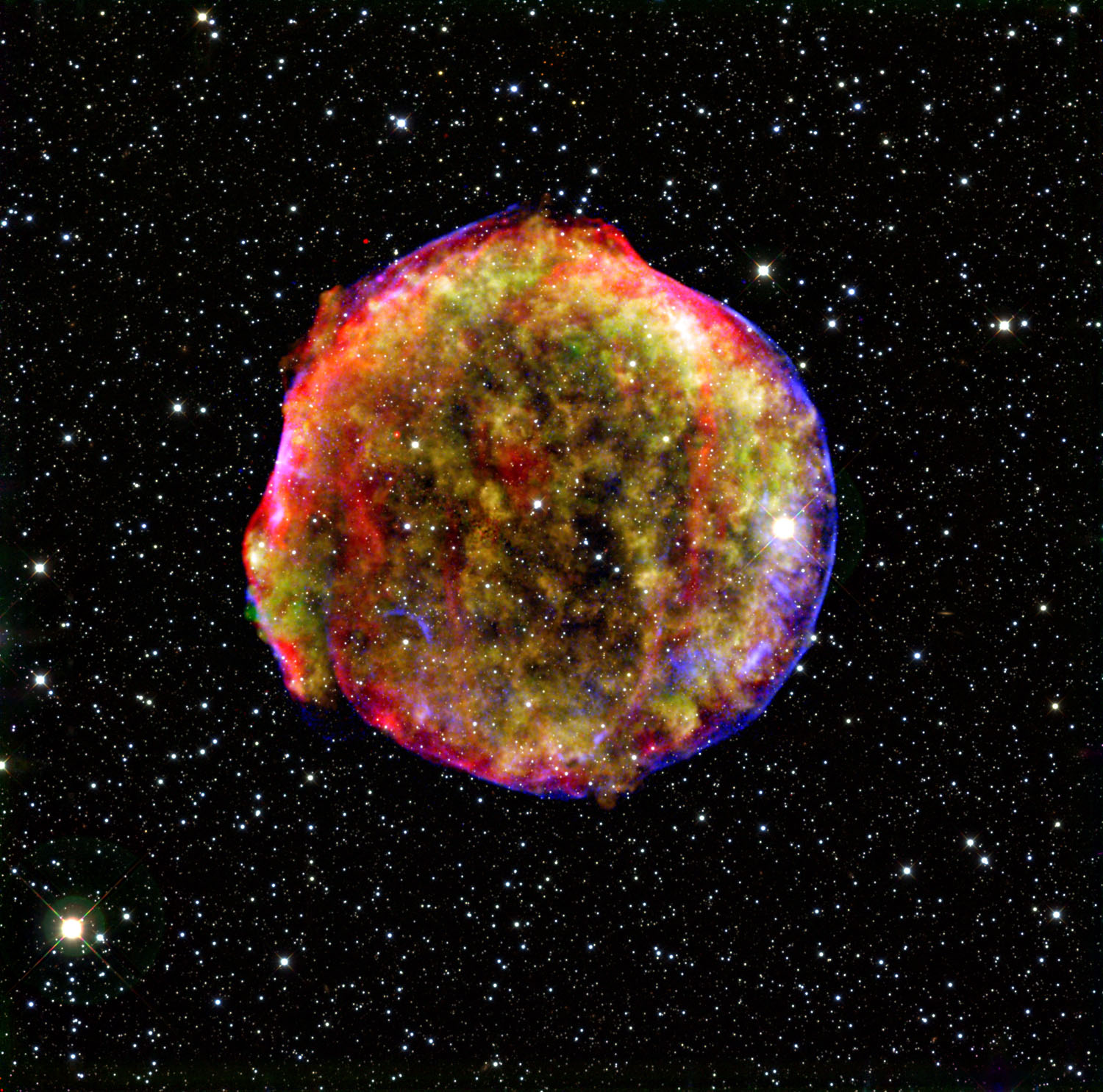
    image of the Tycho supernova
    This composite image of the Tycho supernova remnant combines infrared and X-ray observations obtained with NASA’s Spitzer and Chandra space observatories, respectively, and the Calar Alto observatory, Spain. It shows the scene more than four centuries after the brilliant star explosion witnessed by Tycho Brahe and other astronomers of that era. Credit: MPIA/NASA/Calar Alto Observatory

    Using sodium gas signatures, which have been recognized as being associated with type Ia supernovae, a team of scientists from the Carnegie Institution for Science was able to identify a binary star called QU Carinae as a possible supernova progenitor.

    Type Ia supernovae are violent stellar explosions. Observations of their brightness are used to determine distances in the universe and have shown scientists that the universe is expanding at an accelerating rate. But there is still too little known about the specifics of the processes by which these supernovae form. New research led by Carnegie’s Stella Kafka identifies a star, prior to explosion, which will possibly become a type Ia supernova. The work will be published by the Monthly Notices of the Royal Astronomical Society.

    The widely accepted theory is that type Ia supernovae are thermonuclear explosions of a white dwarf star that’s part of a binary system—two stars that are physically close and orbit around a common center of mass. This white dwarf has mass gradually donated to it by its companion. When the white dwarf mass eventually reaches 1.4 times the sun, it explodes to produce a type Ia supernova. The crucial questions are: What is the nature of the donor star and how does this white dwarf increase its mass. Also, how would that process affect the properties of the explosion?

    With these questions in mind, scientists have been searching for candidate systems that could become type Ia supernovae. There are thousands of possibilities in the candidate pool, none of which have yet been observed to produce an explosion. Recent studies, some of which involved scientists at Carnegie observatories, have identified sodium gas associated with type Ia supernovae. This gas, might be ejected from the binary’s donor star, and linger around the system to be detected after the white dwarf explodes. This provides a clue to the progenitor. Even so, Kafka still compared the search to “looking for a needle in a stellar haystack.”

    Using these gas signatures Kafka and her team—Kent Honeycutt of Indiana University and Bob Williams of the Space Telescope Science Institute—were able to identify a binary star called QU Carinae as a possible supernova progenitor. It contains a white dwarf, which is accumulating mass from a giant star, and sodium has been detected around the system.

    This star belongs to a small category of binaries that are very bright and in which the white dwarf accretes material from its companion at very high rates. Sodium should be produced in the atmosphere of the mass-donor giant star, and it can be ejected from the system via a stellar wind. If the white dwarf of this binary explodes into a supernova, the sodium would be detected with the same sort of signature as those found in other type Ia supernovae.

    “We are really excited to have identified such a system,” Kafka said. “Understanding these systems, the nature of the two stars, the manner in which mass is exchanged, and their long-term evolution will give us a comprehensive picture on how binaries can create one of the most important explosions in the universe.”

    Reference: ” QU Carinae: Type Ia supernova in the making?” by S. Kafka, R. K. Honeycutt and R. Williams, 11 September 2012, Monthly Notices of the Royal Astronomical Society.
    DOI: 10.1111/j.1365-2966.2012.21618.x

    Never miss a breakthrough: Join the SciTechDaily newsletter.
    Follow us on Google and Google News.

    Astrobiology Astronomy Astrophysics Carnegie Institution for Science Supernova
    Share. Facebook Twitter Pinterest LinkedIn Email Reddit

    Related Articles

    Cosmic Mistaken Identity: “Supernova” Is Actually Something Much Rarer

    Carbon-Rich Stardust Grains Unlock Astrophysical Mysteries

    Astronomers Discover First Evidence of Water Ice Clouds Outside Our Solar System

    Supernova Shock Wave Breaks Through a Cocoon of Gas

    Origins of Type Ia Supernovae

    Possible Evidence of Hadron Acceleration in Tycho Supernova Remnant

    Links Between Core Collapse Supernovae and Star Formation Established

    Lasers Mimic Supernova to Explain Cosmic Magnetic Fields

    SN Primo Is Farthest Type Ia Supernova Discovered

    Leave A Reply Cancel Reply

    • Facebook
    • Twitter
    • Pinterest
    • YouTube

    Don't Miss a Discovery

    Subscribe for the Latest in Science & Tech!

    Trending News

    JWST Finds a “Star” 100 Billion Times Brighter Than Any Star Should Be

    Scientists Find a Hidden Biological Link Across Different Forms of Autism

    Astronomers Discover a Ghostly River of Stars That Could Reveal Dark Matter

    Why Is Colorectal Cancer Rising in People Under 50? New Clues Point to the Environment

    Quantum Fluctuations Break a Crystal’s Symmetry Rules

    Why Does an Irregular Heartbeat Strike 40 Years Early in Some People?

    Scientists Reveal How ADHD Could Fuel Creative Thinking

    Scientists Find Just 3 Minutes of Sprinting Can Transform Blood Chemistry

    Follow SciTechDaily
    • Facebook
    • Twitter
    • YouTube
    • Pinterest
    • Newsletter
    • RSS
    SciTech News
    • Biology News
    • Chemistry News
    • Earth News
    • Health News
    • Physics News
    • Science News
    • Space News
    • Technology News
    Recent Posts
    • Common Plant Chemical Linked to Widespread Organ Damage in Aquatic Animals
    • Scientists Discover a Hidden Baobab Species in Madagascar
    • Dogs and Humans May Share a Surprising Biological Secret to Longevity
    • A 150-Million-Year-Old Dinosaur Flight Mystery May Finally Have an Answer
    • Giant Crocodylians Ruled South America’s Ancient Food Chain
    Copyright © 1998 - 2026 SciTechDaily. All Rights Reserved.
    • Science News
    • About
    • Contact
    • Editorial Board
    • Privacy Policy
    • Terms of Use

    Type above and press Enter to search. Press Esc to cancel.