
Close Menu
    Facebook X (Twitter) Instagram
    SciTechDaily
    • Biology
    • Chemistry
    • Earth
    • Health
    • Physics
    • Science
    • Space
    • Technology
    Facebook X (Twitter) Pinterest YouTube RSS
    SciTechDaily
    Home»Space»Space Weather Puzzle Unlocked by Supercomputer Simulations
    Space

    Space Weather Puzzle Unlocked by Supercomputer Simulations

    By University College LondonMay 19, 20211 Comment4 Mins Read
    Facebook Twitter Pinterest Telegram LinkedIn WhatsApp Email Reddit
    Share
    Facebook Twitter LinkedIn Pinterest Telegram Email Reddit
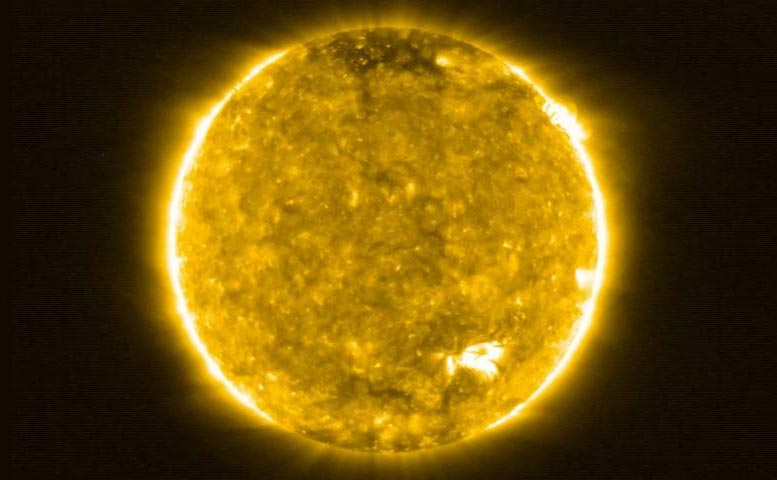
    Solar Orbiter Sun Extreme Ultraviolet Imager
    The Extreme Ultraviolet Imager (EUI) on ESA’s Solar Orbiter spacecraft took this image on May 30, 2020. Dr. David Long (UCL Mullard Space Science Laboratory) is Co-Principal Investigator of the instrument. The image shows the Sun’s appearance at a wavelength of 17 nanometers, which is in the extreme ultraviolet region of the electromagnetic spectrum. Images at this wavelength reveal the upper atmosphere of the Sun, the corona, with a temperature of around 1 million degrees. EUI takes full disk images using the Full Sun Imager (FSI) telescope. The color on this image has been artificially added because the original wavelength detected by the instrument is invisible to the human eye. Credit: Solar Orbiter/EUI Team (ESA & NASA); CSL, IAS, MPS, PMOD/WRC, ROB, UCL MSSL

    Scientists have long questioned why the bursts of hot gas from the Sun do not cool down as fast as expected, and now a UCL-led team of researchers has used a supercomputer to find out why.
    The team will now compare their simulations with ‘real’ data from the European Space Agency’s flagship Solar Orbiter mission, with the hope that it will confirm their predictions and provide a conclusive answer.

    The solar wind is a stream of charged particles continuously shot out from the Sun into the solar system. These ejections greatly impact the conditions of our solar system and constantly hit the Earth. When the solar wind hits the Earth, it is almost 10 times hotter than expected, with a temperature of about 100,000 to 200,000 degrees Celsius (180,000 to 360,000 degrees Fahrenheit). The outer atmosphere of the Sun, where the solar wind originates, is typically a million degrees C.

    If the solar wind is particularly strong, it can cause problems to satellites, astronauts in space, mobile phones, transport, and even electricity networks that power our homes.

    Unraveling the Mysteries of Space Weather

    To successfully forecast and prepare for such space weather events, a team of scientists are trying to solve the mysteries that space weather holds, including how the solar wind is heated and accelerated.
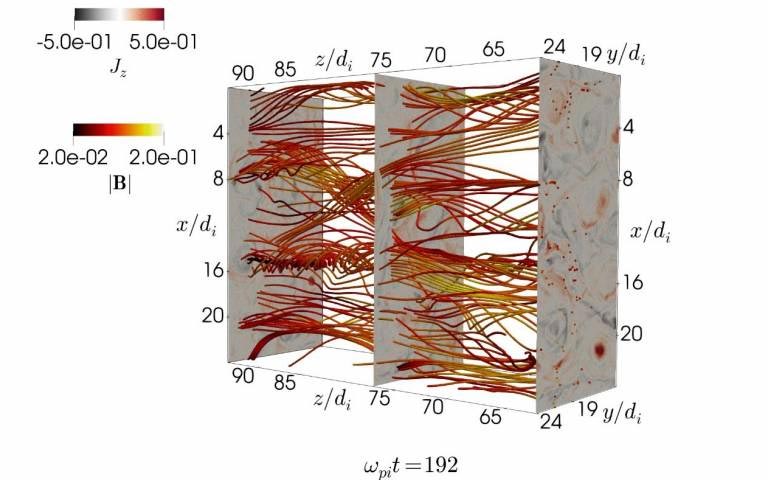
    Solar Wind Simulations
    Credit: Agudelo et al./ Journal of Plasma Physics

    The team, with funding from the Science and Technology Facilities Council (STFC) and the European Space Agency (ESA), ran and analyzed simulations of the solar wind on a powerful supercomputer.

    The simulations were carried out using the DiRAC High Performance Computing (HPC) facility’s Data Intensive at Leicester service, funded by STFC.

    Using these simulations, the team deduced that the solar wind stays hot for longer because of small-scale magnetic reconnection that forms in the turbulence of the solar wind. This phenomenon occurs when two opposing magnetic field lines break and reconnect with each other, releasing huge amounts of energy. This is the same process that triggers large flares erupting from the Sun’s outer atmosphere.

    Small-Scale Events, Huge Energetic Effects

    Lead author and PhD student Jeffersson Agudelo (UCL Mullard Space Science Laboratory) said: “Magnetic reconnection occurs almost spontaneously and all the time in the turbulent solar wind. This type of reconnection typically occurs across an area of several hundred kilometers – which is really tiny compared to the vast dimensions of space.

    “Using the power of supercomputers, we have been able to approach this problem like never before. The magnetic reconnection events we observe in the simulation are so complicated and asymmetric, we are continuing our analysis of these events.”

    To confirm their predictions, the team will compare their data with the data collected by ESA’s Solar Orbiter mission, in which the UCL Mullard Space Science Laboratory plays a leading role.

    Reference: “Three-dimensional magnetic reconnection in particle-in-cell simulations of anisotropic plasma turbulence” by Jeffersson A. Agudelo Rueda, Daniel Verscharen, Robert T. Wicks, Christopher J. Owen, Georgios Nicolaou and Andrew P. Wals, 14 May 2021, Journal of Plasma Physics.
    DOI: 10.1017/S0022377821000404

    Co-author Dr. Daniel Verscharen (UCL MSSL) said: “If we link our detailed simulation results with the cutting-edge observations from Solar Orbiter, we will hopefully make a major leap forward in our understanding of the solar wind.”

    Professor Chris Owen (UCL MSSL) is Principal Investigator of Solar Orbiter’s Solar Wind Analyser, and co-author of the latest paper. Another UCL MSSL scientist, Dr. David Long, is co-Principal Investigator of the spacecraft’s Extreme Ultraviolet Imager.

    Never miss a breakthrough: Join the SciTechDaily newsletter.
    Follow us on Google and Google News.

    Astrophysics Space Weather Sun University College London
    Share. Facebook Twitter Pinterest LinkedIn Email Reddit

    Related Articles

    Scientists Finally Locate the Sun’s Hidden Magnetic Engine Deep Beneath Its Surface

    Satellites at Risk? New AI Predicts Space Weather With Breakthrough Accuracy

    It Rains on the Sun, and Scientists Finally Know Why

    New “Sun Clock” Quantifies Cycle of Extreme Space Weather With Astonishing Precision

    New Research Helps Explain Why the Sun’s Magnetic Field Reverses Every Eleven Years

    NASA Spacecraft Observe Magnetic Reconnection in Action

    Sun’s Magnetic Field Weaker Than a Normal Fridge Magnet

    New Model Advances the Understanding of How Solar Wind Works

    New Light Shed on the Origins of Extreme Space Storms

    1 Comment

    1. Ed Stauffer on May 19, 2021 8:52 am

      Dark matter circulation in the solar system can result in phase transition on the way to the sun releasing heat and causing turbulence in the process. If velocity versus gravity equals zero g then phase transition will occur, think vomit comet.

      Reply
    Leave A Reply Cancel Reply

    • Facebook
    • Twitter
    • Pinterest
    • YouTube

    Don't Miss a Discovery

    Subscribe for the Latest in Science & Tech!

    Trending News

    Researchers Have Found a Dietary Compound That Increases Longevity

    Scientists Baffled by Bizarre “Living Fossil” From 275 Million Years Ago

    Your IQ at 23 Could Predict Your Wealth at 27, Study Finds

    320 Light-Years Away, a Planet Confirms a Fundamental Cosmic Assumption

    The Crown Jewel of Dentistry? Breakthrough Tech Could Transform Tooth Repair

    Python Blood Could Hold the Secret to Weight Loss Without Side Effects

    Naturally Occurring Bacteria Completely Eradicate Tumors in Mice With a Single Dose

    New “Nanozyme Hypothesis” Could Rewrite the Story of Life’s Origins

    Follow SciTechDaily
    • Facebook
    • Twitter
    • YouTube
    • Pinterest
    • Newsletter
    • RSS
    SciTech News
    • Biology News
    • Chemistry News
    • Earth News
    • Health News
    • Physics News
    • Science News
    • Space News
    • Technology News
    Recent Posts
    • How Quantum Mechanics Went From Baffling Theory to Revolutionizing Modern Technology
    • Scientists May Have Found the Key to Jupiter and Saturn’s Moon Mystery
    • Scientists Uncover Hidden Clues to the Origin of the Genetic Code
    • Scientists Discover Unexpected Role of Alzheimer’s Protein in Cell Division
    • Scientists Uncover Brain Changes That Link Pain to Depression
    Copyright © 1998 - 2026 SciTechDaily. All Rights Reserved.
    • Science News
    • About
    • Contact
    • Editorial Board
    • Privacy Policy
    • Terms of Use

    Type above and press Enter to search. Press Esc to cancel.