
Close Menu
    Facebook X (Twitter) Instagram
    SciTechDaily
    • Biology
    • Chemistry
    • Earth
    • Health
    • Physics
    • Science
    • Space
    • Technology
    Facebook X (Twitter) Pinterest YouTube RSS
    SciTechDaily
    Home»Health»Photoactivatable Metabolic Warheads: Light-Sensitive Drug Acts As Trojan Horse to Kill Cancer Cells
    Health

    Photoactivatable Metabolic Warheads: Light-Sensitive Drug Acts As Trojan Horse to Kill Cancer Cells

    By University of EdinburghJune 14, 2021No Comments3 Mins Read
    Facebook Twitter Pinterest Telegram LinkedIn WhatsApp Email Reddit
    Share
    Facebook Twitter LinkedIn Pinterest Telegram Email Reddit
    Photoactivatable Metabolites
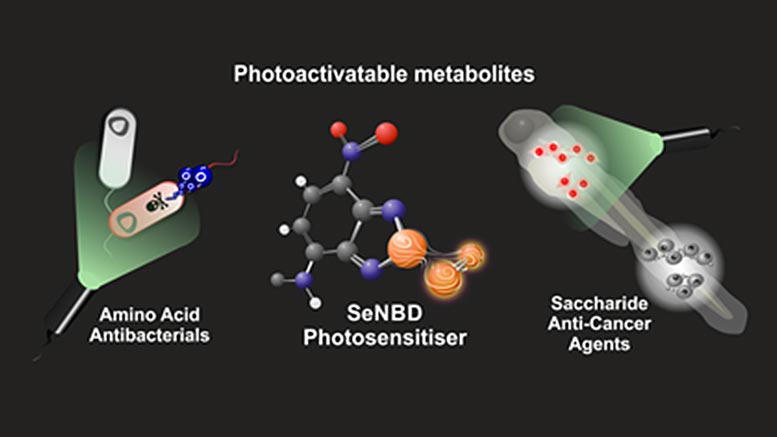
    Scientists found that combining a small bacteria-killing molecule with a chemical food compound tricks bacteria into ingesting the drug, allowing it to penetrate the cell’s defenses more effectively.  Credit: University of Edinburgh

    A light-activated drug that can enter and kill bacterial and cancer cells without harming nearby healthy cells has been tested successfully.

    Scientists found that combining the tiny bacteria-killing molecule with a chemical food compound can trick bacteria into ingesting the drug.

    The molecule – called SeNBD – is smaller than existing light-sensitive treatments, which means it can pass through the cell’s defenses more easily.

    Researchers say further tests are needed to show if the drug is a safe and quick method of treating early stage cancers and drug-resistant bacteria. This study was carried out in zebrafish and human cells.

    Coupling Drug With Metabolite Is Key

    Coupling the drug with a food compound is key to its success. For cells to survive, they must consume chemical components of food – known as metabolites – such as sugars and amino acids for energy.

    Bacterial and cancer cells are greedy, tending to consume higher concentrations and different types of metabolites than healthy cells. Pairing SeNBD with a metabolite makes it ideal prey for harmful cells.

    Until now, most light-activated drugs have been bigger than metabolites, which means bacteria and cancer cells do not recognize them as normal food.

    Researchers at the University of Edinburgh, who have invented SeNBD, compare it to a Trojan horse and describe its effect as that of a metabolic warhead. Harmful cells ingested the linked drug without being alerted to its toxic nature.

    With SeNBD, we can combine a light activated drug with the food that cancerous and bacterial cells normally eat. This means we can deliver our ‘Trojan horse’ directly through the front door of the cell rather than trying to find a way to batter through the cells defences.
    Dr Sam BensonPost-doctoral researcher, at University of Edinburgh’s Centre for Inflammation

    Activated by Visible Light

    As well as being small enough to enter cells, SeNBD is also a type of drug called a photosensitizer, which means that it kills cells only after it is activated by visible light.

    Switching on the drug with light means a surgeon could decide exactly where they want the drug to be active, avoiding the chances of attacking healthy tissue and preventing the kind of side effects caused by other drugs.

    Lead researcher Professor Marc Vendrell, Chair of Translational Chemistry and Biomedical Imaging at the University of Edinburgh, said:

    “This research represents an important advance in the design of new therapies that can be simply activated by light irradiation, which is generally very safe. SeNBD is one of the smallest photosensitizers ever made and its use as a ‘Trojan horse’ opens many new opportunities in interventional medicine for killing harmful cells without affecting surrounding healthy tissue.”

    The findings of this research are published in Nature Communications journal.

    Reference: “Photoactivatable metabolic warheads enable precise and safe ablation of target cells in vivo” by Sam Benson, Fabio de Moliner, Antonio Fernandez, Erkin Kuru, Nicholas L. Asiimwe, Jun-Seok Lee, Lloyd Hamilton, Dirk Sieger, Isabel R. Bravo, Abigail M. Elliot, Yi Feng and Marc Vendrell, 22 April 2021, Nature Communications.
    DOI: 10.1038/s41467-021-22578-2

    Never miss a breakthrough: Join the SciTechDaily newsletter.
    Follow us on Google and Google News.

    Antibiotics Cancer Cell Biology University of Edinburgh
    Share. Facebook Twitter Pinterest LinkedIn Email Reddit

    Related Articles

    Scientists Identify Genes Associated with Progression of Melanoma

    New Research Shows Cellular Clean-Up Can Also Sweep Away Forms of Cancer

    Researchers Identify a New Way to Suppress Lung Tumors

    Yale Study Reveals How a Cancer Gene Promotes Tumor Growth

    Yale Study Shows Key Protein In Pancreatic Cancer Growth May Also Be Its Undoing

    Scientists Reveal Amino Acids Supply Most Building Blocks for Tumor Cells

    MIT Research Shows How Diet Influences Colon Cancer

    New Model Captures Shape and Speed of Tumor Growth for the First Time

    New Form of Radiation Cancer Therapy Has No Side-Effects

    Leave A Reply Cancel Reply

    • Facebook
    • Twitter
    • Pinterest
    • YouTube

    Don't Miss a Discovery

    Subscribe for the Latest in Science & Tech!

    Trending News

    Scientists Warn That This Common Pet Fish Can Wreck Entire Ecosystems

    Scientists Make Breakthrough in Turning Plastic Trash Into Clean Fuel Using Sunlight

    This Popular Supplement May Interfere With Cancer Treatment, Scientists Warn

    Scientists Finally Solved One of Water’s Biggest Mysteries

    Could This New Weight-Loss Pill Disrupt the Entire Market? Here’s What You Should Know About Orforglipron

    Earth’s Crust Is Tearing Open in Africa, and It Could Form a New Ocean

    Breakthrough Bowel Cancer Trial Leaves Patients Cancer-Free for Nearly 3 Years

    Natural Compound Shows Powerful Potential Against Rheumatoid Arthritis

    Follow SciTechDaily
    • Facebook
    • Twitter
    • YouTube
    • Pinterest
    • Newsletter
    • RSS
    SciTech News
    • Biology News
    • Chemistry News
    • Earth News
    • Health News
    • Physics News
    • Science News
    • Space News
    • Technology News
    Recent Posts
    • The Most Effective Knee Arthritis Treatments Aren’t What You Expect
    • Scientists Develop Bioengineered Chewing Gum That Could Help Fight Oral Cancer
    • Popular Weight-Loss Drugs Found To Cut Heart Attack and Stroke Risk
    • After 37 Years, the World’s Longest-Running Soil Warming Experiment Uncovers a Startling Climate Secret
    • NASA Satellite Captures First-Ever High-Res View of Massive Pacific Tsunami
    Copyright © 1998 - 2026 SciTechDaily. All Rights Reserved.
    • Science News
    • About
    • Contact
    • Editorial Board
    • Privacy Policy
    • Terms of Use

    Type above and press Enter to search. Press Esc to cancel.