
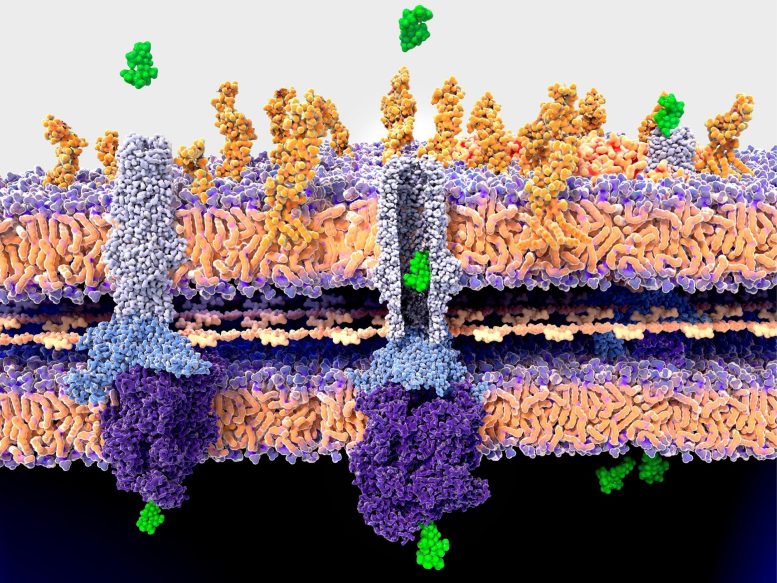
The mechanism which allows β-lactam antibiotics, including penicillin, to kill MRSA has been revealed for the first time.
An international team of researchers led by the University of Sheffield discovered that β-lactam antibiotics kill MRSA (Methicillin Resistant S. aureus) by creating holes in the cell wall which enlarge as the cell grows, eventually killing the bacteria.
The growth of these holes leads to failure of the cell wall and death of the bacteria, something which the scientists now plan to exploit in order to create new therapeutics for antibiotic-resistant superbugs.
It was previously known that β-lactam antibiotics work by preventing cell wall growth, but exactly how they kill has remained a mystery until now.
Professor Simon Foster, from the University of Sheffield’s School of Biosciences, said: “Penicillin and other antibiotics in its class have been a centerpiece of human healthcare for over 80 years and have saved over 200 million lives. However, their use is severely threatened by the global spread of antimicrobial resistance.
“Concentrating on the superbug MRSA, our research revealed that the antibiotics lead to the formation of small holes that span the cell wall that gradually enlarge as part of growth-associated processes, eventually killing the bacteria. We also identified some of the enzymes that are involved in making the holes.
“Our findings get to the heart of understanding how existing antibiotics work and give us new avenues for further treatment developments in the face of the global pandemic of antimicrobial resistance.”
Using this knowledge and an understanding of how the enzymes are controlled, the scientists also showed the efficacy of a novel combination therapy against S. aureus.
The team worked with a simple model for how the bacterial cell wall expands during growth and division and established a hypothesis for what happens when this is inhibited by antibiotics like penicillin. The predictions of this model were tested using a combination of molecular approaches, including high resolution atomic force microscopy.
The project was led by the University of Sheffield as an international, interdisciplinary effort, involving groups at Xiamen University in China, Masaryk University in the Czech Republic, and McMaster University in Canada.
In 1930 the first documented use of penicillin as a therapy was carried out in Sheffield by Cecil George Paine, a member of the University’s Pathology Department. He treated an eye infection in two babies with a crude filtrate from a penicillin-producing mold supplied by his lecturer, Alexander Fleming, whilst studying at St Mary’s Hospital Medical School in London.
Reference: “Demonstration of the role of cell wall homeostasis in Staphylococcus aureus growth and the action of bactericidal antibiotics” by Bartłomiej Salamaga, Lingyuan Kong, Laia Pasquina-Lemonche, Lucia Lafage, Milena von und zur Muhlen, Josie F. Gibson, Danyil Grybchuk, Amy K. Tooke, Viralkumar Panchal, Elizabeth J. Culp, Elizabeth Tatham, Mary E. O’Kane, Thomas E. Catley, Stephen A. Renshaw, Gerard D. Wright, Pavel Plevka, Per A. Bullough, Aidong Han, Jamie K. Hobbs and Simon J. Foster, 29 October 2021, Proceedings of the National Academy of Sciences.
DOI: 10.1073/pnas.2106022118
Never miss a breakthrough: Join the SciTechDaily newsletter.
Follow us on Google and Google News.
2 Comments
It looks like the study used S. Aureus, not Methicillin resistant S. Aureus which is beta-lactam resistant.
MRSA is intrinsically beta lactam resistant due to it’s acquisition of the MecA gene. This must be written by a particularly dim AI.