
Close Menu
    Facebook X (Twitter) Instagram
    SciTechDaily
    • Biology
    • Chemistry
    • Earth
    • Health
    • Physics
    • Science
    • Space
    • Technology
    Facebook X (Twitter) Pinterest YouTube RSS
    SciTechDaily
    Home»Space»Nebula Churns Out Massive B-Type Stars in New Hubble Image
    Space

    Nebula Churns Out Massive B-Type Stars in New Hubble Image

    By NASA's Goddard Space Flight CenterNovember 18, 2021No Comments2 Mins Read
    Facebook Twitter Pinterest Telegram LinkedIn WhatsApp Email Reddit
    Share
    Facebook Twitter LinkedIn Pinterest Telegram Email Reddit
    Star-Forming Nebula (G035.20–0.74)
    The star-forming nebula (G035.20-0.74) in this Hubble image is in the constellation Aquila, the Eagle. Credit: NASA, ESA, and J. Tan (Chalmers University of Technology); Processing; Gladys Kober (NASA/Catholic University of America)

    Hubble revealed that massive protostars produce jets like smaller stars, hinting at a universal star-formation process.

    Stars are born from turbulent clouds of gas and dust that collapse under their own gravitational attraction. As the cloud collapses, a dense, hot core forms and begins gathering dust and gas, creating a protostar. This star-forming nebula in the constellation Aquila, G035.20-0.74, is known for producing a particular kind of massive star known as a B-Type star. These stars are hot, young, blue stars up to five times hotter than our Sun.

    Hubble observed this region because it is home to a massive protostar, specifically as part of a program examining jets of glowing gas blasted into space by massive protostars. These fast-moving jets, which form as gas collects around newly forming stars and last for only about 100,000 years, are known to play a role in star formation. Astronomers were interested to learn whether such jets influence the formation of massive stars similar to the way they affect the formation of lower-mass stars. Massive stars are typically rarer, more distant, and more hidden by dust than lower-mass stars, making studies of their jets more challenging.

    Researchers combined infrared observations from Hubble with those from radio telescopes in order to see inside these dusty star-forming regions. They found a jet of material with properties similar to jets associated with young, low-mass stars. This implies that the mechanism creating the light emitted by these jets is similar in young stars of different masses, up to 10 times the mass of the Sun.
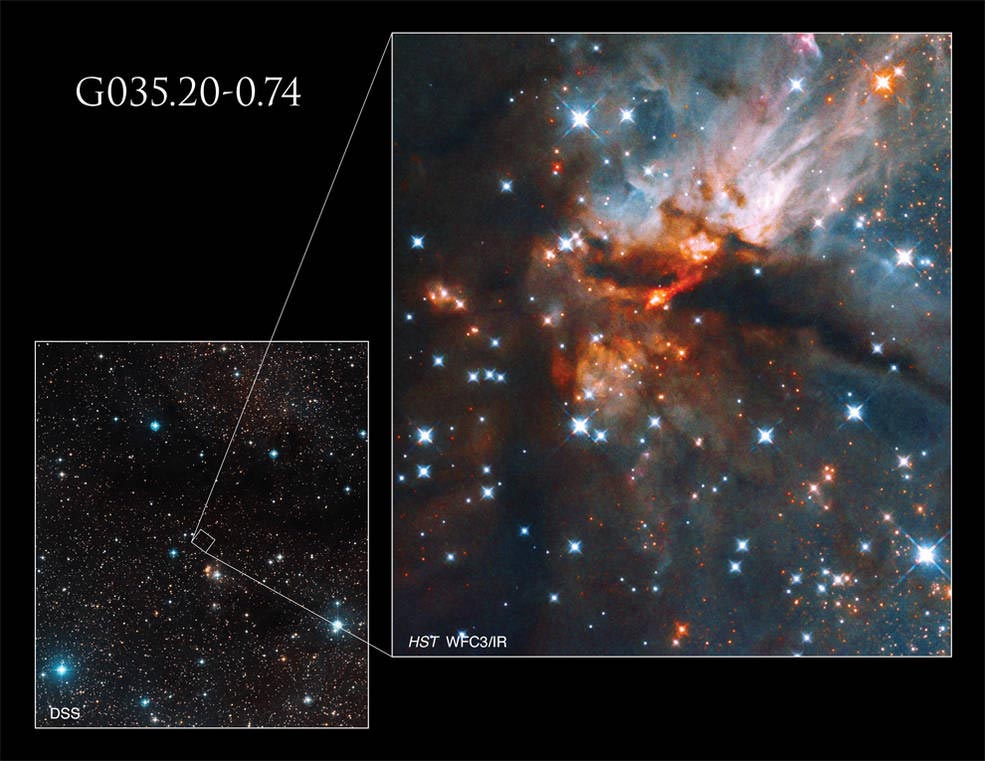
    Nebula (G035.20–0.74)
    The star-forming nebula (G035.20-0.74) in this Hubble image is in the constellation Aquila, the Eagle. Credit: NASA, ESA, J. Tan (Chalmers University of Technology), and DSS; Processing; Gladys Kober (NASA/Catholic University of America)

    Never miss a breakthrough: Join the SciTechDaily newsletter.
    Follow us on Google and Google News.

    Astronomy Hubble Space Telescope NASA NASA Goddard Space Flight Center
    Share. Facebook Twitter Pinterest LinkedIn Email Reddit

    Related Articles

    Astronomers Finally Solve Betelgeuse’s Biggest Mystery

    The Andromeda Mystery: Hubble Discovers Strange Galactic Behavior

    3.7 Billion Miles Away: Hubble Uncovers a Hidden Trio That Could Rewrite Kuiper Belt History

    Historic Discovery: Twin Titans Clash As NASA Unveils Closest Supermassive Black Hole Duo

    The Great Escape: NASA’s Hubble and MAVEN Help Solve Mystery of Mars’ Vanishing Water

    Into the Rosy Depths: Hubble’s Journey Through Andromeda

    Hubble Observes a Lonely Beacon in the Cosmic Dark

    What Lies Within? Hubble’s Deep Dive Into the Structured Chaos of Leo A

    Hubble Spots Billowing Bubbles of Stellar Floss Across 1,000 Light-Year Expanse

    Leave A Reply Cancel Reply

    • Facebook
    • Twitter
    • Pinterest
    • YouTube

    Don't Miss a Discovery

    Subscribe for the Latest in Science & Tech!

    Trending News

    Sitting Up Straight Could Actually Help You Make Better Decisions

    Never-Before-Seen Vortices Are Swirling Across the Sun

    This Common Amino Acid May Help the Body Fight Cancer and Viruses

    Low-Protein “Longevity Diet” Linked to Fat Loss, Muscle Preservation, and Healthy Aging

    How Prehistoric Poop Changed Earth’s Ecosystems Forever

    This Fossil Upends a Decades-Old Debate About Snake Evolution

    A Blood Test Years Before Cancer May Reveal a Hidden Warning Sign

    Starlink Satellites Reveal a Hidden Atmosphere 300 Miles Above Earth

    Follow SciTechDaily
    • Facebook
    • Twitter
    • YouTube
    • Pinterest
    • Newsletter
    • RSS
    SciTech News
    • Biology News
    • Chemistry News
    • Earth News
    • Health News
    • Physics News
    • Science News
    • Space News
    • Technology News
    Recent Posts
    • A Simple Feeding Change Makes Zoo Lions Behave More Like They Do in the Wild
    • Scientists Discover a Hidden World of Fungi 1,640 Feet Beneath Michigan
    • Where Were All the Tiny Dinosaurs? Scientists May Finally Have an Answer
    • Astronomers Caught a Star Exploding Almost the Instant It Began
    • Empty Space May Not Be Empty After All: Magnetar Reveals a Bizarre Quantum Effect
    Copyright © 1998 - 2026 SciTechDaily. All Rights Reserved.
    • Science News
    • About
    • Contact
    • Editorial Board
    • Privacy Policy
    • Terms of Use

    Type above and press Enter to search. Press Esc to cancel.