
Close Menu
    Facebook X (Twitter) Instagram
    SciTechDaily
    • Biology
    • Chemistry
    • Earth
    • Health
    • Physics
    • Science
    • Space
    • Technology
    Facebook X (Twitter) Pinterest YouTube RSS
    SciTechDaily
    Home»Space»Hubble Spots Billowing Bubbles of Stellar Floss Across 1,000 Light-Year Expanse
    Space

    Hubble Spots Billowing Bubbles of Stellar Floss Across 1,000 Light-Year Expanse

    By NASA's Goddard Space Flight CenterAugust 21, 2024No Comments2 Mins Read
    Facebook Twitter Pinterest Telegram LinkedIn WhatsApp Email Reddit
    Share
    Facebook Twitter LinkedIn Pinterest Telegram Email Reddit
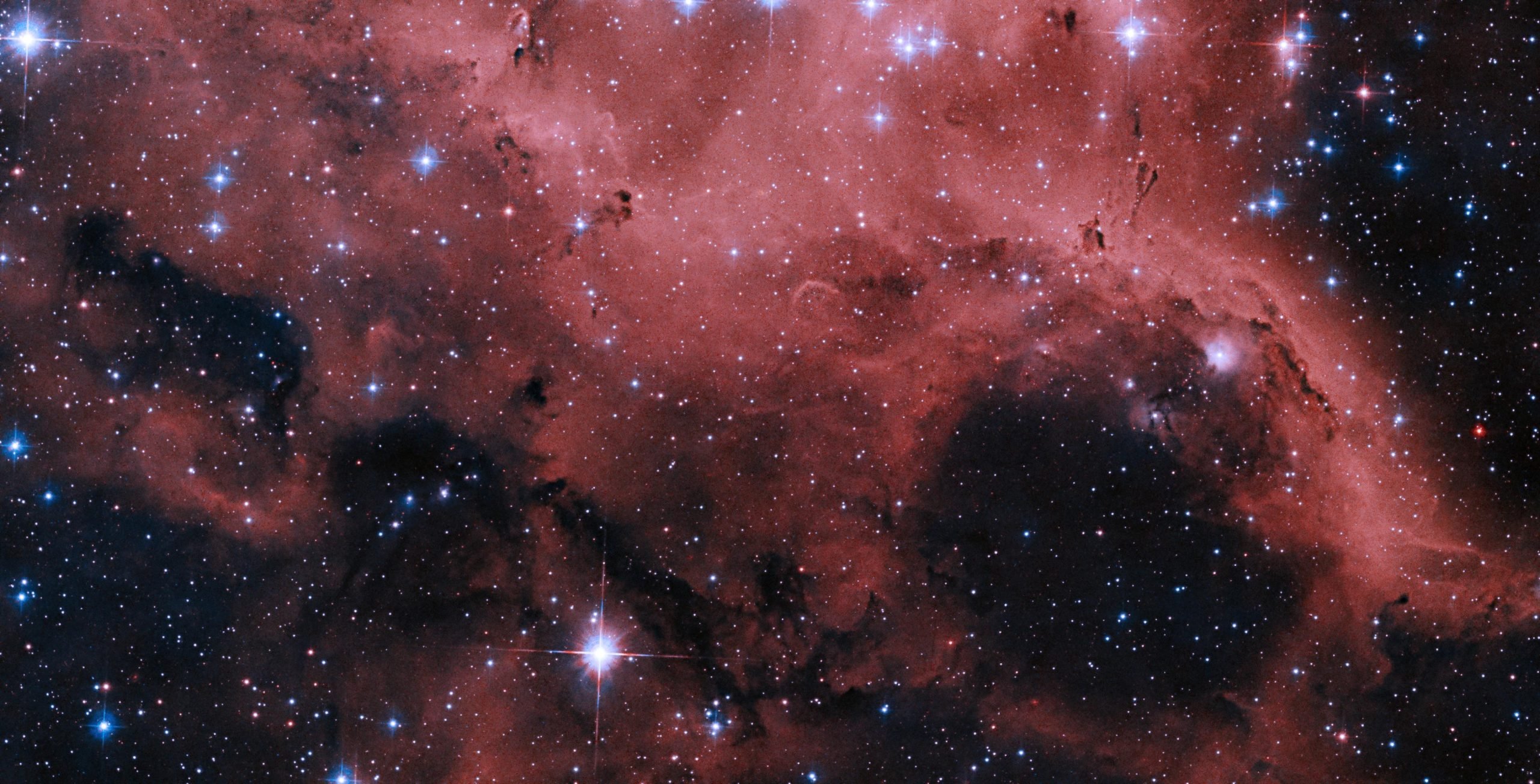
    Complex Cluster of Emission Nebulae Within the Large Magellanic Cloud
    This Hubble image shows a complex cluster of emission nebulae, nestled within the Large Magellanic Cloud. Credit: NASA, ESA, and J. M. Apellaniz (Centro de Astrobiologia (CSIC/INTA Inst. Nac. de Tec. Aero.); Image Processing: Gladys Kober (NASA/Catholic University of America)

    Situated in the constellation Dorado, the N11 star cluster lies within the Large Magellanic Cloud and features a mix of old and new stars across its 1,000-light-year expanse. NASA’s Hubble has vividly imaged this region, revealing its complex interstellar dynamics and diverse stellar populations, making it a focal point for astronomical studies.

    A bubbling region of stars both old and new lies some 160,000 light-years away in the constellation Dorado. This complex cluster of emission nebulae is known as N11, and was discovered by American astronomer and NASA astronaut Karl Gordon Henize in 1956. NASA’s Hubble Space Telescope brings a new image of the cluster in the Large Magellanic Cloud (LMC), a nearby dwarf galaxy orbiting the Milky Way.

    About 1,000 light-years across, N11’s sprawling filaments weave stellar matter in and out of each other like sparkling candy floss. These cotton-spun clouds of gas are ionized by a burgeoning host of young and massive stars, giving the complex a cherry-pink appearance. Throughout N11, colossal cavities burst from the fog. These bubbles formed as a result of the vigorous emergence and death of stars contained in the nebulae. Their stellar winds and supernovae carved the surrounding area into shells of gas and dust.
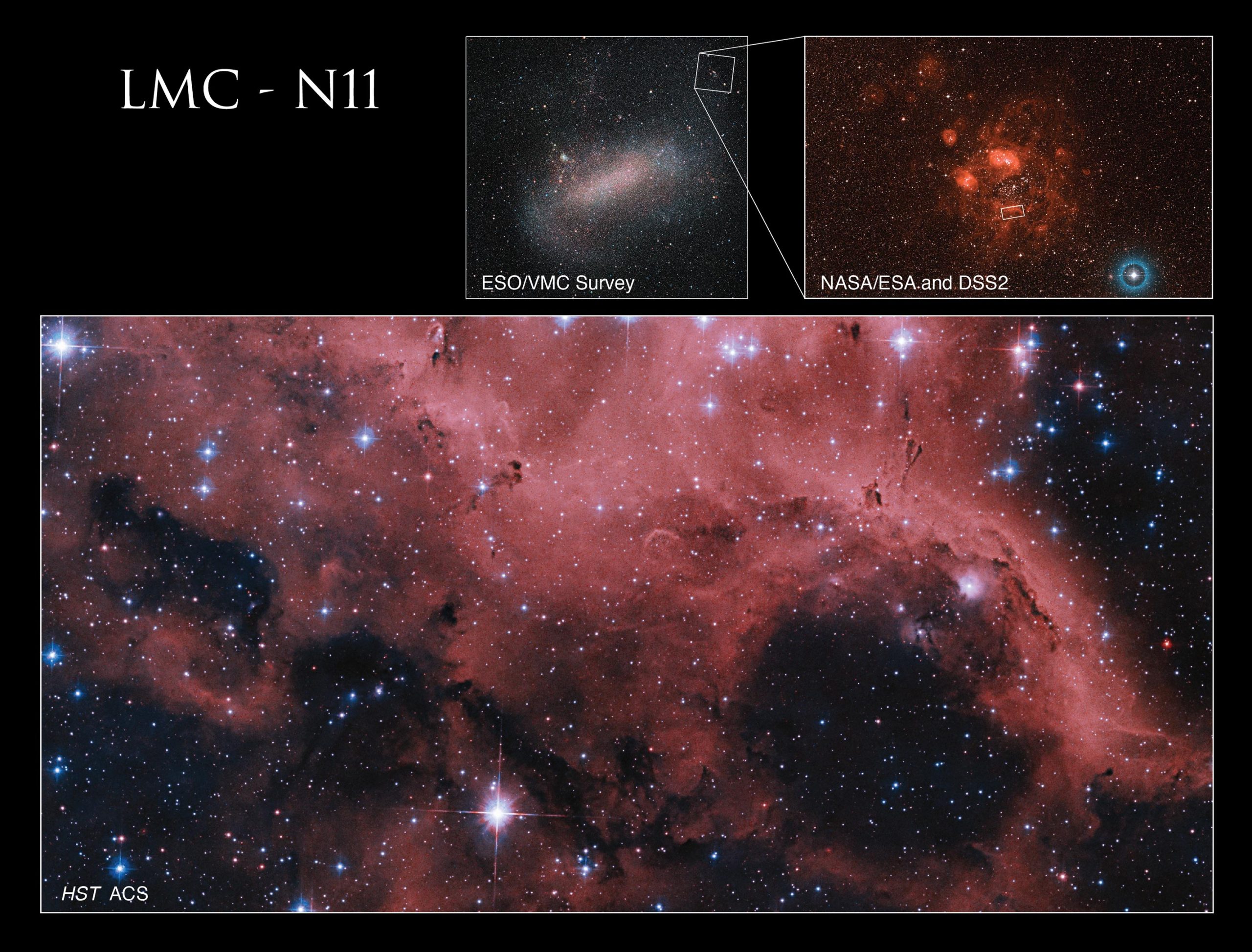
    Large Magellanic Cloud LMC N11
    This inset image shows where N11 is located within the Large Magellanic Cloud. Credit: NASA, ESA, J. M. Apellaniz (Centro de Astrobiologia (CSIC/INTA Inst. Nac. de Tec. Aero.), ESO VMC Survey, and DSS2; Image Processing: Gladys Kober (NASA/Catholic University of America)

    N11’s stellar activity caught the attention of many astronomers, as it is one of the largest and most energetic regions in the LMC. To investigate the distribution of stars in N11, scientists used Hubble’s Advanced Camera for Surveys (ACS), taking advantage of its sensitivity and excellent wide-field resolution. The cluster houses a wide array of stars for Hubble to examine, including one area that has stopped forming stars, and another that continues to form them. Hubble’s unique capabilities allowed astronomers to comprehensively study the diversity of stars in the N11 complex, and map the differences between each region.

    Never miss a breakthrough: Join the SciTechDaily newsletter.
    Follow us on Google and Google News.

    Astronomy Hubble Space Telescope NASA NASA Goddard Space Flight Center
    Share. Facebook Twitter Pinterest LinkedIn Email Reddit

    Related Articles

    “Ghost Galaxy” Made of 99% Dark Matter Discovered 300 Million Light Years Away

    Astronomers Finally Solve Betelgeuse’s Biggest Mystery

    The Andromeda Mystery: Hubble Discovers Strange Galactic Behavior

    3.7 Billion Miles Away: Hubble Uncovers a Hidden Trio That Could Rewrite Kuiper Belt History

    Historic Discovery: Twin Titans Clash As NASA Unveils Closest Supermassive Black Hole Duo

    The Great Escape: NASA’s Hubble and MAVEN Help Solve Mystery of Mars’ Vanishing Water

    Into the Rosy Depths: Hubble’s Journey Through Andromeda

    Hubble Observes a Lonely Beacon in the Cosmic Dark

    What Lies Within? Hubble’s Deep Dive Into the Structured Chaos of Leo A

    Leave A Reply Cancel Reply

    • Facebook
    • Twitter
    • Pinterest
    • YouTube

    Don't Miss a Discovery

    Subscribe for the Latest in Science & Tech!

    Trending News

    What Causes Chronic Pain? Scientists Identify Key Culprit in the Brain

    Semaglutide Shows Surprising Mental Health Benefits in Massive 100,000-Person Study

    This Liquid Snapped Instead of Flowing and Scientists Were Shocked

    Breakthrough Alzheimer’s Drug Rewires the Brain Instead of Just Clearing Plaques

    Scientists Discover Hidden “Footprint of Death” That Could Transform How We Fight Disease

    A Simple Nose Swab Could Detect Alzheimer’s Years Before Symptoms Appear

    Scientists Just Rewrote the Timeline of Complex Life on Earth

    Teenager’s Fossil Find Leads to Discovery of Shark Teeth in 5 Million-Year-Old Whale Skull

    Follow SciTechDaily
    • Facebook
    • Twitter
    • YouTube
    • Pinterest
    • Newsletter
    • RSS
    SciTech News
    • Biology News
    • Chemistry News
    • Earth News
    • Health News
    • Physics News
    • Science News
    • Space News
    • Technology News
    Recent Posts
    • Even “Failed” Diets May Deliver Long-Term Health Gains, Study Finds
    • Childhood Junk Food May Rewire the Brain for Life
    • NIH Scientists Discover Powerful New Opioid That Relieves Pain Without Dangerous Side Effects
    • Breakthrough Study Reveals Why Damaged Nerves Struggle To Heal
    • 20-Year Study Reveals Cholera’s Surprising Weakness
    Copyright © 1998 - 2026 SciTechDaily. All Rights Reserved.
    • Science News
    • About
    • Contact
    • Editorial Board
    • Privacy Policy
    • Terms of Use

    Type above and press Enter to search. Press Esc to cancel.