
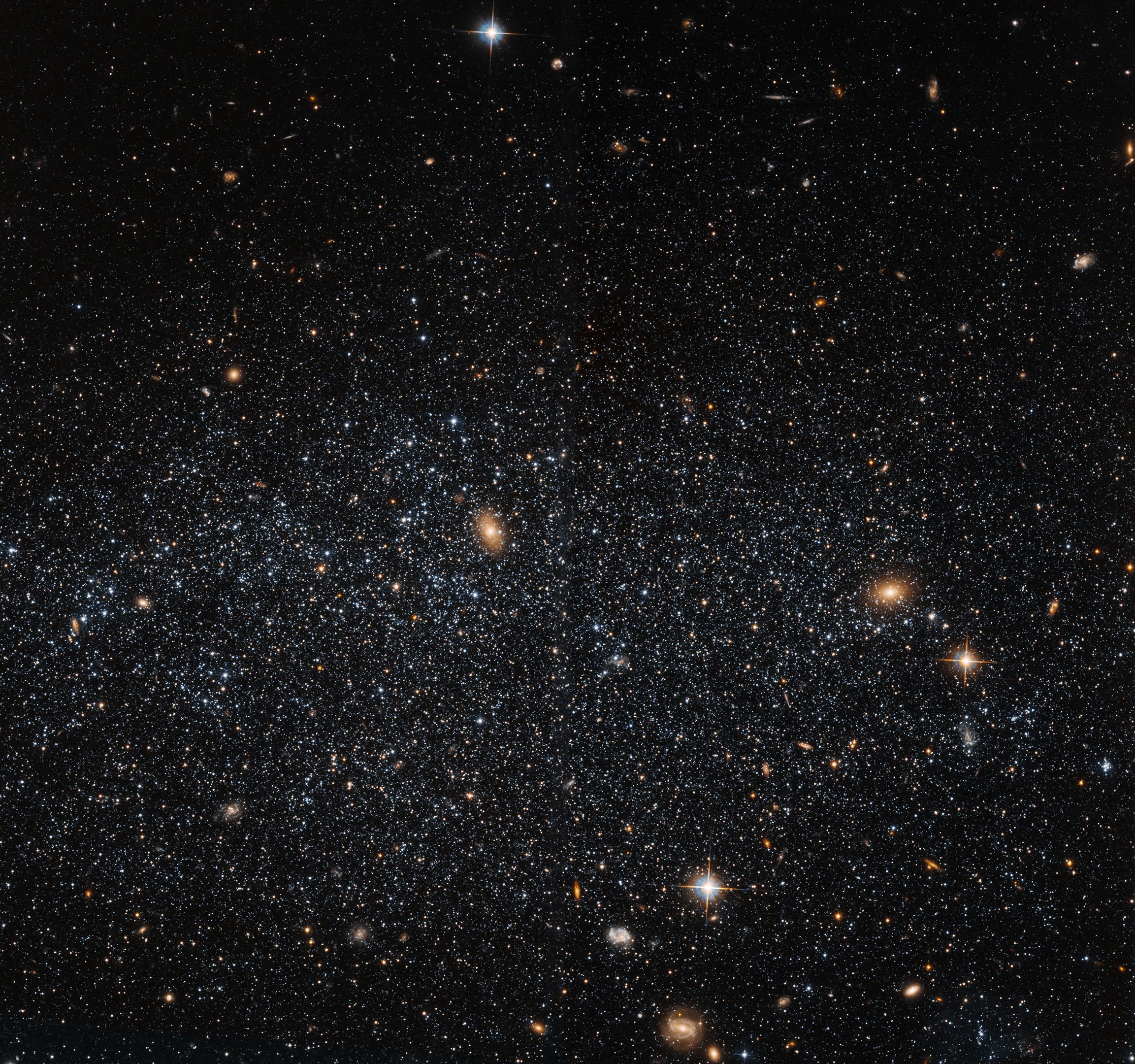
The Hubble Space Telescope captured an image of Leo A, a dwarf irregular galaxy 2.6 million light-years away. This galaxy, crucial for studying the evolution of galaxies due to its proximity and distinct characteristics, reveals a sparse distribution of stars that allows light from distant galaxies to penetrate through.
This NASA Hubble Space Telescope image features the nearby dwarf irregular galaxy Leo A, located approximately 2.6 million light-years away. The relatively open distribution of stars in this diminutive galaxy allows light from distant background galaxies to shine through.
Importance of Dwarf Galaxies in Astronomy
Astronomers study dwarf galaxies like Leo A because they are numerous and may offer clues to how galaxies grow and evolve. Dwarf galaxies are small and dim making the most distant members of this galaxy type difficult to study. As a result, astronomers point their telescopes toward those that are relatively near to our own Milky Way galaxy, like Leo A.
Structural Insights and Isolation of Leo A
Leo A is one of the most isolated galaxies in our Local Group of galaxies. Its form appears as a roughly spherical, sparsely populated mass of stars with no obvious structural features like spiral arms.
The data that created this image came from four Hubble observing programs. Three of these looked at star formation histories of relatively nearby dwarf galaxies. The fourth sought to better determine the mass of our Local Group by looking at the motions of dwarf galaxies just outside of the Local Group.
Revealing Star Formation Patterns in Leo A
The Hubble observations that looked at star formation found distinct structural differences in the age and distribution of stars in the galaxy. Most of the younger stars are located in the middle of the galaxy, while the number of older stars increases as you move outward from the center.
Hubble observations also suggest that the galaxy’s halo of stars is about one-third larger than previous estimates. This distribution suggests that star formation in Leo A occurred from the outside-in, or that older stars efficiently migrated to the outskirts of Leo A in the early stages of its evolution.
Never miss a breakthrough: Join the SciTechDaily newsletter.
Follow us on Google and Google News.
2 Comments
Space has physical properties of zero viscosity and absolute incompressibility. Zero viscosity and absolute incompressibility are physical characteristics of ideal fluids. The space with ideal fluid physical characteristics forms vortices via topological phase transitions, which is not difficult to understand mathematically. Once the topological vortex is formed, it occupies space and maintains its presence in time. This is the transition from chaos to order via two bidirectional coupled continuous chaotic systems.
From cosmic accretion disks to particle spins, topological vortex fractal structures are ubiquitous. Symmetry of topological vortex can be used to explore particle behavior under spatial, temporal, and quantum reversals, involving quantum gravity, discrete and continuous changes. It underpins the consistency of natural laws and experiment reproducibility.
Scientific research guided by correct theories can help humanity avoid detours, failures, and pomposity. Please witness the exemplary collaboration between theoretical physicists and experimentalists (https://scitechdaily.com/microscope-spacecrafts-most-precise-test-of-key-component-of-the-theory-of-general-relativity/#comment-854286). Some people in contemporary physics has always lived in a self righteous children’s story world. Whose values have been overturned by such a comical and ridiculous reality?
From Physical Review Letters (PRL), to Nature, and Science, even the Proceedings of the National Academy of Sciences (PNAS), the so-called academic journals firmly believe that two high-dimensional spacetime objects (such as two sets of cobalt-60) rotating in opposite directions can be transformed into two objects that mirror each other, and that the asymmetry between the amount of created matter and antimatter led to the matter-dominated Universe as we know it today.
Does the facts tell the so-called academic journals that two sets of cobalt-60 rotating in opposite directions can be transformed into two objects that mirror each other? Does mathematics tell the so-called academic journals that matter and antimatter are asymmetric? When physics no longer believes in facts and mathematics, it is no different from theology.
Naked walkers never consider themselves ugly, but rather consider themselves cool.
The physical phenomena observed in scientific experiments are always just appearances, not the natural essence of things. The natural essence of things needs to be extracted and sublimated based on natural phenomena via mathematical theories. Mathematics is the main environment for modeling problems in other areas. Observations and experiments, theory, and modeling reinforce each other and together lead to our understanding of physical phenomena. After understanding and mastering the natural essence of things, humans can predict more possible natural phenomena, and even manipulate and implement them.
Blah blah blah
Organized chaos?
Only in man’s mind.