
Close Menu
    Facebook X (Twitter) Instagram
    SciTechDaily
    • Biology
    • Chemistry
    • Earth
    • Health
    • Physics
    • Science
    • Space
    • Technology
    Facebook X (Twitter) Pinterest YouTube RSS
    SciTechDaily
    Home»Space»Hubble Observes a Lonely Beacon in the Cosmic Dark
    Space

    Hubble Observes a Lonely Beacon in the Cosmic Dark

    By NASA's Goddard Space Flight CenterAugust 30, 2024No Comments3 Mins Read
    Facebook Twitter Pinterest Telegram LinkedIn WhatsApp Email Reddit
    Share
    Facebook Twitter LinkedIn Pinterest Telegram Email Reddit
    Tucana Dwarf Galaxy
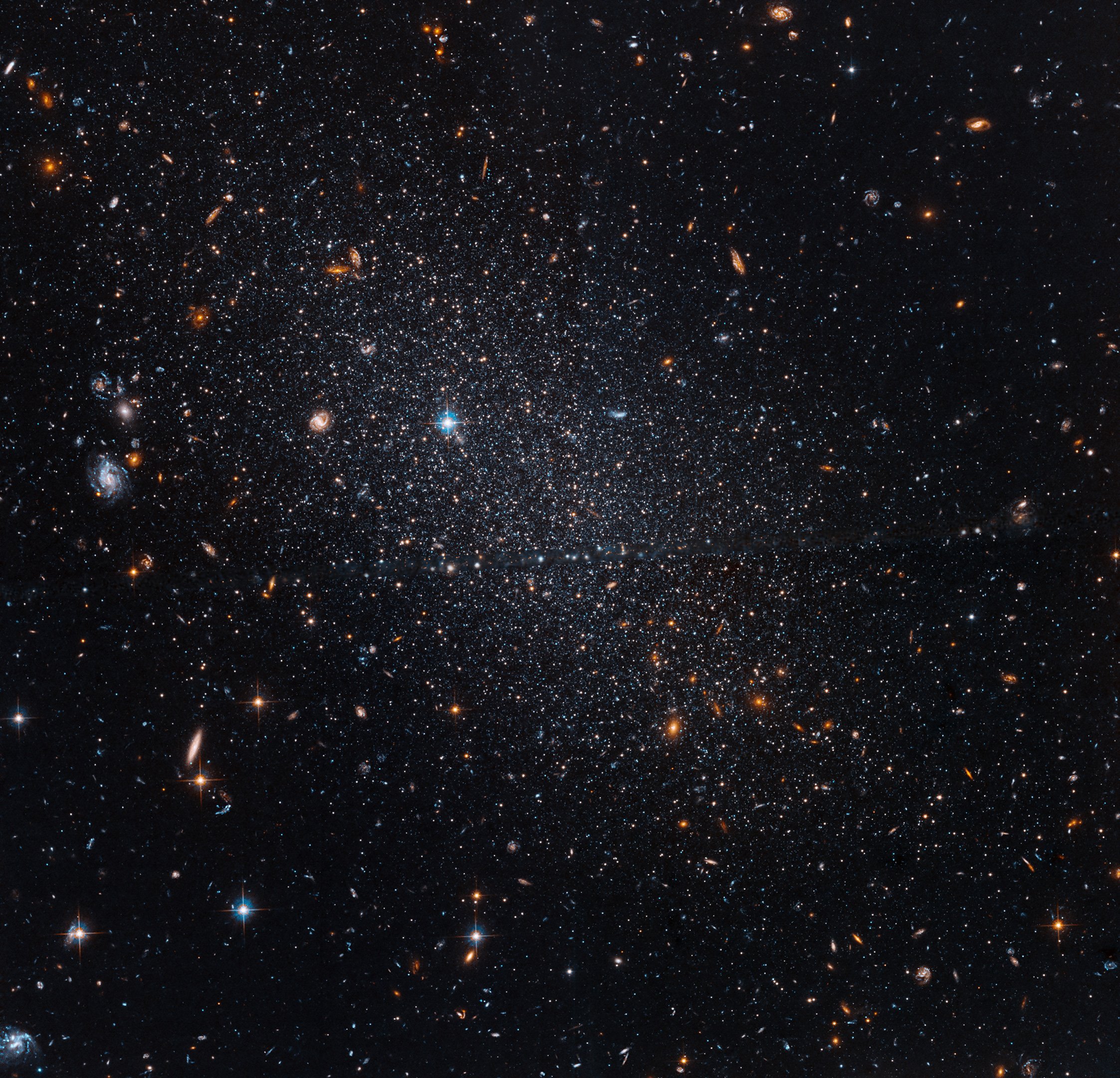
    The Tucana Dwarf galaxy resides about 3 million light-years away, at the far edge of our Local Group of galaxies. Credit: NASA, ESA, C. Gallart (Instituto de Astrofisica de Canarias), A. del Pino Molina (Centro de Estudios de Fisica del Cosmos de Aragon), and R. van der Marel (Space Telescope Science Institute); Image Processing: Gladys Kober (NASA/Catholic University of America)

    Situated in the constellation Tucana, the Tucana Dwarf is a distant and isolated galaxy observed by the Hubble Space Telescope.

    It’s notable for its older stars and sparse dust, lying far from the Local Group’s center. This galaxy helps astronomers explore the early stages of galaxy formation and the universe’s history.

    Tucana Dwarf Galaxy

    A splatter of stars glows faintly at almost 3 million light-years away in this new image from NASA’s Hubble Space Telescope. Known as the Tucana Dwarf for lying in the constellation Tucana, this dwarf galaxy contains a loose bundle of aging stars at the far edge of the Local Group, an aggregation of galaxies including our Milky Way, bound together by gravity. The Tucana Dwarf was discovered in 1990 by R.J. Lavery, the same year Hubble launched.

    Unique Characteristics of the Tucana Dwarf

    What makes the Tucana Dwarf distinct from other dwarf galaxies comes in two parts: its classification, and its isolation. As a dwarf spheroidal galaxy, it is much smaller and less luminous than most other dwarf galaxies. Dust is sparse and the stellar population skews towards the older range, giving them a dimmer look. Additionally, the Tucana Dwarf lies about 3.6 million light-years from the Local Group’s center of mass, far from the Milky Way and other galaxies.

    It is only one of two dwarf spheroidal galaxies in the Local Group to be this remote, making astronomers theorize that a close encounter with a larger galactic neighbor called Andromeda slingshotted it into the distance about 11 billion years ago.

    The Tucana Dwarf as a Cosmic Fossil

    Having such pristine properties enables scientists to use the Tucana Dwarf as a cosmic fossil. Dwarf galaxies could be the early ingredients for larger galaxies, and with older stars residing in such an isolated environment, analyzing them can help trace galaxy formation back to the dawn of time.

    For that reason, Hubble reached far across the Local Group using the capabilities of the Advanced Camera for Surveys (ACS) and Wide Field and Planetary Camera 2 to meet this distant, lonely galaxy. Examining its structure, composition, and star formation history sheds light on the epoch of reionization, when the first stars and galaxies arose from the dark billions of years ago.

    Never miss a breakthrough: Join the SciTechDaily newsletter.
    Follow us on Google and Google News.

    Astronomy Hubble Space Telescope NASA NASA Goddard Space Flight Center
    Share. Facebook Twitter Pinterest LinkedIn Email Reddit

    Related Articles

    “Ghost Galaxy” Made of 99% Dark Matter Discovered 300 Million Light Years Away

    Astronomers Finally Solve Betelgeuse’s Biggest Mystery

    The Andromeda Mystery: Hubble Discovers Strange Galactic Behavior

    3.7 Billion Miles Away: Hubble Uncovers a Hidden Trio That Could Rewrite Kuiper Belt History

    Historic Discovery: Twin Titans Clash As NASA Unveils Closest Supermassive Black Hole Duo

    The Great Escape: NASA’s Hubble and MAVEN Help Solve Mystery of Mars’ Vanishing Water

    Into the Rosy Depths: Hubble’s Journey Through Andromeda

    What Lies Within? Hubble’s Deep Dive Into the Structured Chaos of Leo A

    Hubble Spots Billowing Bubbles of Stellar Floss Across 1,000 Light-Year Expanse

    Leave A Reply Cancel Reply

    • Facebook
    • Twitter
    • Pinterest
    • YouTube

    Don't Miss a Discovery

    Subscribe for the Latest in Science & Tech!

    Trending News

    The Universe Is Expanding Too Fast and Scientists Can’t Explain Why

    “Like Liquid Metal”: Scientists Create Strange Shape-Shifting Material

    Early Warning Signals of Esophageal Cancer May Be Hiding in Plain Sight

    Common Blood Pressure Drug Shows Surprising Power Against Deadly Antibiotic-Resistant Superbug

    Scientists Uncover Dangerous Connection Between Serotonin and Heart Valve Disease

    Scientists Discover a “Protector” Protein That Could Help Reverse Hair Loss

    Bone-Strengthening Discovery Could Reverse Osteoporosis

    Scientists Uncover Hidden Trigger Behind Stem Cell Aging

    Follow SciTechDaily
    • Facebook
    • Twitter
    • YouTube
    • Pinterest
    • Newsletter
    • RSS
    SciTech News
    • Biology News
    • Chemistry News
    • Earth News
    • Health News
    • Physics News
    • Science News
    • Space News
    • Technology News
    Recent Posts
    • The Simple Habit That Could Help Prevent Cancer
    • Forgotten Medicinal Plant Shows Promise in Fighting Dangerous Superbugs
    • Millions Take These IBS Drugs, But a New Study Finds Serious Risks
    • 5 Common Myths About Learning a New Language, Debunked
    • The Neanderthal “Love Story” Isn’t What It Seems
    Copyright © 1998 - 2026 SciTechDaily. All Rights Reserved.
    • Science News
    • About
    • Contact
    • Editorial Board
    • Privacy Policy
    • Terms of Use

    Type above and press Enter to search. Press Esc to cancel.