
Close Menu
    Facebook X (Twitter) Instagram
    SciTechDaily
    • Biology
    • Chemistry
    • Earth
    • Health
    • Physics
    • Science
    • Space
    • Technology
    Facebook X (Twitter) Pinterest YouTube RSS
    SciTechDaily
    Home»Health»Muscle Loss Can Be Counteracted With Early Interventions
    Health

    Muscle Loss Can Be Counteracted With Early Interventions

    By Karolinska InstituteNovember 30, 2021No Comments3 Mins Read
    Facebook Twitter Pinterest Telegram LinkedIn WhatsApp Email Reddit
    Share
    Facebook Twitter LinkedIn Pinterest Telegram Email Reddit
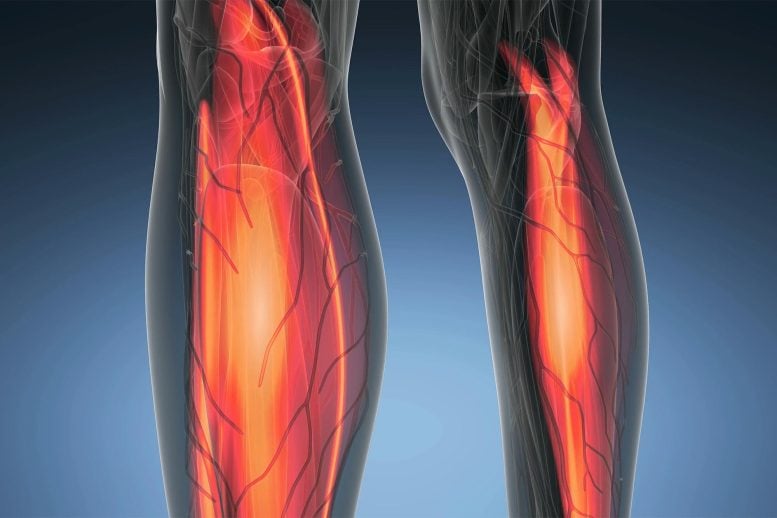
    Human Calf Muscles
    A recent study suggests timely interventions could help counteract early sarcopenia stages, preserving physical and cognitive function and managing chronic conditions.

    Weakening muscles are a natural part of the aging process, but for some people with a condition called sarcopenia the decline is abnormally fast. A new study from Karolinska Institutet in Sweden suggests that the early stages of sarcopenia could be counteracted with timely interventions designed to preserve physical and cognitive function and manage chronic conditions. The results are published in the Journal of Cachexia, Sarcopenia and Muscle.

    As we age, we start to lose muscle mass and function. When this decline is more extensive or rapid than expected, it is categorized as sarcopenia, a common condition in the elderly that often lowers their quality of life and increases the risk of falls and bone fractures.

    Researchers at Karolinska Institutet have now examined how different factors such as sex, age, educational level, living arrangement, lifestyle, and chronic conditions affected the development of sarcopenia in people aged 60 or over across a 12-year period. The study included over 3,200 individuals from the SNAC-K (Swedish National Study on Ageing and Care in Kungsholmen) study.

    At the start of the study, almost 10 percent of the participants had sarcopenia, 27 percent had probable sarcopenia, and just over 63 percent had no sarcopenia. Metrics such as grip strength, walking speed, speed of rising from a chair five times, and calf circumference were used to evaluate muscle strength and mass and physical performance.

    Dynamic Nature of Sarcopenia Offers Hope

    “Perhaps the most interesting result was that after five years, a roughly equal proportion (just over 10 percent) of the individuals with probable sarcopenia had either improved or deteriorated. This suggests that sarcopenia is a dynamic condition that is modifiable, especially in the initial stages, which is a hopeful message,” says the study’s corresponding author Caterina Trevisan, affiliated researcher at the Department of Neurobiology, Care Sciences and Society, Karolinska Institutet.

    Factors that could be associated with an increased chance of improvement and lower mortality were physical activity and higher results on cognitive tests, while a higher number of chronic conditions, male sex, and older age had the opposite correlation. For individuals initially diagnosed with severe sarcopenia, the likelihood of improvement was low, and many of them died during the follow-up period (almost 71 percent).

    “Our results support the need of early interventions to preserve physical and cognitive functions and manage chronic conditions in older individuals,” says the study’s last author Anna-Karin Welmer, senior lecturer at the Department of Neurobiology, Care Sciences and Society, Karolinska Institutet. “With these tools, we could probably counteract muscle deterioration and the impairment in quality of life this entails. We now need intervention studies to find ways to use these tools to counteract sarcopenia.”

    Reference: “Twelve-Year Sarcopenia Trajectories in Older Adults: Results from a Population-Based Study” by Caterina Trevisan, Davide Liborio Vetrano, Riccardo Calvani, Anna Picca and Anna-Karin Welmer, 30 November 2021, Journal of Cachexia, Sarcopenia and Muscle.
    DOI: 10.1002/jcsm.12875

    The study was financed through the Ministry of Health and Social Affairs, the Swedish Research Council and Swedish Research Council for Health, Working Life and Welfare (Forte).

    Never miss a breakthrough: Join the SciTechDaily newsletter.
    Follow us on Google and Google News.

    Aging Karolinska Institutet Muscle
    Share. Facebook Twitter Pinterest LinkedIn Email Reddit

    Related Articles

    Revolution in Age Measurement: Scientists Develop the Most Accurate Biological Aging Test Yet

    Researchers Discover Surprising Side Effect of Common Diabetes Drug

    Reclaiming Youth – How Scientists Are Getting Around Muscle Aging

    Don’t Ignore Your Slowing Mobility: It Could Be a Sign of Something More Sinister

    Researchers Identify a New Hallmark of Aging

    The Anti-Aging Secret of Ceramides: Scientists Discover Potential Key to Slowing Muscle Decline

    Anti-Aging: Scientists Discovered an Enzyme That Is Key to Why Exercise Improves Our Health

    Scientists Identify Factor in “Young Blood” That Helps Rejuvenate Aging Muscle

    New Study Uncovers Why People Gain Weight As They Get Older [Video]

    Leave A Reply Cancel Reply

    • Facebook
    • Twitter
    • Pinterest
    • YouTube

    Don't Miss a Discovery

    Subscribe for the Latest in Science & Tech!

    Trending News

    AI Could Detect Early Signs of Alzheimer’s in Under a Minute – Far Before Traditional Tests

    What if Dark Matter Has Two Forms? Bold New Hypothesis Could Explain a Cosmic Mystery

    This Metal Melts in Your Hand – and Scientists Just Discovered Something Strange

    Beef vs. Chicken: Surprising Results From New Prediabetes Study

    Alzheimer’s Breakthrough: Scientists Discover Key Protein May Prevent Toxic Protein Clumps in the Brain

    Quantum Reality Gets Stranger: Physicists Put a Lump of Metal in Two Places at Once

    Scientists May Have Found the Key to Jupiter and Saturn’s Moon Mystery

    Scientists Uncover Brain Changes That Link Pain to Depression

    Follow SciTechDaily
    • Facebook
    • Twitter
    • YouTube
    • Pinterest
    • Newsletter
    • RSS
    SciTech News
    • Biology News
    • Chemistry News
    • Earth News
    • Health News
    • Physics News
    • Science News
    • Space News
    • Technology News
    Recent Posts
    • What if Your Memories Never Happened? Physicists Take a New Look at the Boltzmann Brain Paradox
    • Students Found an Ancient Star That Shouldn’t Be in the Milky Way
    • Astronomers Solve 50-Year Mystery and Reveal Hidden Culprit Behind Strange X-Ray Emissions
    • One of the Universe’s Largest Stars May Be Getting Ready To Explode
    • Scientists Discover Enzyme That Could Supercharge Ozempic-Like Weight Loss Drugs
    Copyright © 1998 - 2026 SciTechDaily. All Rights Reserved.
    • Science News
    • About
    • Contact
    • Editorial Board
    • Privacy Policy
    • Terms of Use

    Type above and press Enter to search. Press Esc to cancel.