
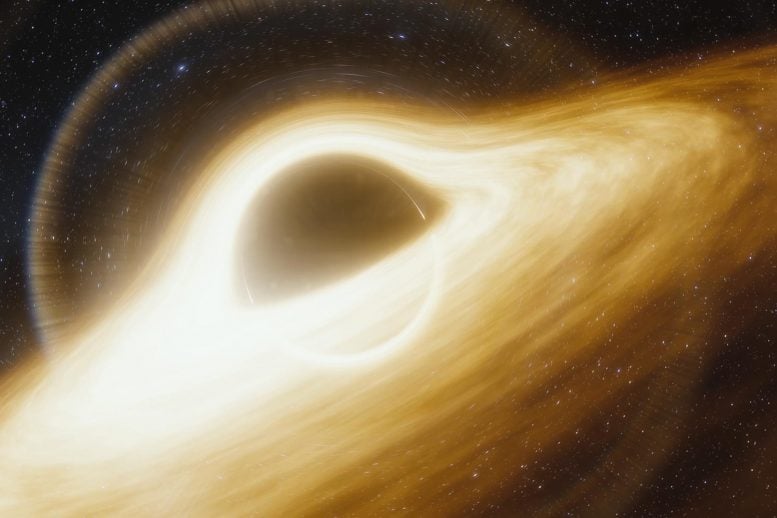
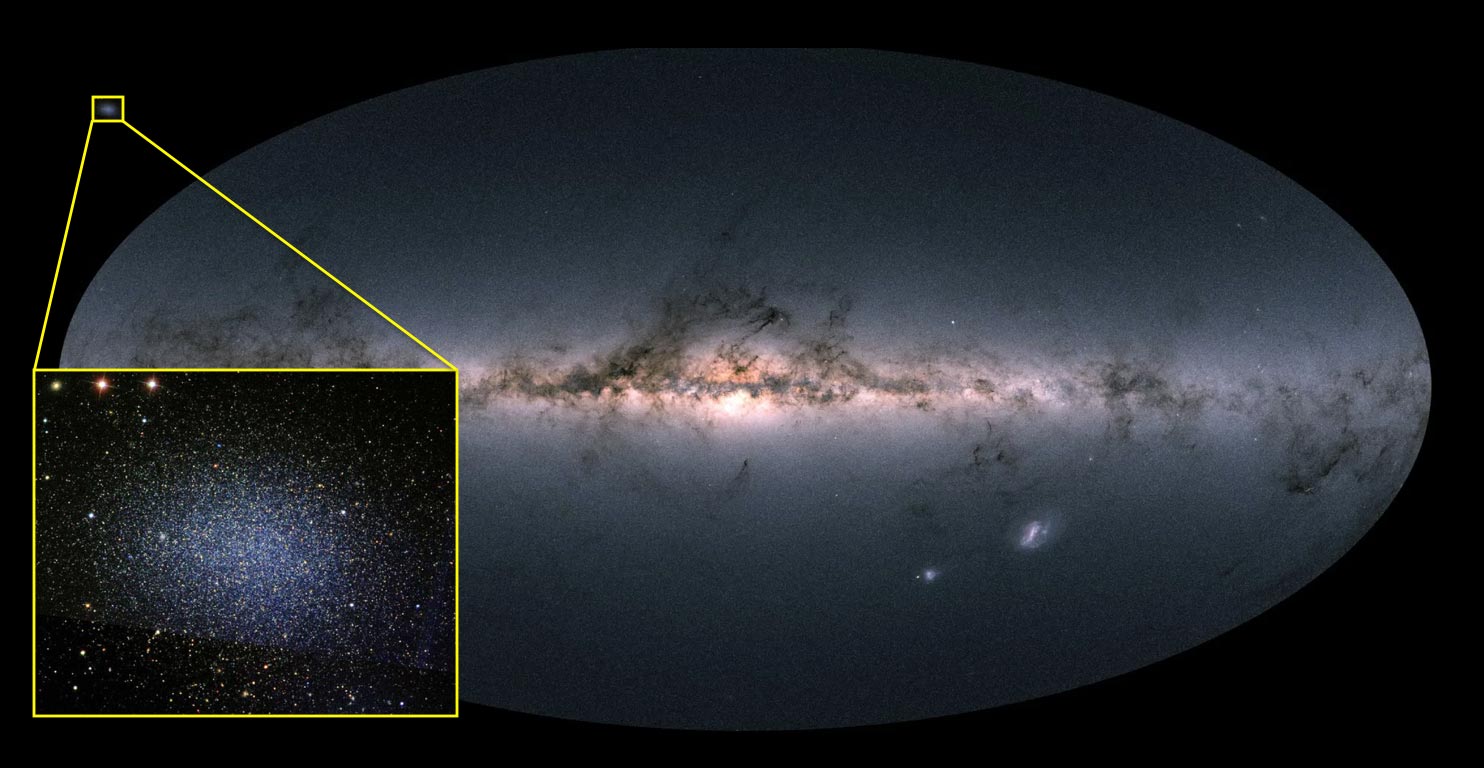
Leo I, a dwarf galaxy orbiting the Milky Way, contains a black hole nearly as massive as our galaxy’s own.
Astronomers at The University of Texas at Austin’s McDonald Observatory have discovered an unusually massive black hole at the heart of one of the Milky Way’s dwarf satellite galaxies, called Leo I. Almost as massive as the black hole in our own galaxy, the finding could redefine our understanding of how all galaxies — the building blocks of the universe — evolve. The work is published in a recent issue of The Astrophysical Journal.
The team decided to study Leo I because of its peculiarity. Unlike most dwarf galaxies orbiting the Milky Way, Leo I does not contain much dark matter. Researchers measured Leo I’s dark matter profile — that is, how the density of dark matter changes from the outer edges of the galaxy all the way into its center. They did this by measuring its gravitational pull on the stars: The faster the stars are moving, the more matter there is enclosed in their orbits. In particular, the team wanted to know whether dark matter density increases toward the galaxy’s center. They also wanted to know whether their profile measurement would match previous ones made using older telescope data combined with computer models.
Led by recent UT Austin doctoral graduate María José Bustamante, the team includes UT astronomers Eva Noyola, Karl Gebhardt and Greg Zeimann, as well as colleagues from Germany’s Max Planck Institute for Extraterrestrial Physics (MPE).
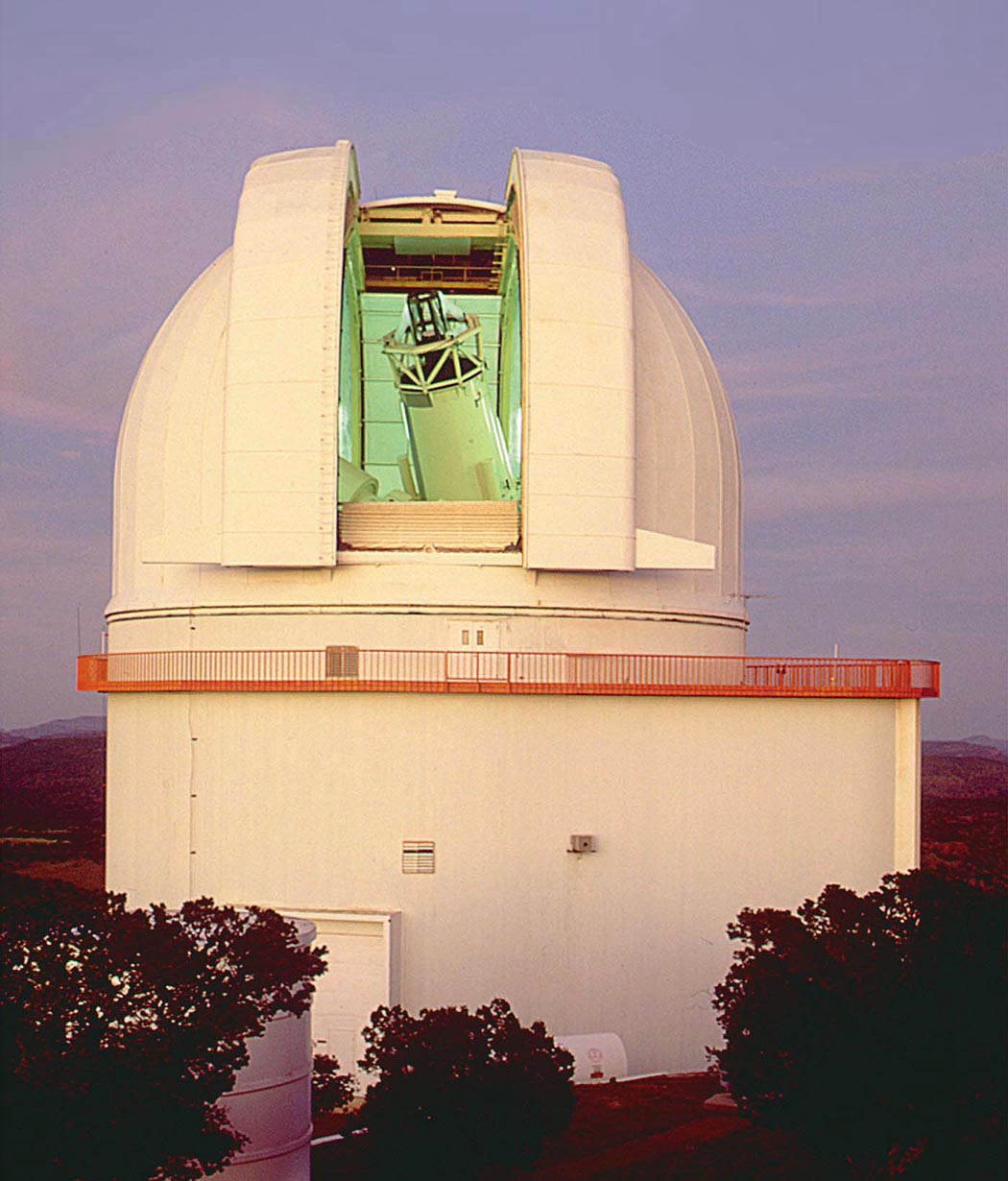
For their observations, they used a unique instrument called VIRUS-W on McDonald Observatory’s 2.7-meter Harlan J. Smith Telescope.
When the team fed their improved data and sophisticated models into a supercomputer at UT Austin’s Texas Advanced Computing Center, they got a startling result.
A Black Hole Nearly as Massive as the Milky Way’s
“The models are screaming that you need a black hole at the center; you don’t really need a lot of dark matter,” Gebhardt said. “You have a very small galaxy that is falling into the Milky Way, and its black hole is about as massive as the Milky Way’s. The mass ratio is absolutely huge. The Milky Way is dominant; the Leo I black hole is almost comparable.” The result is unprecedented.
The researchers said the result was different from the past studies of Leo I due to a combination of better data and the supercomputer simulations. The central, dense region of the galaxy was mostly unexplored in previous studies, which concentrated on the velocities of individual stars. The current study showed that for those few velocities that were taken in the past, there was a bias toward low velocities. This, in turn, decreased the inferred amount of matter enclosed within their orbits.
The new data is concentrated in the central region and is unaffected by this bias. The amount of inferred matter enclosed within the stars’ orbits skyrocketed.
The finding could shake up astronomers’ understanding of galaxy evolution, as “there is no explanation for this kind of black hole in dwarf spheroidal galaxies,” Bustamante said.
Implications for Dark Matter Studies and Gravitational Waves
The result is all the more important as astronomers have used galaxies such as Leo I, called “dwarf spheroidal galaxies,” for 20 years to understand how dark matter is distributed within galaxies, Gebhardt added. This new type of black hole merger also gives gravitational wave observatories a new signal to search for.
“If the mass of Leo I’s black hole is high, that may explain how black holes grow in massive galaxies,” Gebhardt said. That’s because over time, as small galaxies like Leo I fall into larger galaxies, the smaller galaxy’s black hole merges with that of the larger galaxy, increasing its mass.
Built by a team at MPE in Germany, VIRUS-W is the only instrument in the world now that can do this type of dark matter profile study. Noyola pointed out that many southern hemisphere dwarf galaxies are good targets for it, but no southern hemisphere telescope is equipped for it. However, the Giant Magellan Telescope (GMT) now under construction Chile was, in part, designed for this type of work. UT Austin is a founding partner of the GMT.
Reference: “Dynamical Analysis of the Dark Matter and Central Black Hole Mass in the Dwarf Spheroidal Leo I” by M. J. Bustamante-Rosell, Eva Noyola, Karl Gebhardt, Maximilian H. Fabricius, Ximena Mazzalay, Jens Thomas and Greg Zeimann, 5 November 2021, The Astrophysical Journal.
DOI: 10.3847/1538-4357/ac0c79
Never miss a breakthrough: Join the SciTechDaily newsletter.
Follow us on Google and Google News.
2 Comments
INTERESTING STUFF ON THE GALAXIES.
Now that that is straightened out….