
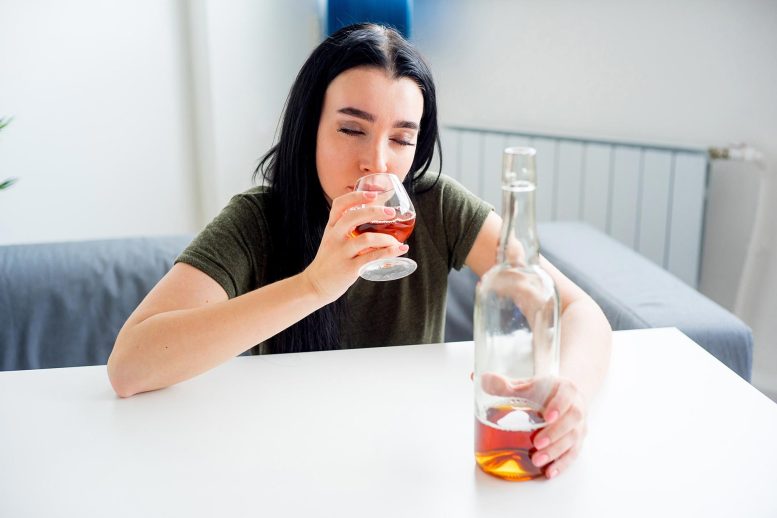
Study shows stress led to drinking more than intended in men only when they already had consumed alcohol.
A new study has shown that stress alone can drive women to excessive drinking.
Men who experienced the same stress only drank to excess when they had already started consuming alcohol.
Though rates of alcohol misuse are higher in men than women, women are catching up. Women also have a greater risk than men of developing alcohol-related problems.
Participants consumed alcoholic beverages in a simulated bar while experiencing stressful and non-stressful situations. Stress led women, but not men, to drink more than intended, a finding that demonstrates the importance of studying sex differences in alcohol consumption. The study was published in Psychology of Addictive Behaviors.
“Some people can intend to have one or two alcoholic beverages and stop drinking, but other people just keep going. This impaired control over drinking is one of the earliest indicators of alcohol use disorders, and we know stress contributes to both impaired control over drinking and dysregulated drinking. The role of stress in impaired control over drinking is understudied, especially in women,” said Julie Patock-Peckham, assistant research professor at ASU and lead author on the study.
The study took place in a research laboratory designed to simulate a bar, complete with a bartender, bar stools and lively conversations. The participants included 105 women and 105 men. They were randomized into different groups, with some either experiencing a stressful situation and others a non-stressful situation. Next, half the participants received an alcoholic drink that was equivalent to three cocktails, and the other half received three non-alcoholic drinks. After that, all participants had unrestricted access to alcoholic drinks from the bar for 90 minutes.
“We know that both genes and the environment play a role in problematic drinking. We can’t do anything about the genes, but we can intervene with the environment. Stress and impaired control over drinking are tightly connected, and because stress is something we can manipulate, we tested whether stressors cause dysregulated drinking,” said Patock-Peckham, who leads the Social Addictions Impulse Lab at ASU.
The experimental set-up let the research team determine whether stress, the initial drink or the combination of the two caused how much alcohol the participants consumed. The team measured alcohol consumption in total number of drinks consumed and by using breath blood alcohol content (BAC).
Exposure to stress led to heavier drinking in all participants. Men who received a first drink with alcohol in it and experienced stress drank more than men who received the placebo.
Whether the first drink was alcoholic or not did not matter for women: Experiencing stress led to heavy drinking.
“That women just needed the stress but men needed the push of already having alcohol on board shows how important this type of research is,” Patock-Peckham said. “The outcomes from alcohol use are not the same for men and women, and we cannot keep using models that were developed in men to help women.”
Reference: “Effects of stress, alcohol prime dose, and sex on ad libitum drinking” by Patock-Peckham, J. A., Corbin, W. R., Smyth, H., Canning, J. R., Ruof, A. and Williams, J., 13 December 2021, Psychology of Addictive Behaviors.
DOI: 10.1037/adb0000801
The study was funded by the National Institute on Alcohol Abuse and Alcoholism and Burton Family Foundation. In addition to Patock-Peckham, the research team consisted of William Corbin, professor of psychology at ASU; Heather Smyth and Arian Rouf, graduate students at ASU; Jessica Canning of the University of Washington; and J. Williams of RTI International.
Never miss a breakthrough: Join the SciTechDaily newsletter.
Follow us on Google and Google News.
2 Comments
Wait… are these researchers assume gender?
easy solution- don’t drink alcohol and don’t buy it.