
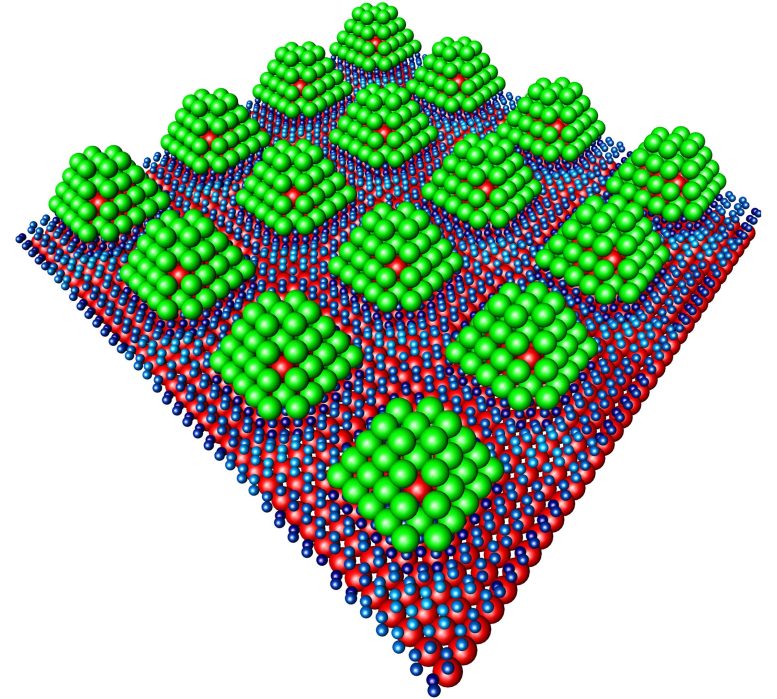
Researchers developed palladium–iridium nanoparticles that store hydrogen on their surfaces, offering an easier, low-energy release method than current storage systems.
An innovative approach could turn nanoparticles into simple reservoirs for storing hydrogen. The highly volatile gas is considered a promising energy carrier for the future, which could provide climate-friendly fuels for airplanes, ships, and lorries, for example, as well as allowing climate-friendly steel and cement production – depending on how the hydrogen gas is generated. However, storing hydrogen is costly: either the gas has to be kept in pressurized tanks, at up to 700 bar, or it must be liquified, which means cooling it down to minus 253 degrees Celsius (-423 degrees Fahrenheit). Both procedures consume additional energy.
A team led by DESY’s Andreas Stierle has laid the foundations for an alternative method: storing hydrogen in tiny nanoparticles made of the precious metal palladium, just 1.2 nanometers in diameter. The fact that palladium can absorb hydrogen like a sponge has been known for some time. “However, until now getting the hydrogen out of the material again has posed a problem,” Stierle explains. “That’s why we are trying palladium particles that are only about one nanometer across.” A nanometer is a millionth of a millimeter.
Iridium Core and Graphene Support
To ensure that the tiny particles are sufficiently sturdy, they are stabilized by a core made of the rare precious metal iridium. In addition, they are attached to a graphene support, an extremely thin layer of carbon. “We are able to attach the palladium particles to the graphene at intervals of just two and a half nanometers,” reports Stierle, who is the head of the DESY NanoLab. “This results in a regular, periodic structure.” The team, which also includes researchers from the Universities of Cologne and Hamburg, published its findings in the American Chemical Society (ACS) journal ACS Nano.
DESY’s X-ray source PETRA III was used to observe what happens when the palladium particles come into contact with hydrogen: essentially, the hydrogen sticks to the nanoparticles’ surfaces, with hardly any of it penetrating inside. The nanoparticles can be pictured as resembling chocolates: an iridium nut at the center, enveloped in a layer of palladium, rather than marzipan, and chocolate-coated on the outside by the hydrogen. All it takes to recover the stored hydrogen is for a small amount of heat to be added; the hydrogen is rapidly released from the surface of the particles, because the gas molecules don’t have to push their way out from inside the cluster.
“Next, we want to find out what storage densities can be achieved using this new method,” says Stierle. However, some challenges still need to be overcome before proceeding to practical applications. For example, other forms of carbon structures might be a more suitable carrier than graphene – the experts are considering using carbon sponges, containing tiny pores. Substantial amounts of the palladium nanoparticles should fit inside these.
Reference: “Hydrogen Solubility and Atomic Structure of Graphene Supported Pd Nanoclusters” by Dirk Franz, Ulrike Schröder, Roman Shayduk, Björn Arndt, Heshmat Noei, Vedran Vonk, Thomas Michely and Andreas Stierle, 11 October 2021, ACS Nano.
DOI: 10.1021/acsnano.1c01997
Never miss a breakthrough: Join the SciTechDaily newsletter.
Follow us on Google and Google News.
3 Comments
How does the hydrogen absorption capacity of these nano chocs compare with the conventional absorption of hydrogen by a variety of metal hydrides?
My first thought is that it is enormously more expensive and incredibly more unscalable, but that’s just the engineer in me. Perhaps this leads to other materials and mechanisms down the road though.
Palladium and iridium? Doesn’t sound like a viable solution for the masses.