
Close Menu
    Facebook X (Twitter) Instagram
    SciTechDaily
    • Biology
    • Chemistry
    • Earth
    • Health
    • Physics
    • Science
    • Space
    • Technology
    Facebook X (Twitter) Pinterest YouTube RSS
    SciTechDaily
    Home»Space»Astronomy & Astrophysics 101: Globular Cluster
    Space

    Astronomy & Astrophysics 101: Globular Cluster

    By ESA/HubbleMarch 30, 20221 Comment3 Mins Read
    Facebook Twitter Pinterest Telegram LinkedIn WhatsApp Email Reddit
    Share
    Facebook Twitter LinkedIn Pinterest Telegram Email Reddit
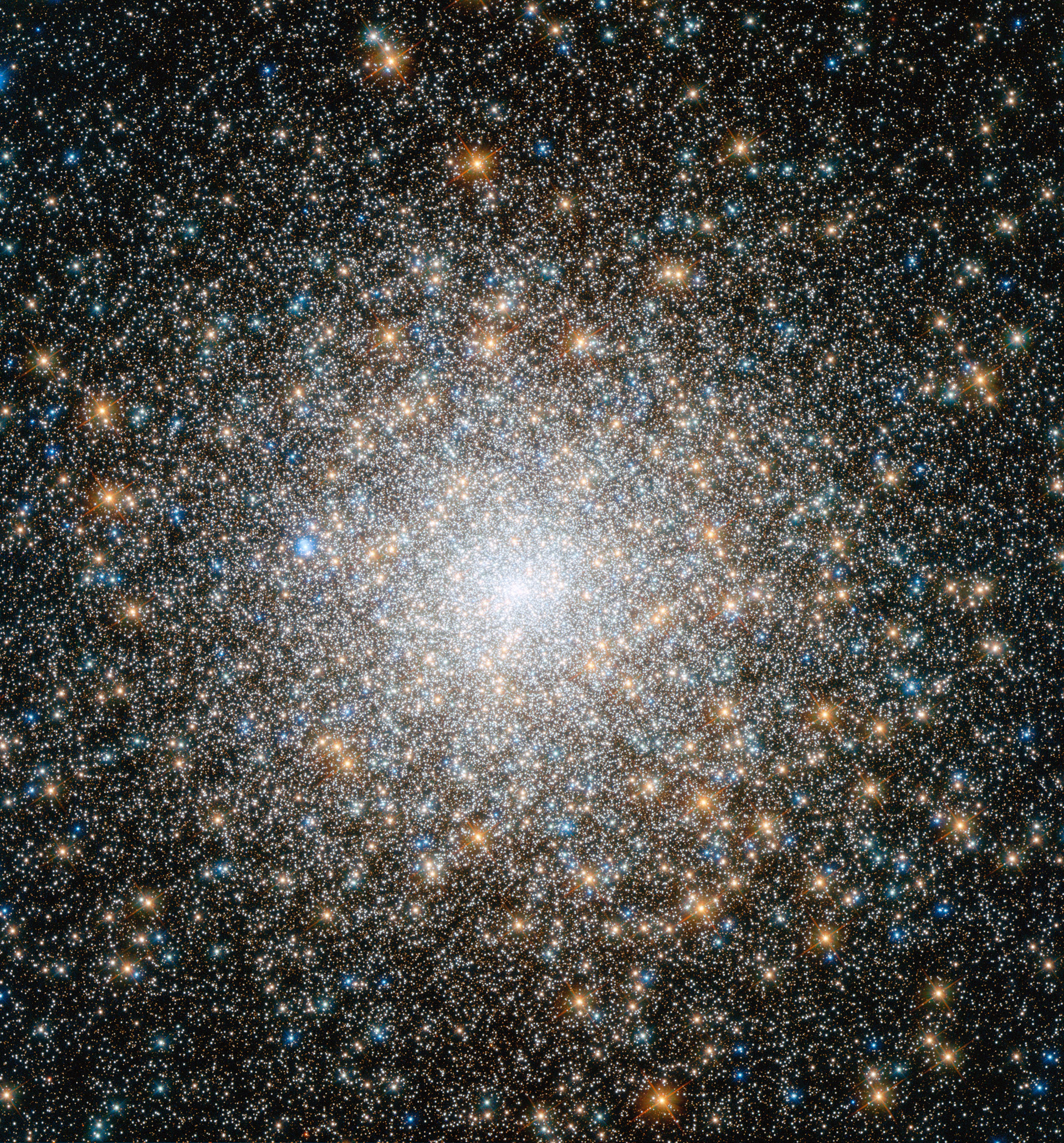
    Hubble Views Messier 15
    This cluster of stars is known as Messier 15, and is located some 35,000 light-years away in the constellation of Pegasus (The Winged Horse). It is one of the oldest globular clusters known, with an age of around 12 billion years. Credit: NASA, ESA

    What Is a Globular Cluster?

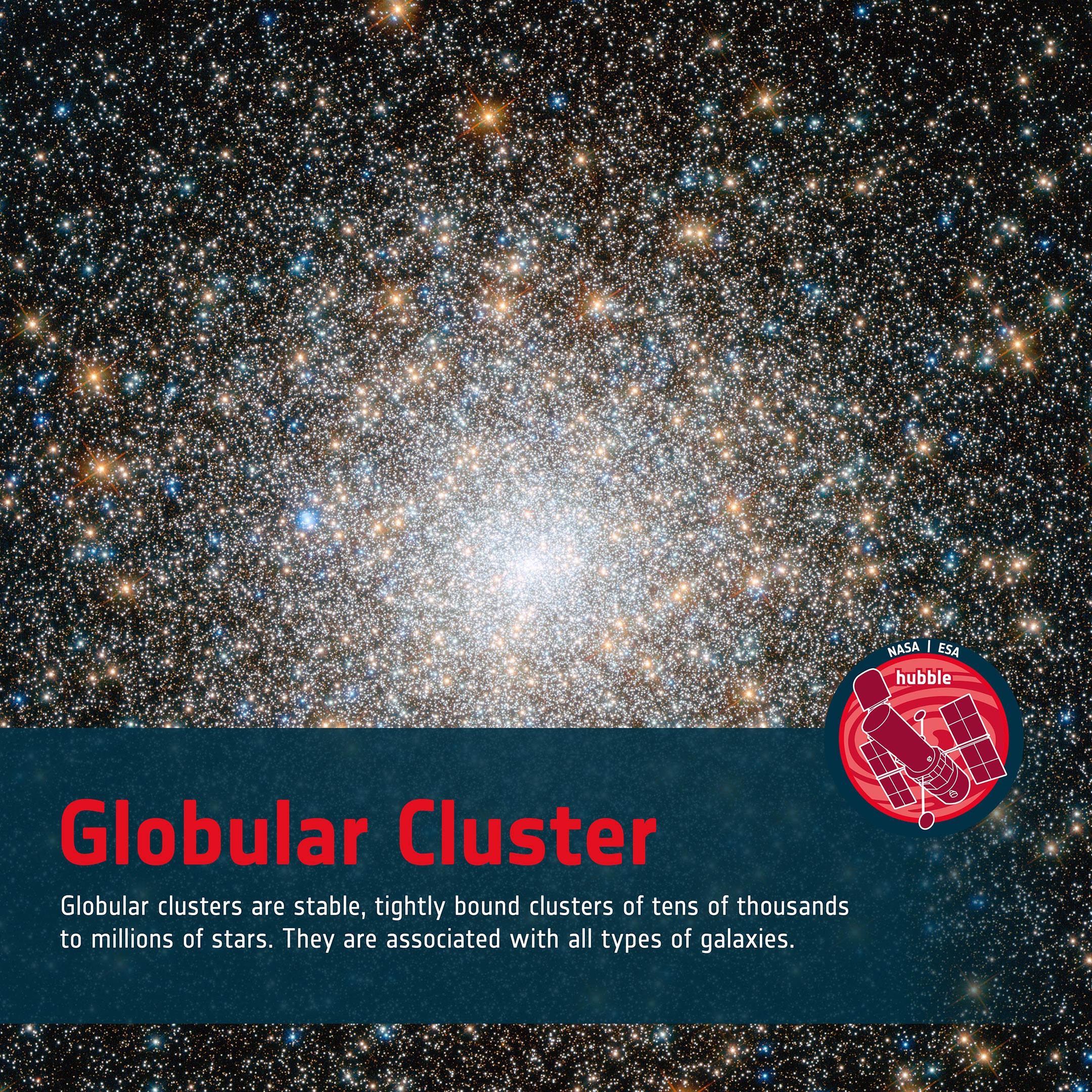
    Globular clusters are stable, tightly bound clusters of tens of thousands to millions of stars. They are associated with all types of galaxies.

    Globular clusters are typically much larger than open clusters and are tightly gravitationally bound. They are far more densely populated, with populations ranging from tens of thousands to millions of stars. The intense gravitational attraction between the closely packed stars gives globular clusters their regular, spherical shape. They are populated by older, redder stars than open clusters (which might disperse before their stars can become really old). Their considerable gravitational attraction makes them very stable, and therefore they can be extremely long-lived, surviving to be billions of years old. They are associated with all types of galaxies, and within the Milky Way they are found in the halo and the bulge.

    All star clusters are of great interest to astronomers, because their constituent stars all formed at approximately the same time and location, and had similar initial composition. Therefore stellar clusters offer unique insights into how stars form and evolve. It is very challenging to observe individual stars within globular clusters, however, as they are so densely packed.


    Globular clusters are stable, tightly bound clusters of tens of thousands to millions of stars. They are associated with all types of galaxies. Credit: NASA & ESA

    Hubble revolutionized the study of globular clusters, as it is almost impossible to distinguish the stars in globular clusters from one another with ground-based telescopes. Hubble has been used to study what kind of stars globular clusters are made up of, how they evolve, and the role of gravity in these dense systems.

    In 2021, new data from Hubble led to the first measurement of the extent of a collection of black holes in a core-collapsed globular cluster. Scientists were expecting to find an intermediate-mass black hole at the heart of NGC 6397, but instead they found evidence of a concentration of smaller black holes lurking there. This discovery raised the question of whether mergers of these tightly packed black holes in core-collapsed globular clusters may be an important source of gravitational waves.

    Hubble was the first telescope to directly observe white dwarfs in globular star clusters, which astronomers reported as the dimmest stars ever seen in a globular star cluster. This study also focused on NGC 6397, one of the closest globular clusters to Earth. By seeing the whole range of stars in this area, researchers garnered new insights into the age, origin, and evolution of the cluster.
    Word Bank Globular Cluster
    Credit: NASA & ESA

    The telescope has also contributed to our understanding of a special type of re-invigorated stars in globular clusters, known as blue stragglers. Under certain circumstances, stars receive extra fuel that bulks them up and substantially brightens them. This can happen if one star pulls matter off a neighbor, or if they collide. Blue stragglers therefore appear to regress from ‘old age’ back to a hotter and brighter ‘youth’, gaining a new lease on life in the process.

    Hubble’s collection of imagery of globular clusters can be explored here. This includes a stunning image of Messier 15, which is one of the oldest globular clusters known, with an age of around 12 billion years.

    Never miss a breakthrough: Join the SciTechDaily newsletter.
    Follow us on Google and Google News.

    Astronomy Astrophysics European Space Agency Globular Cluster
    Share. Facebook Twitter Pinterest LinkedIn Email Reddit

    Related Articles

    Feared Apophis Impact Ruled Out – Asteroid Will Pass Close Enough to Earth to See With Naked Eye

    Tantalizing Evidence: Is the Nearest Star Cluster to the Sun Being Destroyed?

    Tantrums of a Baby Star: Herbig-Haro Objects

    Unexpected Discovery: Hubble Space Telescope Uncovers Concentration of Small Black Holes

    Unique Planetary System With Rhythmic Orbital Resonance Revealed by Exoplanet Watcher Cheops

    Cosmic Neon Lights: Strange New Type of Star Revealed in X-ray Light

    “Unprecedented” – Unusual Planetary Nebula Fades Mere Decades After It Arrived

    Hubble Captures Unprecedented Fading of Stingray Nebula – “This Is Very, Very Dramatic, and Very Weird”

    To the Milky Way’s Anticenter and Beyond: Gaia’s New Detailed Data From More Than 1.8 Billion Stars

    1 Comment

    1. Donna Hughs on March 30, 2022 11:30 pm

      Do stars in or near a globular cluster have planets? If so, are the planets incredibly hot with so many stars nearby? What might their sky look like? Do some of them rotate around more than one star?

      Reply
    Leave A Reply Cancel Reply

    • Facebook
    • Twitter
    • Pinterest
    • YouTube

    Don't Miss a Discovery

    Subscribe for the Latest in Science & Tech!

    Trending News

    Scientists Discover Mysterious Creature Living in the Great Salt Lake – and It Exists Nowhere Else on Earth

    It’s Alive? Surprising Discovery Changes What We Know About Fog

    A Tiny Bright-Blue Octopus Found in the Galápagos Is Completely New to Science

    Scientists Discover Surprising Anti-Aging Power Hidden in Aged Garlic

    Why More People in Their 30s Are Suddenly Getting Colon Cancer

    Scientists Discover Sperm Seem To Bypass a Fundamental Law of Physics

    Archaeologists Discover Mysterious Artificial Island Older Than Stonehenge in Scotland

    Massive Study Warns Marijuana Use in Teens Is Linked to Serious Mental Illness

    Follow SciTechDaily
    • Facebook
    • Twitter
    • YouTube
    • Pinterest
    • Newsletter
    • RSS
    SciTech News
    • Biology News
    • Chemistry News
    • Earth News
    • Health News
    • Physics News
    • Science News
    • Space News
    • Technology News
    Recent Posts
    • Scientists Discover Surprising Similarities Between Freud’s Ideas and Modern Neuroscience
    • New 7-Dimensional Theory May Finally Solve the Black Hole Information Paradox
    • The Missing Notebooks That Solved a 25-Year-Old Paleontology Mystery
    • Scientists Discover a Simple Writing Test That May Detect Cognitive Impairment
    • Scientists Made Older Mice Biologically Younger Using Gut Microbes
    Copyright © 1998 - 2026 SciTechDaily. All Rights Reserved.
    • Science News
    • About
    • Contact
    • Editorial Board
    • Privacy Policy
    • Terms of Use

    Type above and press Enter to search. Press Esc to cancel.