
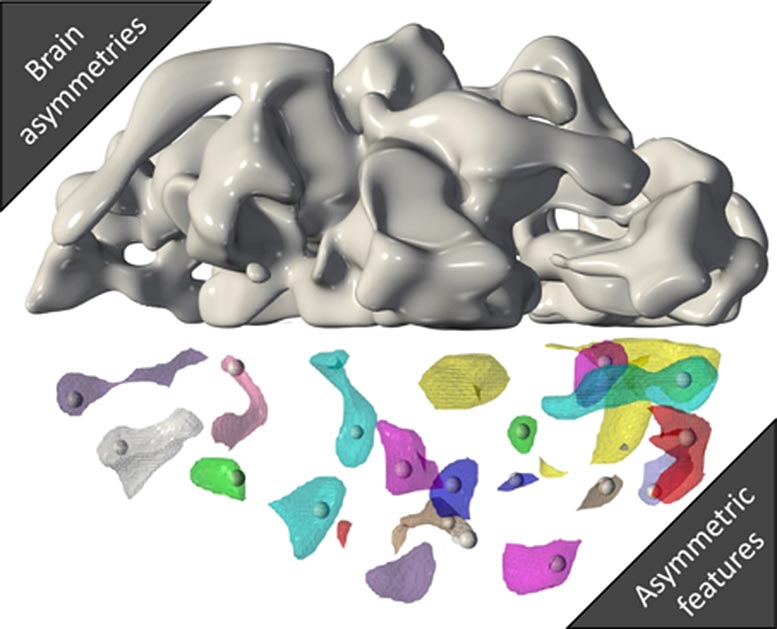
Different ways of looking at structural asymmetry show parallel effects on processing of speech sounds related to dyslexia.
Researchers led by Mark Eckert at the Medical University of South Carolina, United States, report that two seemingly opposing theories of language processing are both correct. Published in the open-access journal PLOS Biology on April 5th 2022, the study shows that greater left-brain asymmetry can predict both better performance and average performance on a foundational measure of reading ability, depending on whether analysis is conducted over the whole brain or in specific regions.
Being able to fluently convert written symbols into speech sounds is a basic aspect of reading that varies from person to person and is difficult for individuals with conditions like dyslexia. While structural asymmetries between the right and left sides of the brain seem to be related to this ability, exactly how remains a mystery. Using structural MRI from over 700 children and adults, along with a reading test of pseudo-words and a mathematical method called persistent homology, the new study tested two opposing theories of how brain asymmetries should affect phonological processing.
Left-Brain Asymmetry and Phonological Processing
The researchers developed a way to determine levels of brain asymmetry from the MRI images using persistent homology. They found that when the location of each individual’s most asymmetric region was considered, greater left-brain asymmetry was related to better pseudo-word reading ability. This supports a cerebral lateralization hypothesis. At the same time, they found that greater left-asymmetry in specific regions – including a motor planning region called Brodmann Area 8, and a performance monitoring region called the dorsal cingulate – were associated with average reading ability, which supports a canalization hypothesis.
Of note was that pseudo-word reading ability was not consistently related to asymmetries in brain regions known to be important for specific language functions. How left/right structural asymmetries affect other types of reading abilities and influence the functions of a left language network remains to be studied.
Eckert adds, “Our findings indicate that, at a population level, structural brain asymmetries are related to the normal development of a speech sound processing ability that is important for establishing proficient reading.”
Reference: “Cortical asymmetries at different spatial hierarchies relate to phonological processing ability” by Mark A. Eckert, Kenneth I. Vaden Jr., Federico Iuricich and Dyslexia Data Consortium, 5 April 2022, PLOS Biology.
DOI: 10.1371/journal.pbio.3001591
Funding: This work was supported (in part) by the National Institutes of Health (NIH)/Eunice Kennedy Shriver National Institute of Child Health and Human Development (R01 HD 069374) (Author MAE) and was conducted in a facility constructed with support from Research Facilities Improvement Program (C06 RR 014516) from the NIH/National Center for Research Resources. Clemson University is acknowledged for its generous allotment of compute time on the Palmetto cluster. The funders had no role in study design, data collection and analysis, decision to publish, or preparation of the manuscript.
Never miss a breakthrough: Join the SciTechDaily newsletter.
Follow us on Google and Google News.
2 Comments
Manic bipolar is not difficult for me because I learned behaviors coping skills networking would help if I had someone with real unconditional love in mind most that should be role modeling prefer to label me rather than have open communication work a recover based system for themselves to ensure they don’t remain stuck in anger dysfunction self defeating behaviors…
… if one can train its skills and obtain the fast reading skills. So! How that affects the theories mentioned in this article! I just don’t get it, is it bit… skew or what…