
Close Menu
    Facebook X (Twitter) Instagram
    SciTechDaily
    • Biology
    • Chemistry
    • Earth
    • Health
    • Physics
    • Science
    • Space
    • Technology
    Facebook X (Twitter) Pinterest YouTube RSS
    SciTechDaily
    Home»Earth»Seismic Algorithm Reveals Tonga Islands Eruption Was the Largest Explosive Eruption of the 21st Century
    Earth

    Seismic Algorithm Reveals Tonga Islands Eruption Was the Largest Explosive Eruption of the 21st Century

    By CNRSApril 20, 20221 Comment3 Mins Read
    Facebook Twitter Pinterest Telegram LinkedIn WhatsApp Email Reddit
    Share
    Facebook Twitter LinkedIn Pinterest Telegram Email Reddit
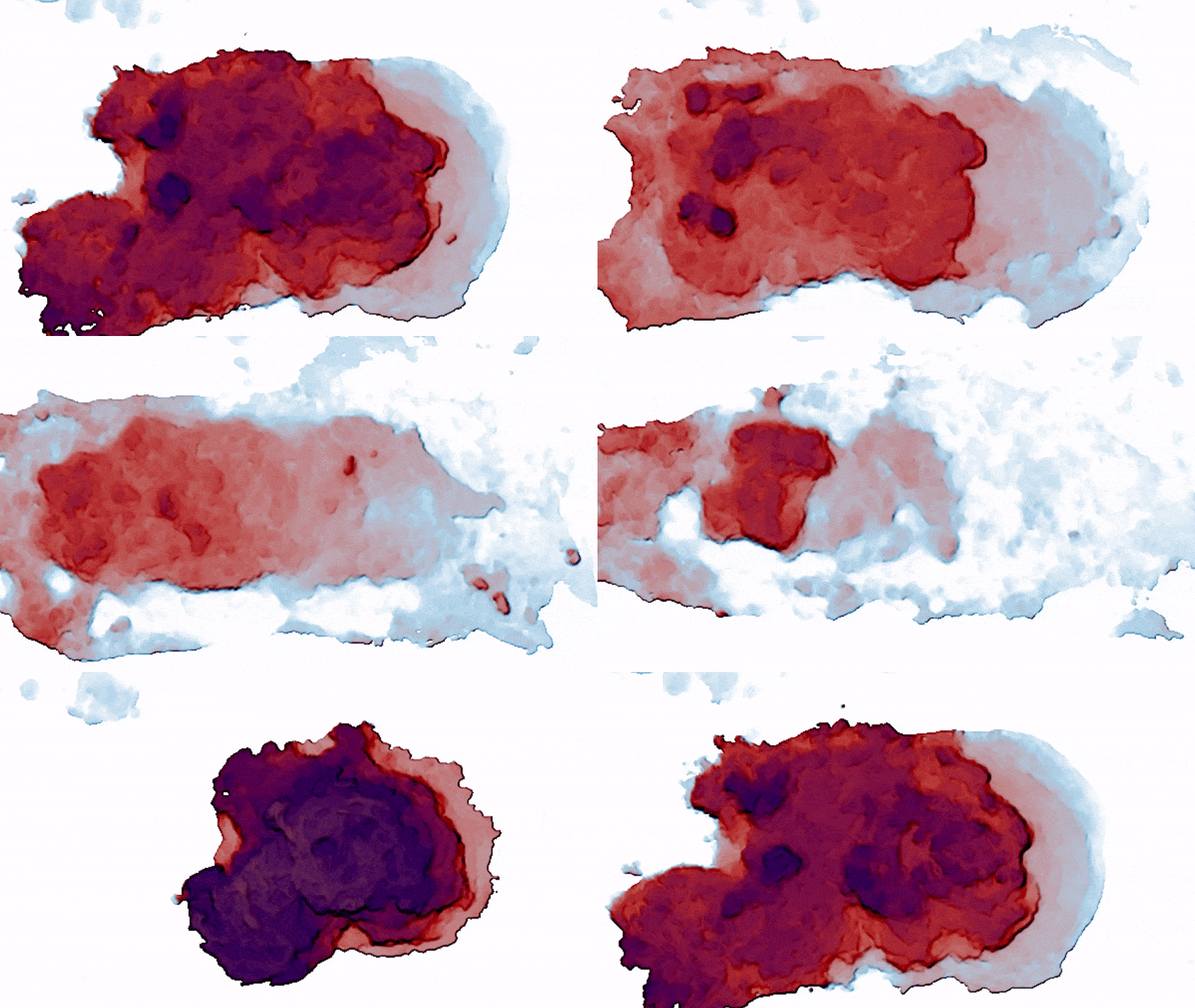
    Tonga Volcano Plume Reached the Mesosphere
    This animation shows a stereo view of the Tonga eruption plume as it rose, evolved, and dispersed over the course of 13 hours on January 15, 2022. The animation was built from infrared observations acquired every 10 minutes by GOES-17 and Himawari-8. According to these observations, the initial blast rapidly rose from the ocean surface to 58 kilometers in about 30 minutes. Shortly afterward, a secondary pulse rose above 50 kilometers (31 miles), then separated into three pieces. Credit: NASA Earth Observatory

    Seismic Algorithm Reveals the Magnitude of the January 2022 Tonga Islands Eruption

    On January 15, 2022, the eruption of a submarine volcano in the Tonga archipelago destroyed 90% of the uninhabited island of Hunga Tonga Ha’apai and formed an ash plume half the size of France. It also generated an atmospheric shock wave that circled the Earth several times, and, more classically, seismic waves recorded by monitoring stations around the world.

    By analyzing the seismic waves, two CNRS researchers[1] were able to design an algorithm that can detect and locate a volcanic eruption in near real-time and, using equations that describe explosive eruptions, assess its size. Until now, such an assessment required fieldwork and took several weeks or months, since it was necessary to estimate the volume of ash and lava produced.
    Seismic Recordings of the Hunga Tonga Volcanic Eruption
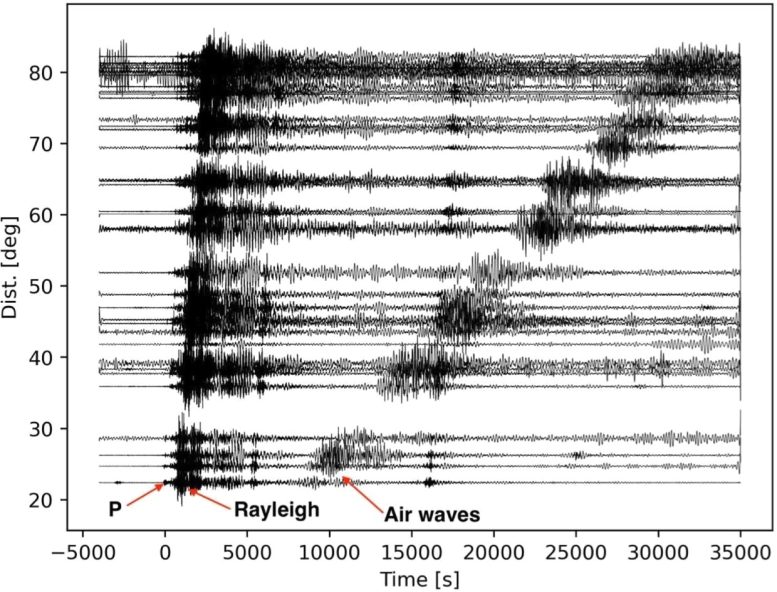
    Recordings of the eruption of the Hunga Tonga volcano by the stations of the global seismological network. The first ‘burst’ corresponds to the recording of surface seismic waves (P- and Rayleigh waves), while the later-arriving waves are due to sound waves traveling through the air (air waves). Credit: © Piero Poli

    The authors show that the Hunga Tonga eruption ejected a volume of around 10 km3, making it the largest explosive eruption of the twenty-first century, equivalent in strength to that of the devastating eruption of Pinatubo (Philippines) in 1991.

    This method should make it easier to study large explosive eruptions in remote regions. Its reactivity, of the order of an hour, could help to predict the areas likely to be affected by ash, which can disrupt human activities both on the ground and in the air.

    The study will be published today (April 20, 2022) in Geophysical Research Letters, received funding from two ERC grants, Monifaults (Starting grant) and Seismaze (Advanced grant).

    Notes

    1. Working at the Institut des Sciences de la Terre (CNRS/Université Grenoble Alpes/IRD/Université Savoie Mont Blanc).

    Reference: “Rapid characterization of large volcanic eruptions: measuring the impulse of the Hunga Tonga explosion from teleseismic waves” by Piero Poli and Nikolai M. Shapiro, 20 April 2022, Geophysical Research Letters.
    DOI: 10.1029/2022GL098123

    Never miss a breakthrough: Join the SciTechDaily newsletter.
    Follow us on Google and Google News.

    CNRS Popular Volcano
    Share. Facebook Twitter Pinterest LinkedIn Email Reddit

    Related Articles

    A New Lake — Water Not Lava — On Kilauea Volcano in Hawaii

    Contrary to Popular Belief, Neanderthals Were as Technologically Advanced as Homo Sapiens

    Ancient Tree Rings Could Pin Down Date of Massive Thera Volcano Eruption

    Tungurahua Volcano “The Black Giant” Showing Warning Signs of “Potential Collapse”

    Taal Volcano in the Philippines Erupted – See the Incredible Satellite View

    Study Finds One Cause for Several Mysteries Linked to Breathable Oxygen 2.5 Billion Years Ago

    Deep-Rooted Plumbing System Uncovered Beneath Ocean Volcanoes

    Volcanic Eruption at Fuego in Guatemala Intensifies

    Little Ice Age Sparked by Volcanoes, Sustained by Sea-Ice Feedback

    1 Comment

    1. Randy Ison on April 20, 2022 8:38 am

      As a result of the eruption, we should expect the earth’s weather to cool and become rainier from now throughout the next two years.

      Pinatubo Eruption (Philippines) in 1991 Lasting Results
      The cloud over the earth reduced global temperatures. In 1992 and 1993, the average temperature in the Northern Hemisphere was reduced 0.5 to 0.6°C and the entire planet was cooled 0.4 to 0.5°C. The maximum reduction in global temperature occurred in August 1992 with a reduction of 0.73°C. The eruption is believed to have influenced such events as 1993 floods along the Mississippi River and the drought in the Sahel region of Africa. The United States experienced its third coldest and third wettest summer in 77 years during 1992.

      Reply
    Leave A Reply Cancel Reply

    • Facebook
    • Twitter
    • Pinterest
    • YouTube

    Don't Miss a Discovery

    Subscribe for the Latest in Science & Tech!

    Trending News

    Scientists May Have Found the Key to Jupiter and Saturn’s Moon Mystery

    Scientists Uncover Brain Changes That Link Pain to Depression

    Saunas May Do More Than Raise Body Temperature – They Activate Your Immune System

    Exercise in a Pill? Metformin Shows Surprising Effects in Cancer Patients

    Hidden Oceans of Magma Could Be Protecting Alien Life

    New Study Challenges Alzheimer’s Theories: It’s Not Just About Plaques

    Artificial Sweeteners May Harm Future Generations, Study Suggests

    Splashdown! NASA Artemis II Returns From Record-Breaking Moon Mission

    Follow SciTechDaily
    • Facebook
    • Twitter
    • YouTube
    • Pinterest
    • Newsletter
    • RSS
    SciTech News
    • Biology News
    • Chemistry News
    • Earth News
    • Health News
    • Physics News
    • Science News
    • Space News
    • Technology News
    Recent Posts
    • As Cities Invade the Amazon, Yellow Fever Makes a Dangerous Comeback
    • “Asian Flush” May Be a Hidden Trigger for Deadly Heart Damage
    • AI Could Detect Early Signs of Alzheimer’s in Under a Minute – Far Before Traditional Tests
    • What if Dark Matter Has Two Forms? Bold New Hypothesis Could Explain a Cosmic Mystery
    • Researchers Expose Hidden Chemistry of “Ore-Forming” Elements in Biology
    Copyright © 1998 - 2026 SciTechDaily. All Rights Reserved.
    • Science News
    • About
    • Contact
    • Editorial Board
    • Privacy Policy
    • Terms of Use

    Type above and press Enter to search. Press Esc to cancel.