
Close Menu
    Facebook X (Twitter) Instagram
    SciTechDaily
    • Biology
    • Chemistry
    • Earth
    • Health
    • Physics
    • Science
    • Space
    • Technology
    Facebook X (Twitter) Pinterest YouTube RSS
    SciTechDaily
    Home»Space»Hubble Image of Planetary Nebula ESO 456-67
    Space

    Hubble Image of Planetary Nebula ESO 456-67

    By European Space AgencyFebruary 25, 20131 Comment2 Mins Read
    Facebook Twitter Pinterest Telegram LinkedIn WhatsApp Email Reddit
    Share
    Facebook Twitter LinkedIn Pinterest Telegram Email Reddit
    Planetary Nebula ESO 456 67
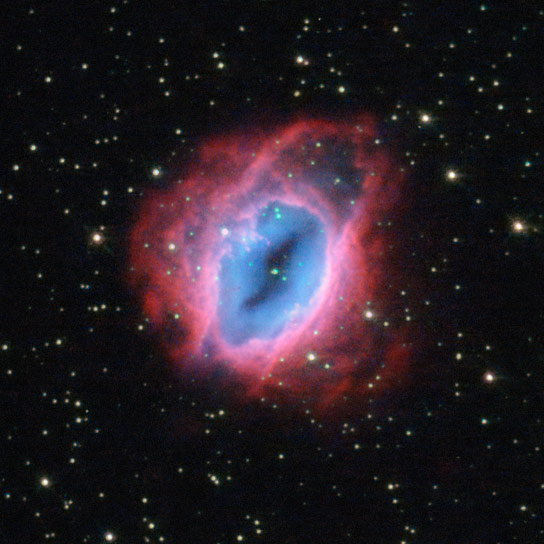
    Planetary nebula ESO 456-67 as seen by the Hubble Space Telescope. The nebula is the product of a dying Sun-like star flinging its shells of dust and gas into space. ESO 456-67 lies in the constellation of Sagittarius (The Archer), in the southern sky. Credit: ESA/Hubble & NASA. Acknowledgment: J.-C. Lambry

    This newly released image from the Hubble Space Telescope shows planetary nebula ESO 456-67.

    It may look like something from The Lord of the Rings, but this fiery swirl is actually a planetary nebula known as ESO 456-67. Set against a backdrop of bright stars, the rust-colored object lies in the constellation of Sagittarius (The Archer), in the southern sky.

    Despite the name, these ethereal objects have nothing at all to do with planets. The misnomer came about over a century ago, when the first astronomers to observe them only had small, poor-quality telescopes. Through these, the nebulae looked small, compact, and planet-like.

    When a star like the Sun approaches the end of its life, it flings material out into space. Planetary nebulae are the intricate, glowing shells of dust and gas pushed outwards from such a star. At their centers lie the remnants of the original stars themselves – small, dense white dwarf stars.

    In this image of ESO 456-67 taken by the Hubble Space Telescope, it is possible to see the various layers of material expelled by the central star. Each appears in a different hue – red, orange, yellow, and green-tinted bands of gas, with clear patches of space at the heart of the nebula.

    It is not fully understood how planetary nebulae form such a wide variety of shapes and structures. Some appear to be spherical, some elliptical, others shoot material in waves from their polar regions, some look like hourglasses or figures of eight, and others resemble large, messy stellar explosions – to describe but a few.

    A version of this image was entered into the Hubble’s Hidden Treasures image processing competition by contestant Jean-Christophe Lambry.

    Never miss a breakthrough: Join the SciTechDaily newsletter.
    Follow us on Google and Google News.

    Astronomy European Space Agency Hubble Space Telescope
    Share. Facebook Twitter Pinterest LinkedIn Email Reddit

    Related Articles

    A Diamond Necklace of Cosmic Proportions

    Hubble Snaps a Stunning Close-Up of a Magnificent Spiral Galaxy

    Extraordinary Hubble Image: Light Bends From the Beyond

    Hubble Space Telescope Sees Volcanic Activity Reforming the Atmosphere on a Rocky Exoplanet

    Hubble Spies a Luminous Heart With Dark Tendrils

    Spectacular Return to the Veil Nebula

    Hubble Spots a Peculiar Sight: Unusual Spiral Galaxy With a Heavy Arm

    A Flash of Life: Hubble Spies an Unusual Planetary Nebula

    Through the Cosmic Clouds: Hubble Spots a Beautiful Stellar Nursery

    1 Comment

    1. David Allen Jones on February 25, 2013 11:51 am

      This is an image Georgia O’Keefe would have loved.

      Reply
    Leave A Reply Cancel Reply

    • Facebook
    • Twitter
    • Pinterest
    • YouTube

    Don't Miss a Discovery

    Subscribe for the Latest in Science & Tech!

    Trending News

    Scientists Recreate a Nuclear Fireball and Uncover Fallout’s Hidden Chemistry

    These Tiny Gut Particles Could Be Accelerating Aging Throughout the Body

    Doctors Changed One Thing and Weight Gain Stopped

    Magnetic Fields May Solve a Longstanding Binary Star Mystery

    The Probiotic Breakthrough for Natural Anxiety Relief and Better Mental Health

    Animal vs. Plant Protein: Scientists Found a Surprising Nutritional Difference

    According to Scientists, This Simple Dietary Change Is Linked to Lower Depression Scores

    Researchers Discover a Hidden Vitamin D Problem That Persists Year-Round

    Follow SciTechDaily
    • Facebook
    • Twitter
    • YouTube
    • Pinterest
    • Newsletter
    • RSS
    SciTech News
    • Biology News
    • Chemistry News
    • Earth News
    • Health News
    • Physics News
    • Science News
    • Space News
    • Technology News
    Recent Posts
    • Scientists Uncover Why Walking Gets Slower and More Exhausting As We Age
    • 24 Hours Without Sleep Changes Your Saliva in Measurable Ways
    • A Major Update Just Hit Cholesterol Guidelines – Here’s What Every Adult Needs To Know
    • Scientists Tracked 4,500 Animals During COVID – What They Discovered Was Surprising
    • Hidden Phase of Matter Finally Captured After Decades of Predictions
    Copyright © 1998 - 2026 SciTechDaily. All Rights Reserved.
    • Science News
    • About
    • Contact
    • Editorial Board
    • Privacy Policy
    • Terms of Use

    Type above and press Enter to search. Press Esc to cancel.