

Researchers have developed an alternative positioning system that is more robust and accurate than GPS, especially in urban settings.
An alternative positioning system that is more robust and accurate than GPS, especially in urban settings has been developed by researchers of Delft University of Technology, Vrije Universiteit Amsterdam, and VSL. The working prototype that demonstrated this new mobile network infrastructure achieved an accuracy of 10 centimeters. This new technology is important for the implementation of a wide range of advanced location-based applications, including autonomous vehicles, quantum communication, and next-generation mobile communication systems. The results will be published today (November 16) in the journal Nature.
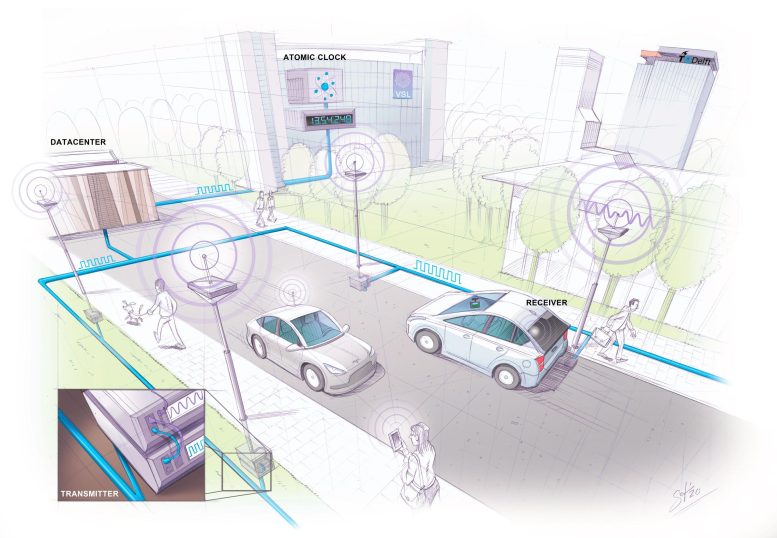
These days, much of our vital infrastructure relies on global navigation satellite systems such as GPS (United States) and Galileo (European Union). Yet these navigation systems that rely on satellites have significant limitations and vulnerabilities. When received on Earth, their radio signals are weak, and accurate positioning is not possible when the radio signals are reflected or blocked by buildings.
“This can make GPS unreliable in urban settings, for instance,” says Christiaan Tiberius of Delft University of Technology and coordinator of the project, “which is a problem if we ever want to use automated vehicles. Also, citizens and our authorities actually depend on GPS for many location-based applications and navigation devices. Furthermore, so far we had no back-up system.”
A project entitled SuperGPS was started with the goal of developing an alternative positioning system that makes use of the mobile telecommunication network instead of satellites and that could be more accurate and reliable than GPS. “We realized that with a few cutting-edge innovations, the telecommunication network could be transformed into a very accurate alternative positioning system that is independent of GPS,” says Jeroen Koelemeij of Vrije Universiteit Amsterdam. “We have succeeded and have successfully developed a system that can provide connectivity just like existing mobile and Wi-Fi networks do, as well as accurate positioning and time distribution like GPS.”
An Atomic Clock
One of these innovations is to connect the mobile network to a very accurate atomic clock, so that it can broadcast perfectly timed messages for positioning, just like GPS satellites do with the help of the atomic clocks they carry on board. These connections are made through the existing fiber-optic network.
“We had already been investigating techniques to distribute the national time produced by our atomic clocks to users elsewhere through the telecommunication network,” says Erik Dierikx of VSL. “With these techniques, we can turn the network into a nationwide distributed atomic clock – with many new applications such as very accurate positioning through mobile networks. With the hybrid optical-wireless system that we have demonstrated now, in principle anyone can have wireless access to the national time produced at VSL. It basically forms an extremely accurate radio clock that is good to one billionth of a second.”
Furthermore, the system employs radio signals with a bandwidth much larger than commonly used. “Buildings reflect radio signals, which can confuse navigation devices. The large bandwidth of our system helps sort out these confusing signal reflections, and enables higher positioning accuracy,” Gerard Janssen of Delft University of Technology explains. “At the same time, bandwidth within the radio spectrum is scarce and therefore expensive. We circumvent this by using a number of related small-bandwidth radio signals spread over a large virtual bandwidth. This has the advantage that only a small fraction of the virtual bandwidth is actually used and the signals can be very similar to those of mobile phones.”
Reference: “A hybrid optical-wireless network for decimetre-level terrestrial positioning” by Jeroen C. J. Koelemeij, Han Dun, Cherif E. V. Diouf, Erik F. Dierikx, Gerard J. M. Janssen and Christian C. J. M. Tiberius, 16 November 2022, Nature.
DOI: 10.1038/s41586-022-05315-7
Never miss a breakthrough: Join the SciTechDaily newsletter.
Follow us on Google and Google News.
15 Comments
So basically they figured out 20th century technology known as Loran-C
Seems quite different than LORAN-C to me: “The absolute accuracy of LORAN-C varies from 0.10 to 0.25 nmi (185 to 463 m). Repeatable accuracy is much greater, typically from 60 to 300 ft (18 to 91 m).[39]”
The secret to navigation is “time” From GEE to present day GNSS the principle of electronic navigation has not changed. It starts with the difference between the sent signal and the received signal. From there on wards it is mathematics
How easy it will be to spoof the system by injecting impersonating element and messing the positioning grid? Resulting in spatial displacement and eventual spatial clash?
Think you can hide, think again!!! Might want to get away from everything digital sooner than later, too many people can’t function without electronics or some form of entertainment!
Could use this while navigating through Houston Texas. I visit twice a year, coming from Hobby and running the gauntlet on I-45 through Houston to Richmond causes my GPS receiver to blink and used to run me off course until I findly familiarized my routes. There is something around there that effects my GPS causing recalculations in both directions and I have used several. That place would be a good candidate as a consumer.
All this technology will someday leave us all in the dark someday.
Seems like just giving government or other agencies an easier way to track your every move even better than current tech, I would almost put a guarantee that this will be made mandatory in new cars and phones. Great idea but unfortunately will be used to take more civil liberties.
I’m pretty sure the government has had 2 GPS systems for years. The one we civilians use is accurate to within about 10 meters and the one the government uses is accurate to within a meter. Much better for precision bombs I would think. The reason for the difference is because of needing the accuracy to drop a bomb on a target. You and I only need directions from from point A to B. 10 meters supposedly protects our privacy against stalkers and bad people.
Loran used the 160 meter band or 1.8Mhz for location distances of several hundred miles. At those distances skipping signals and signal path differences become an accuracy factor. Timing-Distance Direction Finding is a very interesting subject. If you know signal arrival time differences at two or more locations, accurate to nano secs, the calculation is easy.
I can’t be the only one seeing the connection to season 3 of Westworld.
So it needs radio towers everywhere to work?
Land surveyors for decades have had a subscription service for accurate GPS positioning. The service uses fixed, land based nodes that provide accurate corrections to the consumer gps signals (10 meter) allowing surveyors to achieve sub CM accuracy. Nothing new here except the same idea used for everyone.
Muon’s will be used for transmitting time and data. Prototype systems are already in test phase and providing precision <10 cm. One primary benefit is that solid surfaces including earth and water itself do not impede muon particles. My instinct is that data (time) is insinuated from passive muon collection receivers. I have no knowledge of the ability to transmit muons, but apparently it is being done. This is definitely a quantum leap in positioning, not to mention the potential for mobile communications. My instincts are that DARPA has their fingers in this tech; some data and articles are available simply by searching the internet.
Salman zakrul khan