
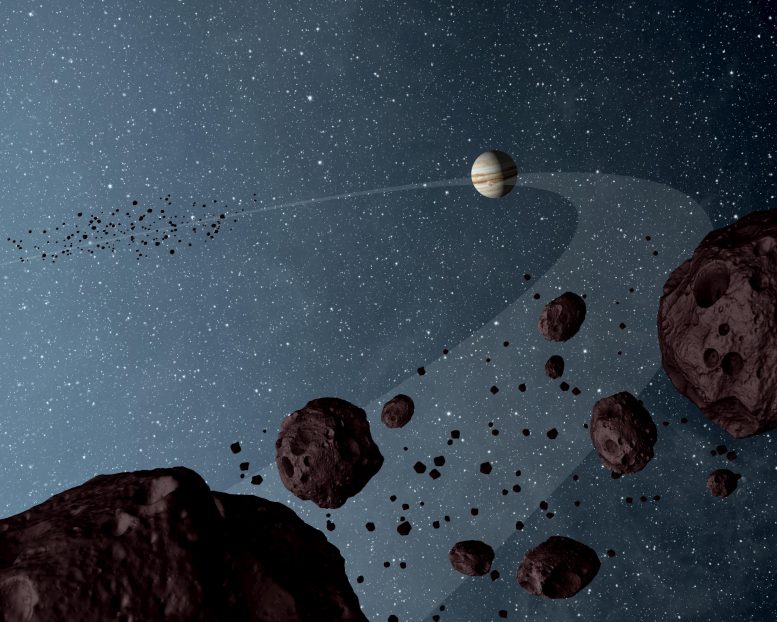
A rapidly migrating Jupiter mechanism offers crucial new insights into the early evolution of the Solar System.
An international team of scientists led by Jian Li from Nanjing University, including NYUAD researcher Nikolaos Georgakarakos and others from the US, Japan, and China, has developed new insights that could explain the numerical asymmetry of the Jupiter Trojan swarms L4 and L5, two groups containing over 10,000 asteroids that orbit along Jupiter’s path around the sun.
For many years, scientists have been aware of the unequal number of asteroids between the L4 and L5 swarms, but the cause of this asymmetry has remained elusive. Despite both swarms currently exhibiting nearly identical stability and survival properties in the Solar System, researchers believe that their differences originated during the earlier stages of the Solar System’s development. Uncovering the root of this disparity could provide new information about the Solar System’s formation and evolution.
In a paper published in the journal Astronomy & Astrophysics, the researchers present a mechanism that can explain the observed number asymmetry. “We propose that an outward, in terms of distance to the Sun, fast migration of Jupiter can distort the configuration of the Trojan swarms, resulting in more stable orbits in the L4 swarm than in the L5 one,” said Li. “This mechanism, which temporarily induced different evolution paths for the two asteroid groups that share the orbit of Jupiter, provides a new and natural explanation for the unbiased observation, that the L4 asteroids are about 1.6 times more than the asteroids in the L5 swarm.”
Jupiter’s Fast Migration and Its Effects
The model simulates the orbital evolution of Jupiter, caused by a planetary orbital instability in the early Solar System. This led to the outward migration of Jupiter at a very high speed; a migration that the researchers hypothesize was the possible cause of the changes in the stability of the nearby asteroid swarms. Future models could expand on this work by including additional aspects of the evolution of the Solar System, which could depict it with improved accuracy. This could include simulating the fast migrations of Jupiter at different speeds, and the effects of nearby planets.
“The characteristics of the current Solar System hold as-yet unsolved mysteries into its formation and early evolution,” said Georgakarakos. “The ability to successfully simulate an event from an early stage of the Solar System’s development and apply those results to modern day questions can also be a key tool as astrophysicists and other researchers work to learn more about the dawn of our world.”
Reference: “Asymmetry in the number of L4 and L5 Jupiter Trojans driven by jumping Jupiter” by Jian Li, Zhihong Jeff Xia, Fumi Yoshida, Nikolaos Georgakarakos and Xin Li, 17 January 2023, Astronomy and Astrophysics.
DOI: 10.1051/0004-6361/202244443
Never miss a breakthrough: Join the SciTechDaily newsletter.
Follow us on Google and Google News.
1 Comment
Why should we expect to detect life on planets hundreds of light years away? If life began simultaneously on planets in several galaxies away, and progressed at approx the same rate as earth, they should have started using radio and other technologies around the same time as earth. That would mean we might predict that we could begin to detect signals in another century or so, unless they used less powerful signals than we were using a hundred years ago. They should detect us at more or less the same time we detect them. If we both figure out how to travel at near light speeds, the life forms on our respective planets might meet our messenger at the same time we meet theirs. No one will find out until after another century, presumably.