
Close Menu
    Facebook X (Twitter) Instagram
    SciTechDaily
    • Biology
    • Chemistry
    • Earth
    • Health
    • Physics
    • Science
    • Space
    • Technology
    Facebook X (Twitter) Pinterest YouTube RSS
    SciTechDaily
    Home»Space»NuSTAR and ESO Composite Image of the Sculptor Galaxy
    Space

    NuSTAR and ESO Composite Image of the Sculptor Galaxy

    By NASASeptember 3, 2013No Comments2 Mins Read
    Facebook Twitter Pinterest Telegram LinkedIn WhatsApp Email Reddit
    Share
    Facebook Twitter LinkedIn Pinterest Telegram Email Reddit
    NuSTAR Views the Sculptor Galaxy
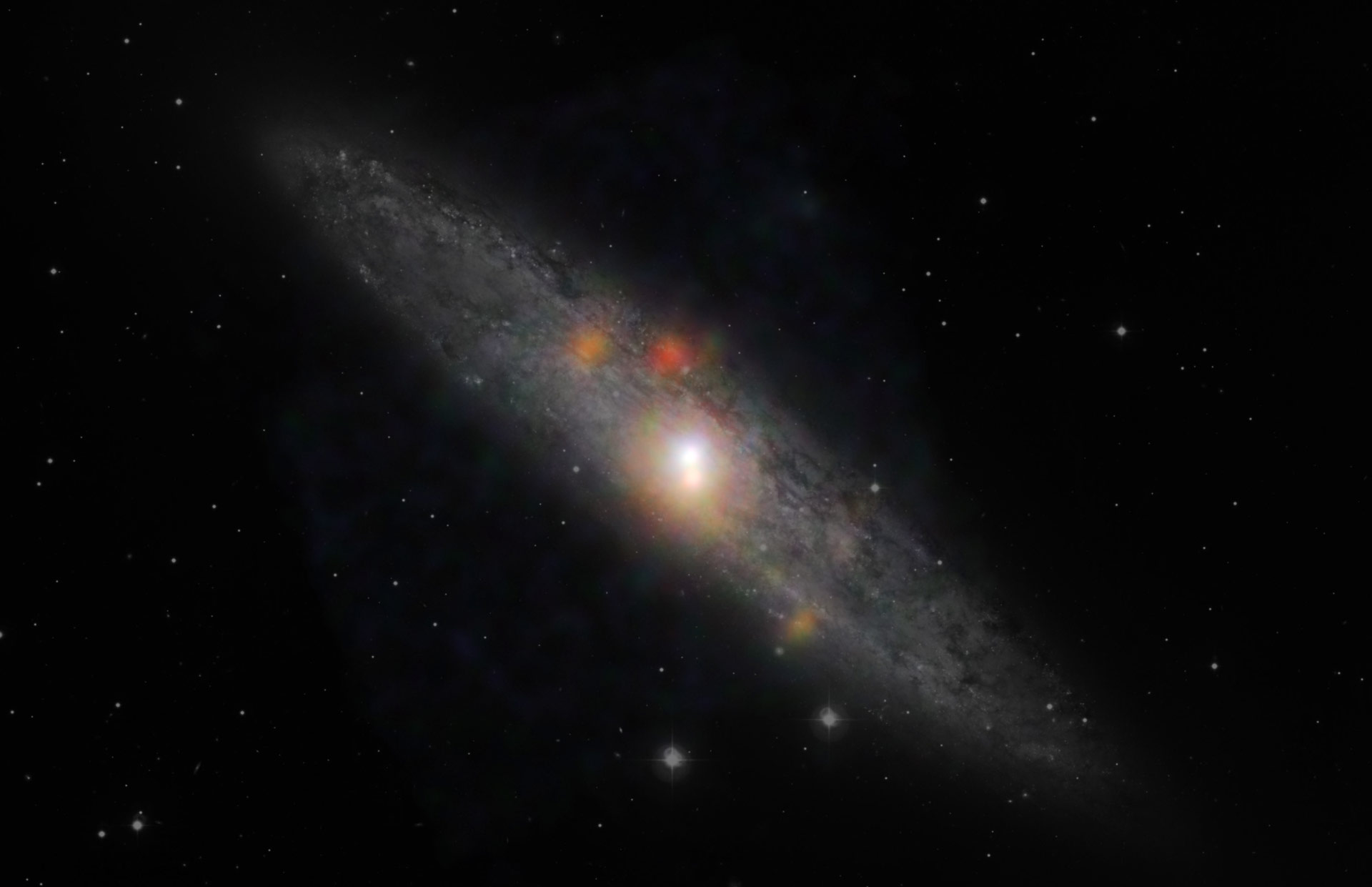
    This composite image from NASA’s NuSTAR and the European Southern Observatory shows the Sculptor galaxy, also known as NGC 253. In this image, red shows low-energy X-ray radiation (3 to 7 kiloelectron volts), green is medium energy (7 to 10 kiloelectron volts), and blue is high energy (10 to 20 kiloelectron volts). Credit: NASA/JPL-Caltech/JHU

    This composite image from NASA’s NuSTAR and the European Southern Observatory shows the Sculptor galaxy, also known as NGC 253.

    The Sculptor galaxy is seen in a new light, in this composite image from NASA’s Nuclear Spectroscopic Telescope Array (NuSTAR) and the European Southern Observatory in Chile. Visible data from the European Space Observatory show the backbone of the galaxy made up of stars, while NuSTAR data, which appear as colored blobs, show high-energy X-rays. The NuSTAR observations are the sharpest ever taken of this galaxy in high-energy X-rays.

    The findings, when combined with those from NASA’s Chandra X-ray Observatory, suggest that the supermassive black hole at the center of the Sculptor galaxy, also known as NGC 253, has dozed off, or gone inactive, sometime in the past decade. Future observations from both telescopes should help address this mystery.

    The NuSTAR data also reveals a flaring source of high-energy X-rays, called an ultraluminous X-ray source, or ULX. This object, which appears as a blue spot near the hotter, central region of the galaxy, is either a black hole or a dense, dead star, called a neutron star, feeding off a partner star. The flare is thought to be the result of a change in the object’s feeding patterns.

    The other orange and reddish points are likely additional X-ray-generating pairs of stars located throughout the galaxy.

    In this image, red shows low-energy X-ray radiation (3 to 7 kiloelectron volts), green is medium energy (7 to 10 kiloelectron volts), and blue is high energy (10 to 20 kiloelectron volts).

    Never miss a breakthrough: Join the SciTechDaily newsletter.
    Follow us on Google and Google News.

    Astronomy Chandra X-ray Observatory European Southern Observatory NuSTAR
    Share. Facebook Twitter Pinterest LinkedIn Email Reddit

    Related Articles

    Chandra Reveals 25 Bright Point-Like X-Ray Sources in Arp 299

    NASA’s NuSTAR Telescope Shows Merging Galaxies Have Enshrouded Black Holes

    Chandra Discovers a Star in the Closest Known Orbit Around a Black Hole

    NASA’s NuSTAR Reveals New Clues to ‘Chameleon Supernova’

    Astronomers Solve the Mystery of a Rare Change in the Behavior of a Supermassive Black Hole

    NASA Telescopes Reveal That Sagittarius A* May Be Producing Neutrinos

    Chandra Views Glowing Gas in the Milky Way, NGC 3576

    Data Reveals Dormant Black Hole Amidst Stellar Chaos

    Spacecraft to Explore Supermassive Black Holes at Center of Galaxies

    Leave A Reply Cancel Reply

    • Facebook
    • Twitter
    • Pinterest
    • YouTube

    Don't Miss a Discovery

    Subscribe for the Latest in Science & Tech!

    Trending News

    JWST Finds a “Star” 100 Billion Times Brighter Than Any Star Should Be

    Scientists Find a Hidden Biological Link Across Different Forms of Autism

    Astronomers Discover a Ghostly River of Stars That Could Reveal Dark Matter

    Why Is Colorectal Cancer Rising in People Under 50? New Clues Point to the Environment

    Quantum Fluctuations Break a Crystal’s Symmetry Rules

    Why Does an Irregular Heartbeat Strike 40 Years Early in Some People?

    Scientists Reveal How ADHD Could Fuel Creative Thinking

    Scientists Find Just 3 Minutes of Sprinting Can Transform Blood Chemistry

    Follow SciTechDaily
    • Facebook
    • Twitter
    • YouTube
    • Pinterest
    • Newsletter
    • RSS
    SciTech News
    • Biology News
    • Chemistry News
    • Earth News
    • Health News
    • Physics News
    • Science News
    • Space News
    • Technology News
    Recent Posts
    • Cleaner Cars May Be Hiding a New Pollution Problem
    • Common Plant Chemical Linked to Widespread Organ Damage in Aquatic Animals
    • Scientists Discover a Hidden Baobab Species in Madagascar
    • Dogs and Humans May Share a Surprising Biological Secret to Longevity
    • A 150-Million-Year-Old Dinosaur Flight Mystery May Finally Have an Answer
    Copyright © 1998 - 2026 SciTechDaily. All Rights Reserved.
    • Science News
    • About
    • Contact
    • Editorial Board
    • Privacy Policy
    • Terms of Use

    Type above and press Enter to search. Press Esc to cancel.